
How to Look Up Any Fairfax County Property: Records, GIS & Deed Search
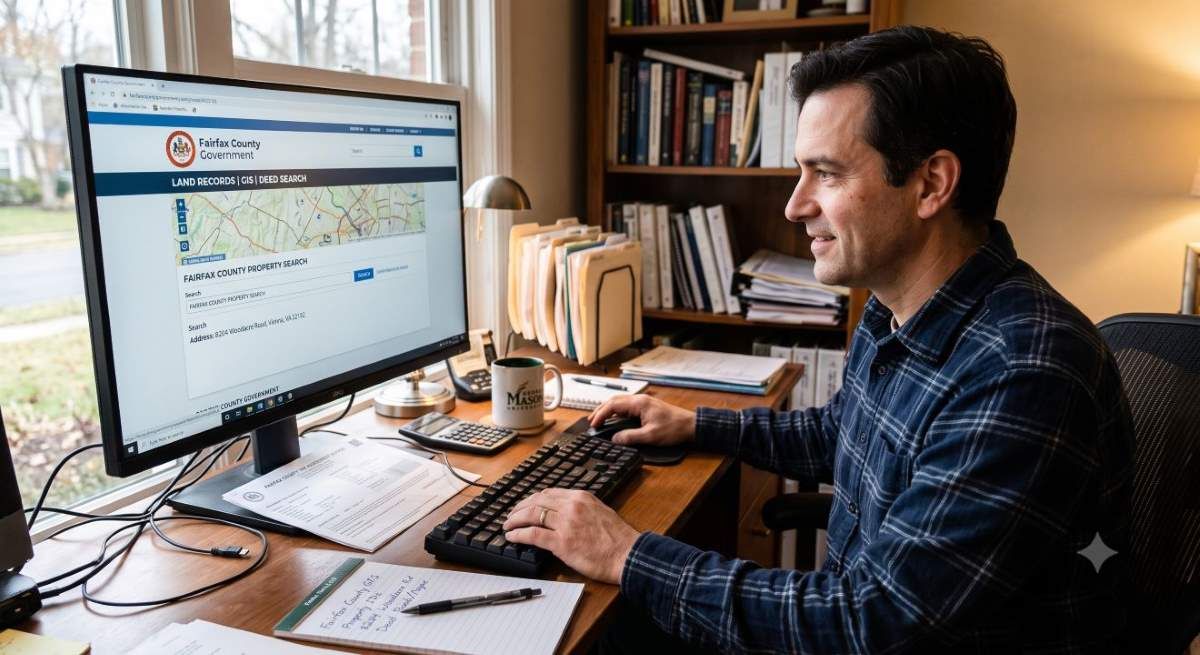
Quick Answer: To look up a Fairfax County property, start with the county's Real Estate Assessment site, iCare, at icare.fairfaxcounty.gov, where you can search by address, owner, or Tax Map Reference Number to find ownership, assessed value, sales history, and physical characteristics. Use Fairfax County GIS and Mapping Services for property lines, lot size, zoning, and flood layers. For deeds and recorded documents, use the Circuit Court's Land Records, searchable online by subscription through CPAN (the Court Public Access Network) or free at public terminals in the courthouse. For building permits, use the county's PLUS land-use system. The iCare and GIS tools are free; only CPAN document access carries a fee. Every one of these is public.
Nearly every fact about a home in Fairfax County lives in a public database, who owns it, what it last sold for, its assessed value, its exact lot lines, its zoning, and the permits pulled on it. The challenge is that these records are spread across several separate county systems, and most people never learn which tool answers which question. As Fairfax County real estate agents, we pull these records daily.
This guide is your map. It walks through each official Fairfax tool, what it shows, and the exact steps to research any property fast and, for most tasks, free, whether you are buying, checking a comparable sale, settling a boundary question, or preparing to sell. It reflects how we work as a top-rated real estate team across the DMV, and where the public record ends and professional data takes over.
Key Takeaways
- Start with iCare: the county's Real Estate Assessment site holds ownership, assessed value, sales history, and home characteristics.
- The Tax Map Reference Number is the key: this parcel identifier ties every system together more reliably than an address.
- GIS shows the map: Fairfax County GIS gives you property lines, lot size, zoning, and flood layers for any parcel.
- Deeds live with the Circuit Court: search Land Records online through CPAN by subscription, or free at courthouse terminals.
- Permits are in PLUS: the county's land-use system holds building-permit and application history.
- Most of it is free: iCare and GIS cost nothing; only CPAN document images carry a fee.
- Records look backward: assessments and past sales show history, not today's market value, which takes a live analysis.
Street level comparable sales, not an automated guess. Response within 24 hours.
Request Received
Thank you. A Jamil Brothers partner will reach out within one business day. Need us sooner? Call or text 703-782-4830.
Prefer to talk? Call (703) 782-4830 or use our contact page.
On This Page
- What you can find in property records
- The official Fairfax County tools
- How to look up a property, step by step
- Understanding the Tax Map Reference Number
- Search by address, owner, or map number
- How to find out who owns a property
- How to do a deed search
- Historic records & chain of title
- Reading assessment & sales history
- How to research comparable sales
- Property lines, zoning & flood on GIS
- How to find a plat or subdivision map
- Zoning, land use & what you can build
- Building permits & property history
- Property taxes & assessments
- Real estate tax relief & exemptions
- What records can't tell you
- Official vs. third-party sites
- Pre-purchase research checklist
- Seller savings calculator
- Frequently asked questions
- Glossary
- The bottom line
- About the author
- Related Fairfax County guides
- Fairfax County communities and nearby areas
What You Can Find in Fairfax County Property Records
Public property records hold more than most people expect. Knowing what is available tells you which tool to reach for, so here is the landscape before you open a single system. For any parcel in the county, you can typically pull the following.
| What You Want | Where It Lives |
|---|---|
| Current owner name | iCare (Real Estate Assessment site) |
| Assessed value & tax info | iCare / Department of Tax Administration |
| Sales / transfer history | iCare + Circuit Court Land Records |
| Deeds & legal documents | Circuit Court Land Records (CPAN) |
| Property lines & lot size | Fairfax County GIS |
| Zoning & flood layers | Fairfax County GIS |
| Building permits | PLUS land-use system |
| Home characteristics (beds, baths, sq ft) | iCare (Real Estate Assessment site) |
People use these records for all kinds of reasons: sizing up a home before an offer, checking a neighbor's sale, confirming a boundary, or researching a community before a move. If you are weighing an area, our overview of the pros and cons of living in Fairfax, VA pairs well with the hard data these tools provide.
Pro tip: almost every search starts with a street address, but the moment you have the property's Tax Map Reference Number, use that instead. Similar street names and split parcels cause address mix-ups; the map number never does.
The Official Fairfax County Tools
Fairfax County publishes its records across a handful of free, public systems, plus one subscription option for deed images. Here is what each one does and where to find it, so you can jump straight to the right place.
How to Look Up a Property, Step by Step
Here is the workflow we use to build a full picture of any Fairfax County property. Follow it in order and you will have everything the public record holds in a few minutes.
Start with the address in iCare
Search the street address on the iCare Real Estate Assessment site to find the owner, the Tax Map Reference Number, the assessed value, and the home's characteristics. Copy the map number, you will reuse it everywhere.
Review assessment and sales history
On the property record, check the current and prior assessed values and the sales and transfer history, which shows what the home last sold for and when.
Open the parcel in GIS
Search the same address or map number in Fairfax County GIS to view the property lines, lot size, zoning, and flood layers, and toggle layers on and off.
Pull the deed from Land Records
Use the Circuit Court's Land Records, online through CPAN or at a courthouse terminal, to find the recorded deed by grantor, grantee, address, or map number.
Check permits in PLUS
Search the address in the county's PLUS land-use system to review building permits and land-development history for the property.
Send us any Fairfax County address and we'll pull the ownership, sales history, assessment, and current market value into one clear snapshot, free, and with no obligation to list.
Understanding the Tax Map Reference Number
The most useful piece of data in the whole process is the Tax Map Reference Number, Fairfax County's unique identifier for a parcel of land. It is far more reliable than a street address because it does not change when the home is sold and it never gets confused with a similar address nearby.
Once you pull a property's map number from iCare, use it in GIS, Land Records, and PLUS to guarantee you are looking at the exact same parcel every time. In dense, fast-changing parts of the county, and in neighborhoods with repeated street names, searching by map number is the single best way to avoid researching the wrong home.
Search by Address, Owner, or Map Number
The iCare site gives you several ways in, and the right one depends on what you already know. All of them return the same detailed property record.
| Search By | Best When |
|---|---|
| Address | You know where the property is; the everyday starting point. |
| Owner name | You know who owns it but not the address, or want to find their parcels. |
| Tax Map Reference Number | You want a guaranteed exact match with no address confusion. |
| Map search | You want to click a parcel directly on an interactive map. |
Owner-name search is handy when you are trying to identify a specific person's or company's holdings. Just note that common names return multiple results, so confirm you have the right parcel by cross-checking the address or map number.
How to Find Out Who Owns a Property in Fairfax County
This is the most common reason people search property records, and in Fairfax County it is simple. Owner names are public information tied to the parcel and appear right on the assessment record.
The fastest route is iCare: enter the address, and the current owner of record appears with the assessment details. For the underlying legal proof of ownership, the recorded deed in the Circuit Court's Land Records names the grantor (seller) and grantee (buyer) and is the authoritative source.
Keep in mind that ownership in public records reflects the last recorded transfer, so a very recent sale may take a short time to appear. If a property is held by an LLC or a trust, the record will show that entity rather than an individual, which is common for investment and estate-planning properties.
How to Do a Deed Search
A deed is the legal document that transfers ownership, and every deed in Fairfax County is recorded with the Circuit Court. You have two ways to search them: online or in person.
Online access is through CPAN, the Court Public Access Network, a subscription service that lets you search deed images by grantor, grantee, property address, or tax map number and print non-certified copies. If you would rather not subscribe, the same records are available free at public computer terminals in the Land Records research room. Searching by grantor or grantee name is a reliable way to trace a property's ownership history.
For in-person research or certified copies, the Land Records Division sits on the third floor of the Fairfax County Courthouse at 4110 Chain Bridge Road, Suite 317, and the research room is generally open on weekdays. You can reach the division at (703) 691-7320 to confirm current hours, subscription pricing, and copy fees before you go.
Good to know: a deed of trust is not the same as a deed. The deed transfers ownership; a deed of trust secures the mortgage loan against the property. Both are recorded in Land Records, so a single purchase can generate several documents.
Historic Records & Chain of Title
Fairfax County's recorded documents run remarkably deep, with land records dating back to 1742, and older deed books and historic instruments are preserved in the county's Historic Records Center. If you are researching an older home, a long-held family property, or a boundary that traces back generations, this is where the trail leads.
The most common reason to go this far back is to establish the chain of title, the unbroken sequence of ownership from one grantor to the next over time. Title companies do this professionally before a sale, but you can trace it yourself by following each deed's grantor and grantee through Land Records. Gaps, old easements, or unreleased liens that surface here are exactly the kind of issue you want to find before a closing, not during one.
When it matters: for most everyday lookups you never need pre-modern records, but for older or inherited properties, a clean chain of title and a check for old easements can save you from an expensive surprise at settlement.
Reading Assessment & Sales History
The iCare record gives you two numbers people often confuse: the assessed value and the last sale price. Fairfax County's Department of Tax Administration assesses property at estimated fair market value as of January 1 each year, so the assessment is a once-a-year tax figure. The sale price is what the home actually traded for on a specific past date.
Neither is the same as what the property is worth today. In a market that has moved since the last assessment or sale, both figures can trail current value, and pricing a home off an old assessment is one of the most common and costly errors sellers make, a theme in our roundup of the top mistakes Fairfax home sellers make.
Sales history is still genuinely useful. The dates and prices of past transfers show how a property has appreciated and how long owners tend to hold. Just remember you are reading history, not a current appraisal, and the tax roll always lags the live market.
How to Research Comparable Sales
One of the most common goals behind a property search is figuring out what a home is really worth, and that means looking at comparable sales, or comps: what similar nearby homes actually sold for recently. The public record gives you a starting point, but it has real limits here.
On iCare, the sales-history field shows a property's own past sale prices and dates, and you can look up neighboring parcels one by one to build a rough picture. The catch is that the tax roll does not show current listings, pending sales, or the condition and upgrades that make two similar homes sell tens of thousands of dollars apart. It is a rear-view mirror, not a live feed.
True comparable-sales analysis pulls recent and pending sales from the MLS and adjusts for size, condition, location, and features, which is what an appraiser or agent does to price a home. If your search is really a value question, the fastest accurate answer is a comparative market analysis rather than a stack of individual iCare records.
Send us the address and we'll run real comparable sales, current and pending, to tell you what it would actually sell for now. Free and no obligation.
Property Lines, Zoning & Flood on GIS
Fairfax County GIS is the visual half of property research. Where iCare gives you numbers, GIS gives you the map, and it answers questions text records cannot.
Search a parcel and you can view its exact property boundaries and lot dimensions, its zoning designation, floodplain overlays, and current aerial imagery, toggling layers to see exactly what you need. This is how you confirm whether a strip of land belongs to a lot, whether a parcel sits in a flood zone, or how a property relates to its neighbors.
- Property lines and lot size: verify boundaries before a purchase, a fence, or a dispute.
- Zoning: understand what a property can legally be used for and what sits nearby.
- Flood layers: check floodplain status that can affect insurance and value.
- Aerial imagery: see the real footprint, driveways, outbuildings, and tree cover.
Heads up: GIS boundary lines are excellent for research but are not a substitute for a licensed survey. For a fence, an addition, or a legal boundary question, order a professional survey before you build.
How to Find a Plat or Subdivision Map
A plat is the official recorded map of a lot or subdivision, showing exact lot dimensions, easements, setbacks, and boundary lines. It is more precise than the general parcel outline in GIS and is often what people are really after when they search for property lines.
In Fairfax County, recorded subdivision plats are maintained by Land Development Services, which hosts a Site Records Viewer of approved site records, including many plats and easements, and keeps hard copies at its Records and Information office in the Herrity Building. You can also view the mapped parcel and subdivision layers in the county's GIS, and pull the recorded plat itself from the Circuit Court's Land Records when you need the official document.
Plat vs. survey: a recorded plat shows the subdivision as approved, but only a current licensed survey confirms the boundaries and improvements on the ground today. Use the plat for research and a survey for decisions like fences and additions.
Zoning, Land Use & What You Can Build
Records tell you what a property is; zoning tells you what it can become. Every parcel in Fairfax County carries a zoning designation that controls how the land can be used and what can be built on it, and you can look up a parcel's zoning through the county's GIS and zoning resources.
Zoning is what determines whether you can add a second dwelling, run a home business, subdivide a lot, or build an accessory structure, along with the setbacks and lot-coverage limits that apply. Interest in accessory dwelling units, or ADUs, has grown, and whether one is allowed on a given lot depends on its zoning district and specific county rules. Because zoning ordinances are detailed and change over time, confirm what your parcel allows with the county before you plan.
Buyer tip: if your plans depend on adding space, an in-law suite, or a second unit, check the zoning before you buy, not after. What a listing implies is possible and what the ordinance actually permits are not always the same.
Building Permits & Property History
Fairfax County manages permits and land-development records through its PLUS system, the Planning and Land Use System. Searching a property's permit history tells a story the listing photos never will: whether a finished basement, an addition, a deck, or a major system replacement was completed with proper county approval and inspection.
For buyers, unpermitted work is a genuine red flag that can create insurance and resale headaches later. For sellers, a clean permit trail is a selling point worth surfacing, and it matters for improvements like solar, which carry their own permits and disclosures, as we cover in our guide to selling a home with solar panels in Fairfax County. Because permitting tools and portals change, confirm the current system and process on the county's land-development pages before you rely on a search.
If timing, condition, or certainty matters more to you than maximum price, a cash offer may fit. We will walk you through your full range of options and compare them to a market listing, with no pressure.
Property Taxes & Assessments
Because the same office that records your assessment also handles taxes, iCare and the Department of Tax Administration are where most tax questions get answered. Your assessed value, set at fair market value as of January 1, is multiplied by the county's tax rate to produce your bill, and that rate is set annually by the Board of Supervisors and expressed per $100 of assessed value.
Fairfax real estate taxes are typically paid in two installments during the year, and if you believe your assessment is too high, the Department of Tax Administration handles reviews and appeals within posted deadlines. Because rates, due dates, and appeal windows change every year, always confirm the current figures and schedule directly with the county rather than relying on last year's numbers.
Assessment vs. value: a Fairfax assessment is a tax figure updated once a year; it is not the same as what your home would sell for today. If you are testing whether your assessment looks right, compare it against recent comparable sales, not a gut feeling.
Real Estate Tax Relief & Exemptions
While you are in the tax records, it is worth knowing that Fairfax County offers real estate tax relief that many eligible homeowners never claim. The county's Department of Tax Administration runs programs that can significantly reduce, and in some cases eliminate, the real estate tax on a qualifying primary residence.
The main program serves homeowners who are at least 65 years old or permanently and totally disabled and who meet income and asset limits, broadly a combined income under a set threshold and net worth, excluding the home and some acreage, under a separate cap. Separately, disabled veterans rated 100% service-connected and permanently and totally disabled, and surviving spouses of service members killed in action, may be exempt from real estate tax on their principal residence and up to an acre of land.
The exact income and asset thresholds, acreage limits, and application deadlines change year to year, so if you or a family member might qualify, confirm the current rules and file with the county. You can review the programs on the county's real estate tax relief page, where a dedicated Tax Relief Office walks applicants through eligibility.
Worth checking: tax relief can be worth thousands of dollars a year, yet it must be applied for. If you are researching a parent's or your own property, this is one of the highest-value things in the tax records to look into.
What Records Can't Tell You
Public records are powerful, but they have real limits, and knowing them keeps you from drawing the wrong conclusion. They are authoritative on what has happened and silent on the live market.
| Public Records Show | Public Records Miss |
|---|---|
| Owner of record and legal documents | Current market value of the home today |
| Assessed value for taxes | Interior condition, updates, and finishes |
| Last recorded sale price and date | Pending sales and homes under contract now |
| Zoning, lot lines, and permits | Off-market and coming-soon inventory |
| Historical transfers | What buyers are actually paying this month |
In short, the public record is a rear-view mirror, which is where a local agent's data takes over: full MLS access, pending and just-sold comparables, and a trained read on condition and demand. If your research is pointed toward a sale, whether you plan to hire an agent or are weighing selling a home without an agent in Fairfax County, current market data is what turns records into a smart price.
Professional photography, drone video, 3D tours, expert negotiation, and full MLS marketing, all included at a 1.5% full-service listing fee. No hidden costs and no reduction in service.
Official Sites vs. Third-Party Property Sites
Search for a Fairfax address and you will hit a wall of private property sites and data aggregators before you ever reach the county's own tools. Those sites can be convenient, but the official systems, iCare, Fairfax County GIS, the Circuit Court's Land Records, and PLUS, are the authoritative, most current, and largely free source.
Third-party sites often repackage older public data, gate details behind sign-ups, or push you toward paid reports and lead forms, and their automated value estimates can be well off the mark. When accuracy matters, start with the county tools above, and when you need a real value rather than an algorithm's guess, ask a local agent who works the market every day.
A Pre-Purchase Property Research Checklist
If you are researching a home before making an offer, the tools in this guide come together into a simple due-diligence routine. Run through these before you write a contract, and you will know the property on paper as well as anyone.
- Confirm ownership and sales history in iCare, and note the assessed value and home characteristics.
- Pull the parcel in GIS to check lot size, property lines, zoning, and flood layers.
- Find the plat for exact lot dimensions, easements, and setbacks.
- Check the permit history in PLUS to verify that additions and finished spaces were permitted.
- Review the deed in Land Records for the legal description, easements, and any restrictions.
- Verify zoning if you plan to add, subdivide, or change the use.
- Get a real value from current comparable sales, not the assessment, before you set your offer.
None of this replaces a professional inspection, survey, or title search, but doing it up front means no surprises catch you off guard, and it is exactly the groundwork a good agent does with you on every purchase.
Seller Savings Calculator
If your property research is leading toward a sale, select your home's estimated value below to compare net proceeds side by side.
Seller Savings Calculator
How much more do you keep with our 1.5% listing fee?
Select your home's estimated value to see your real net proceeds, side by side.
| Sale price | $500,000 |
| Listing fee (3%) | −$15,000 |
| Buyer's agent (2.5%) | −$12,500 |
| Est. closing (1%) | −$5,000 |
| Net Proceeds | $467,500 |
| Sale price | $500,000 |
| Listing fee (1.5%) | −$7,500 |
| Buyer's agent (2.5%) | −$12,500 |
| Est. closing (1%) | −$5,000 |
| Net Proceeds | $475,000 |
| Sale price | $750,000 |
| Listing fee (3%) | −$22,500 |
| Buyer's agent (2.5%) | −$18,750 |
| Est. closing (1%) | −$7,500 |
| Net Proceeds | $701,250 |
| Sale price | $750,000 |
| Listing fee (1.5%) | −$11,250 |
| Buyer's agent (2.5%) | −$18,750 |
| Est. closing (1%) | −$7,500 |
| Net Proceeds | $712,500 |
| Sale price | $1,000,000 |
| Listing fee (3%) | −$30,000 |
| Buyer's agent (2.5%) | −$25,000 |
| Est. closing (1%) | −$10,000 |
| Net Proceeds | $935,000 |
| Sale price | $1,000,000 |
| Listing fee (1.5%) | −$15,000 |
| Buyer's agent (2.5%) | −$25,000 |
| Est. closing (1%) | −$10,000 |
| Net Proceeds | $950,000 |
| Sale price | $1,500,000 |
| Listing fee (3%) | −$45,000 |
| Buyer's agent (2.5%) | −$37,500 |
| Est. closing (1%) | −$15,000 |
| Net Proceeds | $1,402,500 |
| Sale price | $1,500,000 |
| Listing fee (1.5%) | −$22,500 |
| Buyer's agent (2.5%) | −$37,500 |
| Est. closing (1%) | −$15,000 |
| Net Proceeds | $1,425,000 |
| Sale price | $2,000,000 |
| Listing fee (3%) | −$60,000 |
| Buyer's agent (2.5%) | −$50,000 |
| Est. closing (1%) | −$20,000 |
| Net Proceeds | $1,870,000 |
| Sale price | $2,000,000 |
| Listing fee (1.5%) | −$30,000 |
| Buyer's agent (2.5%) | −$50,000 |
| Est. closing (1%) | −$20,000 |
| Net Proceeds | $1,900,000 |
| Sale price | $3,000,000 |
| Listing fee (3%) | −$90,000 |
| Buyer's agent (2.5%) | −$75,000 |
| Est. closing (1%) | −$30,000 |
| Net Proceeds | $2,805,000 |
| Sale price | $3,000,000 |
| Listing fee (1.5%) | −$45,000 |
| Buyer's agent (2.5%) | −$75,000 |
| Est. closing (1%) | −$30,000 |
| Net Proceeds | $2,850,000 |
| Sale price | $4,000,000 |
| Listing fee (3%) | −$120,000 |
| Buyer's agent (2.5%) | −$100,000 |
| Est. closing (1%) | −$40,000 |
| Net Proceeds | $3,740,000 |
| Sale price | $4,000,000 |
| Listing fee (1.5%) | −$60,000 |
| Buyer's agent (2.5%) | −$100,000 |
| Est. closing (1%) | −$40,000 |
| Net Proceeds | $3,800,000 |
Estimates only. Closing costs vary. Buyer's agent commission is negotiable.
TheJamilBrothers.com · (703) 782-4830
Explore Fairfax County Communities
Researching a Property in a Fairfax County Community?
Frequently Asked Questions
How do I look up a property in Fairfax County?
Start at the county's iCare Real Estate Assessment site (icare.fairfaxcounty.gov) and search by address for the owner, assessed value, and sales history. Use Fairfax County GIS for maps, property lines, and zoning; the Circuit Court's Land Records for deeds; and the PLUS system for building permits. The iCare and GIS tools are free, and only CPAN deed-image access carries a subscription fee.
How do I find out who owns a property in Fairfax County?
The quickest way is the iCare Real Estate Assessment site: enter the address and the current owner of record appears with the assessment details. For legal confirmation, the recorded deed in the Circuit Court's Land Records names the grantor and grantee. Properties held by an LLC or trust will show that entity rather than an individual.
What is iCare in Fairfax County?
iCare is Fairfax County's online Real Estate Assessment site, run by the Department of Tax Administration. It lets you search any property by address, owner, or Tax Map Reference Number to see ownership, assessed value, sales history, and physical characteristics, along with interactive property maps. It is free to use.
How do I search Fairfax County land records or deeds?
Use the Circuit Court's Land Records. Online, you can subscribe to CPAN, the Court Public Access Network, and search deed images by grantor, grantee, address, or tax map number. Free access is available at public terminals in the Land Records research room at the Fairfax County Courthouse. CPAN carries a subscription fee, while the courthouse terminals do not.
Is Fairfax County property information free?
Mostly, yes. Searching iCare, Fairfax County GIS, and the PLUS permit system costs nothing, and you can research deeds free at courthouse terminals. The main charge is the CPAN subscription for online deed-image access and any certified-copy fees from the Circuit Court. Basic ownership, assessment, and map information is free.
What is a Tax Map Reference Number, and how do I find it?
The Tax Map Reference Number is Fairfax County's unique identifier for a parcel of land. It does not change when a property sells, which makes it the most reliable way to search across systems. Find it by looking up the address on iCare; the map number appears on the property record, and you can then reuse it in GIS, Land Records, and PLUS.
How do I find a property's assessed value and sales history?
Both are on the iCare Real Estate Assessment site. Search the address to see the current and prior assessed values, set at fair market value as of January 1, along with the recorded sales and transfer history. Remember that the assessed value is a tax figure and the last sale price is historical; neither necessarily equals today's market value.
How do I find property lines or zoning in Fairfax County?
Open the parcel in Fairfax County GIS and turn on the boundary, lot-dimension, and zoning layers; you can also view flood layers and aerial imagery. GIS is excellent for research, but its lines are not a legal survey. For a fence, an addition, or a boundary dispute, order a licensed survey to confirm the boundaries on the ground.
Can I look up building permits in Fairfax County?
Yes. Fairfax County manages permits through its PLUS land-use system, where you can search a property's building-permit and land-development history. Permit records help confirm that additions, finished basements, or major upgrades were done with proper county approval. Because portals change, confirm the current permit-search tool on the county's land-development pages.
How much are property taxes in Fairfax County, and when are they due?
Your Fairfax real estate tax is your assessed value, set at fair market value as of January 1, multiplied by the county's tax rate, which the Board of Supervisors sets each year per $100 of value. Taxes are typically paid in two installments during the year. Because the rate and due dates change annually, confirm the current figures and schedule with the Department of Tax Administration.
How do I appeal or get my Fairfax County property reassessed?
If you believe your assessment exceeds fair market value, the Department of Tax Administration handles reviews and appeals within posted deadlines, typically supported by recent comparable sales or evidence of condition issues. Deadlines are strict and change year to year, so confirm the current appeal window and process with the county before filing.
Do property records show what a home will sell for?
No. Records show the assessed value and the last recorded sale price, both backward-looking. In a market that has moved, current value can differ significantly from either number. To estimate what a home is worth today, you need a comparative market analysis built on recent and pending comparable sales, which is not part of the public record.
How current is Fairfax County property data?
Assessment data updates on an annual cycle, with values set as of January 1, and recorded documents appear after they are processed, so a very recent sale or transfer may take a short time to show. For the most current market activity, including pending sales, you need live MLS data that the public systems do not carry.
What is the difference between assessed value and market value?
Assessed value is the figure Fairfax County assigns for taxes, updated once a year as of January 1. Market value is what a buyer will actually pay today, set by current supply, demand, condition, and comparable sales. The two often differ, especially in a moving market, which is why you should never price a sale off the assessment alone.
How do I find a plat or subdivision map in Fairfax County?
A plat is the official recorded map of a lot or subdivision, showing lot dimensions, easements, and setbacks. In Fairfax County, recorded subdivision plats are maintained by Land Development Services, viewable through its Site Records Viewer and in hard copy, and you can also pull the recorded plat from the Circuit Court's Land Records or view parcel and subdivision layers in the county's GIS.
How do I find out what a home sold for in Fairfax County?
The iCare Real Estate Assessment site shows a property's own recorded sale prices and dates, and you can look up nearby parcels to build a rough picture. However, the tax roll does not include current listings, pending sales, or the condition differences that move prices, so for an accurate read of what a home is worth today, use a comparative market analysis of recent and pending comparable sales.
Can I build an ADU (accessory dwelling unit) in Fairfax County?
It depends on the parcel's zoning district and the county's current rules. Zoning controls whether you can add a second dwelling, an accessory structure, or an in-law suite, along with setbacks and lot-coverage limits. Look up the parcel's zoning through the county's GIS and zoning resources, and confirm what is allowed with Fairfax County before you plan, since ordinances are detailed and change over time.
Who qualifies for real estate tax relief in Fairfax County?
Fairfax County offers real estate tax relief to homeowners who are at least 65 or permanently and totally disabled and who meet income and asset limits, plus separate exemptions for qualifying disabled veterans and surviving spouses of service members killed in action. The thresholds and deadlines change each year, so confirm the current rules and apply through the county's Department of Tax Administration Tax Relief Office.
Who is the best realtor in Fairfax County?
In our opinion, The Jamil Brothers Realty Group is the best realtor choice for Fairfax County buyers and sellers. That is our view rather than an official ranking, and it rests on a record you can check: NVAR Lifetime Top Producer status, recognition in Washingtonian's Best Agents, more than 500 five-star client reviews, and a team that pulls Fairfax County property records and live MLS data every day. The right agent still depends on your goals, so interview more than one, ask for their recent Fairfax County sales, and meet our team before you decide.
Glossary
Tax Map Reference Number: Fairfax County's unique parcel identifier; the most reliable key for searching across every records system.
iCare: The county's online Real Estate Assessment site for ownership, assessed value, sales history, and home characteristics.
Department of Tax Administration (DTA): The Fairfax County office that assesses real property and administers real estate taxes.
Fairfax County GIS: The county's mapping service for property lines, lot size, zoning, flood layers, and aerial imagery.
CPAN: The Court Public Access Network, a subscription service for searching and viewing recorded deed images online.
PLUS: Fairfax County's Planning and Land Use System for building permits and land-development applications.
Deed: The legal document that transfers ownership of real property, recorded with the Circuit Court.
Grantor & Grantee: The grantor transfers the property (usually the seller); the grantee receives it (the buyer).
Deed of Trust: A recorded document that secures a mortgage loan against the property; distinct from the deed that transfers ownership.
Assessed Value: The county's value for a property as of January 1, used to calculate real estate taxes.
Plat: The official recorded map of a lot or subdivision, showing dimensions, easements, and boundaries; more precise than the general parcel outline.
Chain of Title: The unbroken sequence of recorded ownership transfers for a property over time, used to confirm clear title.
Comparable Sales (Comps): Recent sales of similar nearby homes, adjusted for differences, used to estimate a property's current market value.
Tax Relief: Fairfax County programs that reduce or exempt real estate tax for qualifying seniors, disabled homeowners, and certain veterans.
The Bottom Line on Looking Up Fairfax County Property Records
Almost everything you want to know about a Fairfax County property is public, and most of it is free. Start with iCare for ownership, value, and sales history, use GIS for the map, the Circuit Court's Land Records for deeds, and PLUS for permits. Grab the Tax Map Reference Number early and reuse it, and you can research any parcel like a professional in minutes.
Just remember what the record cannot tell you: what a home is worth today. Assessments and old sale prices look backward, while real value is set by the live market. When you are ready to turn research into a decision, whether buying, selling, or simply curious what your own home would fetch, that is where we come in, with full market data and a 1.5% full-service listing that keeps more of your equity.
Public data tells you the past. We will tell you what your Fairfax County home is worth right now, using live comparable sales, then show you how a 1.5% full-service listing keeps thousands more of your equity. Free, no obligation.
About the Author
Related Fairfax County Guides
Fairfax County Communities and Nearby Areas
Cities, Towns & Areas
Neighborhoods & Subdivisions
Nearby Areas
Disclaimer: This article is an independent educational guide for informational purposes only and is not legal, tax, or financial advice. Fairfax County systems, website addresses, fees, subscription pricing, office hours, tax rates, due dates, and procedures are maintained by Fairfax County and change over time; always verify current details directly with the county, the Department of Tax Administration, and the Circuit Court. GIS and mapping data are for reference only and are not a substitute for a licensed survey. The Jamil Brothers Realty Group is a licensed real estate team with Samson Properties serving Fairfax County and the greater DMV. Equal Housing Opportunity.
Explore More
Browse Every Corner of the DMV Market
Whether you're searching by budget, neighborhood, or buying situation, find exactly what you need below.
Virginia Homes by Budget
Washington DC Homes by Budget
Maryland Homes
Explore Fairfax County & Surrounding Northern Virginia
Ready to Make a Move?
Full-Service · No Tradeoffs
List for 1.5% & Keep More Equity
Professional photography, drone video, 3D tours, and expert negotiation, all included. On an $800K home, that's $12,000 more in your pocket vs. a 3% agent.
See the 1.5% Program →Need Speed or Certainty?
Get a No-Obligation Cash Offer
Skip the showings, skip the contingencies. If timing or condition matters more than top dollar, a cash offer may be the right fit. We'll walk you through every option.
Explore Cash Offers →
Categories
- All Blogs (1227)
- Aldie (3)
- Ashburn (6)
- Buyer Guide (8)
- Buying a home (2)
- Buying Strategies (30)
- festivals (1)
- General Blog (67)
- Leesburg (5)
- Market Intelligence (29)
- Market Updates (8)
- Notable Properties For Sale (32)
- Real Estate Tips, News, and More (385)
- Seller Guide (2)
- Seller Guides (60)
- Selling Your Home (522)
- Sterling (6)
- Top Realtors in Northern Virginia (58)
Recent Posts


Message Sent!
Thank you for reaching out. Arslan & Saad have received your details and will be in touch shortly.
Need immediate assistance? Call or text 703-782-4830.