
How to Choose a Listing Agent in Fairfax County: Questions, Red Flags & Fees
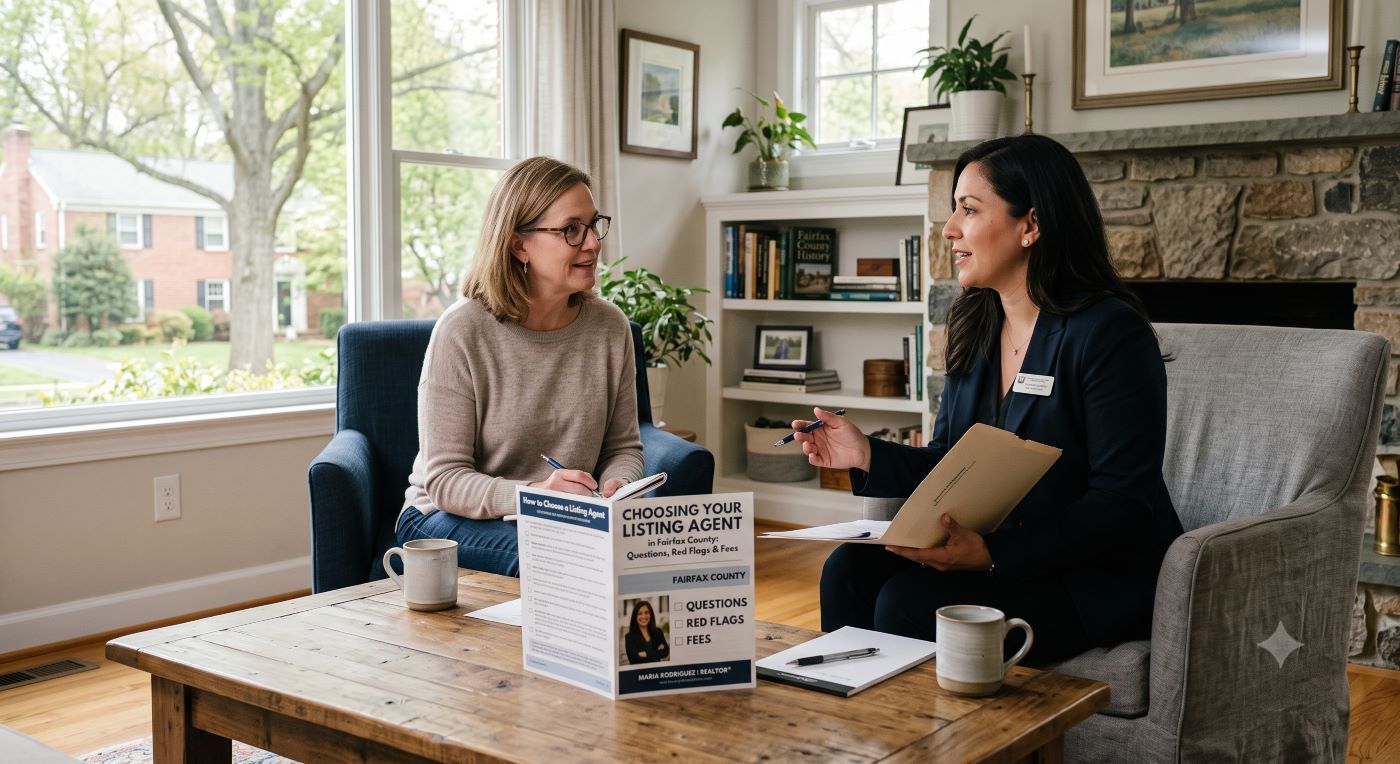
Your listing agent is the single most important decision you make when selling a home, and in a market as competitive and high-value as Fairfax County, the difference between a great agent and an average one can be tens of thousands of dollars. Yet most sellers hire the first agent they meet, or the one with the cheapest sign, without asking the questions that actually matter. As Fairfax County real estate agency, we want you to choose well, whether or not that ends up being us.
Quick Answer: To choose a listing agent in Fairfax County, interview at least two or three agents and compare them on local track record, pricing strategy, marketing plan, communication, and fees, not just who quotes the highest price or the lowest commission. Ask for recent nearby sales, their list-to-sale ratio and days on market, a written marketing plan, and a full breakdown of costs. Watch for red flags like an inflated list price to win your business, vague marketing, poor communication, and pressure to sign a long, non-cancelable contract. On fees, the traditional listing commission is around 3% of the sale price, but it is fully negotiable, and a 1.5% full-service listing keeps thousands more of your equity with no reduction in service. Since the 2024 NAR settlement, buyer-agent compensation is negotiated separately and is no longer posted on the MLS.
Key Takeaways
- Interview more than one agent: compare two or three on evidence, not on who flatters you with the highest price.
- Track record beats promises: ask for recent nearby sales, list-to-sale ratio, and average days on market.
- Demand a real marketing plan: professional photography, full MLS and syndication, and a written strategy, not just a yard sign.
- Watch for the overpricing trap: an agent who quotes an unrealistically high price to win the listing often cuts it later.
- Commission is negotiable: the traditional 3% listing fee is not fixed, and a 1.5% full-service option keeps more of your equity.
- Know the 2024 rules: buyer-agent compensation is now negotiated separately and is not advertised on the MLS.
- Fairfax is many micro-markets: McLean, Vienna, Reston, Burke, and Springfield each behave differently, so local expertise matters.
This guide gives you the exact questions to ask, the red flags that should give you pause, and a clear-eyed look at how listing fees really work, including what changed in 2024. Use it to interview any agent with confidence and to make sure the person representing your largest asset has earned the job. It reflects how we operate as a top-rated real estate team across the DMV, and how any strong agent should.
On This Page
- Why your choice of agent matters
- What a listing agent actually does
- Questions to ask before you hire
- Red flags to watch for
- Green flags: signs of a great agent
- Understanding listing agent fees
- Who pays & what the 2024 rules changed
- Full-service vs. discount vs. 1.5%
- Why Fairfax County expertise matters
- How to compare and interview agents
- Reading the listing agreement
- Common mistakes sellers make
- Frequently asked questions
- Glossary
Why Your Choice of Agent Matters
Fairfax County is one of the most valuable and competitive housing markets in Virginia, home to more than a million residents and a wide range of neighborhoods, from luxury estates in McLean and Great Falls to family communities in Burke, Springfield, and Centreville. Home values here are high, which means the stakes on every decision, especially pricing and negotiation, are high too.
A skilled listing agent earns their keep in ways that show up directly in your bottom line: pricing the home correctly from day one, presenting it to stand out, marketing it to the widest qualified audience, and negotiating hard on your behalf. A weak agent can cost you through a mispriced listing that lingers, thin marketing, or a fumbled negotiation, and those losses usually dwarf any difference in commission.
That is why the choice deserves real diligence. The good news is that a handful of well-aimed questions will quickly separate the professionals from the pretenders, and this guide gives you exactly those questions.
What a Listing Agent Actually Does
A listing agent, also called a seller's agent, represents you, the seller, in the sale of your home. Their job is to get you the best price and terms with the least stress, and a full-service agent handles the entire process end to end.
That work includes pricing the home with a comparative market analysis, advising on preparation and staging, arranging professional photography and marketing, listing on the MLS and syndicating everywhere buyers look, managing showings and open houses, fielding and negotiating offers, and coordinating the transaction through inspection, appraisal, and closing. In short, the listing agent is your project manager, marketer, and negotiator rolled into one.
Understanding that scope matters because it is the yardstick for fees. When you evaluate what an agent charges, you are really asking whether you are getting the full slate of services above, or a stripped-down version, for the price.
Questions to Ask Before You Hire
The fastest way to evaluate a listing agent is to ask specific, evidence-based questions and listen for specific, evidence-based answers. Vague or defensive responses are themselves an answer. Here are the questions that matter most, grouped by what they reveal.
Track record and local expertise
- How many homes have you sold in my area of Fairfax County in the last year?
- What is your average list-to-sale price ratio and days on market?
- Can you share recent comparable sales and references from nearby sellers?
Pricing and strategy
- How did you arrive at your suggested list price, and what data supports it?
- What is your strategy if we do not get an offer in the first two weeks?
- How do you handle multiple offers, and how do you protect my interests?
Marketing
- What exactly does your marketing plan include, in writing?
- Do you provide professional photography, video, and full online syndication?
- How will you reach buyers beyond simply listing on the MLS?
Communication and fees
- How and how often will you update me, and who is my day-to-day contact?
- What is your total fee, what does it include, and what other costs should I expect?
- What are the terms of your listing agreement, and can I cancel if I am unhappy?
Listen for evidence: a strong agent answers with numbers, examples, and a written plan. If the answers are all confidence and no proof, keep interviewing.
Red Flags to Watch For
Some warning signs are subtle and some are glaring, but all of them should make you pause before signing. Here are the red flags we hear about most from Fairfax sellers who switched agents mid-sale.
| Red Flag | Why It Matters |
|---|---|
| Quotes a suspiciously high list price | Often a tactic to win the listing, followed by pressure to cut the price weeks later. |
| No written marketing plan | Suggests a list-it-and-pray approach that under-exposes your home. |
| Poor or slow communication | If they are hard to reach while courting you, it rarely improves after you sign. |
| Pressure to sign a long, non-cancelable contract | Locks you in even if performance disappoints; confident agents earn your loyalty. |
| Vague or evasive about fees | You deserve a clear, itemized breakdown; dodging the question is a bad sign. |
| Little local sales history | Fairfax micro-markets reward agents who know the specific neighborhood. |
| Part-time or hard to verify | Selling a high-value home is not a side project; check their recent activity and reviews. |
Green Flags: Signs of a Great Agent
Just as important as spotting problems is recognizing the real thing. The best Fairfax listing agents share a consistent set of positive signals.
- Data-driven pricing: they justify the list price with recent, genuinely comparable sales rather than a flattering guess.
- A written, specific marketing plan: professional media, full syndication, and a clear timeline you can hold them to.
- Strong, verifiable track record: recent nearby sales, a high list-to-sale ratio, and reviews you can check.
- Clear, prompt communication: they set expectations for updates and actually keep them.
- Transparent fees: an itemized explanation of commission and costs, with no dodging.
- Willingness to be held accountable: reasonable agreement terms and confidence in their own performance.
Understanding Listing Agent Fees
Fees cause more confusion than any other part of hiring an agent, so let us make them simple. Traditionally, a home sale involved a total real estate commission of roughly 5 to 6 percent of the sale price, split between the listing side and the buyer's side, which put the listing agent's share at around 3 percent.
The single most important thing to know is that commission has always been negotiable; there is no fixed or legally required rate. On a high-value Fairfax home, the difference between paying 3 percent and 1.5 percent on the listing side is substantial, often tens of thousands of dollars, and it comes straight out of your equity. Our full breakdown of Fairfax home sale fees and commissions walks through exactly how that math works.
The key question is not simply which agent is cheapest, but which delivers full service for a fair fee. A 1.5% full-service listing gives you the complete slate of marketing and representation at half the traditional listing rate, which is a very different thing from a bare-bones discount broker. Before you decide, it helps to see your actual bottom line, net of commission and every closing cost, rather than reacting to the headline rate alone.
Interactive · Commission Savings
See What You Keep With a 1.5% Listing Fee
Pick your Fairfax home value:
Typical 3% Listing Fee
Your Estimated Savings
$6,000
Kept in your pocket versus a traditional 3% listing fee.
Typical 3% Listing Fee
Your Estimated Savings
$7,500
Kept in your pocket versus a traditional 3% listing fee.
Typical 3% Listing Fee
Your Estimated Savings
$9,000
Kept in your pocket versus a traditional 3% listing fee.
Typical 3% Listing Fee
Your Estimated Savings
$11,250
Kept in your pocket versus a traditional 3% listing fee.
Typical 3% Listing Fee
Your Estimated Savings
$15,000
Kept in your pocket versus a traditional 3% listing fee.
Estimates compare a 3% listing-side fee to our 1.5% listing fee. Full-service representation either way. Buyer's-agent compensation is separate and negotiable.
Who Pays & What the 2024 Rules Changed
Traditionally, the seller paid the full real estate commission out of the sale proceeds, and the listing broker shared a portion with the buyer's agent. That arrangement was largely standardized, and buyer-agent compensation was published on the MLS for agents to see.
The 2024 National Association of Realtors settlement changed how this works. Offers of buyer-agent compensation are no longer posted on the MLS, and buyers now typically sign a written representation agreement with their own agent that spells out that agent's fee. Compensation across the board is explicitly negotiable, and the days of an assumed, standardized rate are over.
For you as a seller, the practical upshot is more flexibility and more to decide: your listing fee is negotiable, and whether, and how much, to contribute toward a buyer's agent is now a separate, strategic choice rather than an automatic line item. A good listing agent will walk you through both decisions in the context of your specific home and the current market.
Note: commission rules and practices continue to evolve, and specifics vary by brokerage and transaction. Confirm current terms with your agent, and get every fee in writing before you sign.
Full-Service vs. Discount vs. 1.5%
Not all low fees are created equal, and not all full service costs the same. Understanding the three broad models helps you match what you pay to what you actually get.
| Model | Typical Listing Fee | Service Level | Best For |
|---|---|---|---|
| Traditional full-service | Around 3% | Complete marketing, negotiation, and management | Sellers wanting full help, at full price |
| Discount / limited-service | Low flat fee or reduced % | Limited, often MLS-only with much left to you | Confident, hands-on DIY sellers |
| 1.5% full-service | 1.5% | Complete service, no cutbacks | Sellers wanting full service and savings |
The trap to avoid is assuming a low fee always means a compromise. A true 1.5% full-service listing is designed to deliver everything the traditional model does, professional media, full exposure, and expert negotiation, while keeping the other half of the traditional listing fee in your pocket. That is a fundamentally different value proposition than a bare-bones discount service. And if you are weighing the do-it-yourself route instead, our honest look at selling a home without an agent in Fairfax County lays out the real tradeoffs.
Why Fairfax County Expertise Matters
Fairfax County is not one market; it is dozens. A luxury home in McLean or Great Falls sells to a different buyer, at a different price point, with different tactics than a townhome in Reston, a family home in Burke or Springfield, or a condo near Tysons. An agent who knows your specific neighborhood prices and markets it far more accurately than one parachuting in from elsewhere.
Local expertise also means understanding what Fairfax buyers pay for: the strength of the school pyramid, commute access to the Silver Line, Metro, and major employers, and the features that command a premium in each community. That knowledge shapes pricing, staging priorities, and how a home is positioned, all of which move the final number.
When you interview agents, weigh genuine, recent, neighborhood-level experience heavily. The right local knowledge is one of the clearest predictors of a strong sale, and it is something a generic or out-of-area agent simply cannot fake.
How to Compare and Interview Agents
The single best move you can make is also the simplest: interview more than one agent before you sign. Comparing two or three gives you a feel for the range of pricing opinions, marketing plans, and fees, and it makes weak candidates obvious.
Shortlist on evidence
Start with agents who have recent, verifiable sales in your part of Fairfax County and solid, checkable reviews.
Interview two or three
Ask each the same questions from this guide so you can compare answers directly rather than by gut feel.
Compare pricing logic, not just the number
Favor the agent whose price is best supported by comparable sales, not the one who simply quotes the highest figure.
Weigh the full value, not just the fee
Look at service, marketing, and track record alongside cost, and get every fee in writing.
Check references and terms
Talk to recent sellers if you can, and read the listing agreement, including its length and cancellation policy, before signing.
If you would like to see how our team measures up on these criteria, you can meet the Jamil Brothers team and judge for yourself against the questions above.
Reading the Listing Agreement
Before you sign, understand the contract you are agreeing to. The most common is an exclusive right to sell agreement, which gives one brokerage the exclusive right to market your home and earn the commission for a set period. It is standard, but the details matter.
Pay attention to the commission and exactly what it includes, the length of the term, and, crucially, the cancellation policy. A confident agent will offer reasonable terms and a fair way out if you are unhappy, because they expect to earn your continued business through performance. A demand that you lock in for many months with no exit should give you pause, and it connects directly to a common question: what if I want to change agents?
The answer is that you generally can, but the ease depends on your agreement, which is exactly why you read it first. Clarify up front how to end the relationship if it is not working, so you are never trapped with an agent who is not delivering.
Common Mistakes Sellers Make
Most regretted agent choices trace back to a few avoidable mistakes, and they overlap closely with the wider top mistakes Fairfax home sellers make. Sidestep these and you dramatically improve your odds of a smooth, profitable sale.
- Hiring the first agent you meet: without comparison, you have no benchmark for price, plan, or fee.
- Choosing on list price alone: the highest suggested price often just wins the listing, then gets cut.
- Ignoring the marketing plan: exposure drives price, so a vague plan is a real cost.
- Focusing only on the lowest fee: a cheap agent who nets you less is no bargain; weigh service and results.
- Not reading the agreement: term length and cancellation terms can trap you with an underperformer.
- Picking based on personal connection alone: a friend or relative in the business still has to be the right agent for the job.
Explore Fairfax County Communities
Selling in a Fairfax County Community?
Frequently Asked Questions
How do I choose a listing agent in Fairfax County?
Interview at least two or three agents and compare them on local track record, pricing strategy, marketing plan, communication, and fees. Ask for recent nearby sales, their list-to-sale ratio and days on market, and a written marketing plan. Favor the agent whose pricing is best supported by comparable sales, not the one who simply quotes the highest number, and get every fee in writing before you sign.
What is a listing agent?
A listing agent, also called a seller's agent, is the real estate agent who represents you when you sell your home. They price it, prepare and market it, list it on the MLS, manage showings, negotiate offers, and coordinate the transaction to closing. Their duty is to you, the seller, to get the best price and terms.
What does a listing agent do?
A full-service listing agent handles the entire sale: a comparative market analysis to price the home, advice on preparation and staging, professional photography and marketing, MLS listing and syndication, showing and open-house management, offer negotiation, and coordination through inspection, appraisal, and closing. In short, they are your marketer, negotiator, and transaction manager.
What questions should I ask a listing agent?
Ask how many homes they have sold in your area recently, their list-to-sale ratio and days on market, how they arrived at your list price, what their written marketing plan includes, how they communicate, what their total fee covers, and the terms of the listing agreement including cancellation. Strong agents answer with numbers, examples, and a plan; vague answers are a warning sign.
What are red flags when choosing a listing agent?
Watch for an agent who quotes a suspiciously high list price to win your business, has no written marketing plan, communicates poorly, pressures you into a long non-cancelable contract, is evasive about fees, or has little recent local sales history. Any of these suggests the agent may not deliver, and selling a high-value Fairfax home is not the place to take that risk.
How much does a listing agent cost in Fairfax County?
Traditionally the listing agent's share of commission has been around 3 percent of the sale price, part of a total commission of roughly 5 to 6 percent split with the buyer's side. But commission is fully negotiable, and there is no fixed rate. A 1.5% full-service listing cuts the listing-side fee in half while keeping full service, which on a high-value Fairfax home saves you tens of thousands of dollars.
What is the average real estate commission?
Historically, the average total real estate commission has been in the range of 5 to 6 percent of the sale price, split between the listing and buyer sides, though it has always been negotiable and there is no standard or required rate. Since the 2024 industry changes, compensation is explicitly negotiated, so actual rates vary. Always confirm the specific fee in writing with your agent.
Who pays the listing agent commission?
The seller traditionally pays the listing agent's commission out of the sale proceeds at closing. What changed in 2024 is buyer-agent compensation: it is no longer posted on the MLS, and buyers typically agree to their own agent's fee in writing. As a seller, your listing fee is negotiable, and whether to contribute toward a buyer's agent is now a separate, strategic decision.
What changed with the 2024 NAR settlement?
The 2024 National Association of Realtors settlement ended the practice of publishing buyer-agent compensation offers on the MLS and required buyers to sign written agreements with their own agents specifying that agent's fee. Commission is explicitly negotiable across the board. For sellers, it means more flexibility and a separate decision about buyer-agent compensation, which a good agent will guide you through.
Is a 1.5% listing fee really full service?
With the right brokerage, yes. A genuine 1.5% full-service listing delivers the complete package, professional photography and marketing, full MLS and online exposure, expert negotiation, and transaction management, for half the traditional 3 percent listing fee. That is different from a discount or limited-service broker that charges less by doing less. Confirm exactly what is included before you compare on price.
How many listing agents should I interview?
At least two or three. Interviewing multiple agents gives you a range of pricing opinions, marketing approaches, and fees to compare, and it quickly exposes weak candidates and overpriced pitches. Ask each the same questions so you are comparing answers directly, then weigh track record, plan, service, and fee together rather than any single factor.
Can I fire my listing agent?
Usually, yes, but how easily depends on your listing agreement. Some contracts allow cancellation with notice, while others bind you for a set term or include conditions. This is exactly why you should read the agreement, especially its length and cancellation policy, before signing, and favor agents who offer reasonable terms and a fair way out if performance disappoints.
How long is a typical listing agreement?
Listing agreements commonly run for a set period, often a few months, during which the brokerage has the exclusive right to sell your home. Terms are negotiable. Look closely at the length and the cancellation policy, and be cautious of unusually long, locked-in terms, since a confident agent expects to earn your continued business through results rather than a binding contract.
Do I need a full-service agent, or is a discount broker fine?
It depends on how much you want to handle yourself. A confident, experienced seller might do well with a limited-service broker, but most sellers net more with full service, through better pricing, marketing, and negotiation, even after the fee. The ideal is full service at a fair price, which is the case a 1.5% full-service listing makes: complete help, half the traditional listing fee.
Glossary
Listing Agent: The agent who represents the seller in a home sale, also called a seller's agent.
Listing Agreement: The contract between you and a brokerage authorizing it to market and sell your home for a set fee and term.
Exclusive Right to Sell: The most common listing agreement, giving one brokerage the sole right to earn the commission during the term.
Commission: The fee paid for real estate services, expressed as a percentage of the sale price and always negotiable.
Buyer-Agent Compensation: The fee paid to the buyer's agent; since 2024 it is negotiated separately and not posted on the MLS.
Comparative Market Analysis (CMA): An agent's estimate of your home's value from recent comparable sales.
List-to-Sale Ratio: The final sale price divided by the list price; a measure of pricing accuracy and negotiating strength.
Days on Market (DOM): How long a listing is active before going under contract; lower generally signals strong demand or sharp pricing.
Seller Net Sheet: An itemized estimate of your proceeds after commission, taxes, and closing costs.
NAR Settlement: The 2024 agreement that changed how buyer-agent compensation is disclosed and negotiated.
The Bottom Line on Choosing a Fairfax County Listing Agent
Choosing the right listing agent is the highest-leverage decision in your entire sale, and it does not come down to luck or a good first impression. It comes down to asking the right questions, watching for the red flags, and understanding exactly what you are paying for. Do that, and you will hire an agent who prices sharply, markets fully, negotiates hard, and treats your equity like it matters.
When you compare agents on evidence, you also discover that full service and a fair fee are not mutually exclusive. That is the case we make: complete, professional representation for a 1.5% listing fee that keeps thousands more of your Fairfax County equity in your pocket. Interview us alongside anyone else, and hold every agent to the standard this guide lays out.
Get complete marketing, expert negotiation, and a team that prices on real data, for half the traditional listing fee. Start with a free valuation and see exactly what you would net when you sell your Fairfax County home.
Disclaimer: This article is an independent educational guide for informational purposes only and is not legal or financial advice. Commission rates are negotiable and not fixed or set by law; fees, practices, and regulations change over time and vary by brokerage and transaction, especially following the 2024 NAR settlement. Always confirm current terms and get all fees in writing with your agent. The Jamil Brothers Realty Group is a licensed real estate team with Samson Properties serving Fairfax County and the greater DMV. Equal Housing Opportunity.
Explore More
Browse Every Corner of the DMV Market
Whether you're searching by budget, neighborhood, or buying situation — find exactly what you need below.
Virginia Homes by Budget
Washington DC Homes by Budget
Maryland Homes
Explore Fairfax County & Surrounding Northern Virginia
Ready to Make a Move?
Full-Service · No Tradeoffs
List for 1.5% & Keep More Equity
Professional photography, drone video, 3D tours, and expert negotiation — all included. On an $800K home, that's $12,000 more in your pocket vs. a 3% agent.
See the 1.5% Program →Need Speed or Certainty?
Get a No-Obligation Cash Offer
Skip the showings, skip the contingencies. If timing or condition matters more than top dollar, a cash offer may be the right fit. We'll walk you through every option.
Explore Cash Offers →
Categories
- All Blogs (1227)
- Aldie (3)
- Ashburn (6)
- Buyer Guide (8)
- Buying a home (2)
- Buying Strategies (30)
- festivals (1)
- General Blog (67)
- Leesburg (5)
- Market Intelligence (29)
- Market Updates (8)
- Notable Properties For Sale (32)
- Real Estate Tips, News, and More (385)
- Seller Guide (2)
- Seller Guides (60)
- Selling Your Home (522)
- Sterling (6)
- Top Realtors in Northern Virginia (58)
Recent Posts

Message Sent!
Thank you for reaching out. Arslan & Saad have received your details and will be in touch shortly.
Need immediate assistance? Call or text 703-782-4830.