Tysons vs Reston: Which Area Fits Your Lifestyle Better?
Tysons vs Reston: Which Area Fits Your Lifestyle Better?
Published February 18, 2026 · By The Jamil Brothers Realty Group
Two of Northern Virginia's most talked-about communities sit just minutes apart on the Silver Line — but they couldn't feel more different. Tysons is rapidly transforming into a high-density urban center with Fortune 500 headquarters, luxury high-rises, and a $100 million mall renovation underway. Reston, on the other hand, was designed from the ground up as a planned community with lakes, 55+ miles of trails, and a village-center model that still defines its character nearly 60 years later.
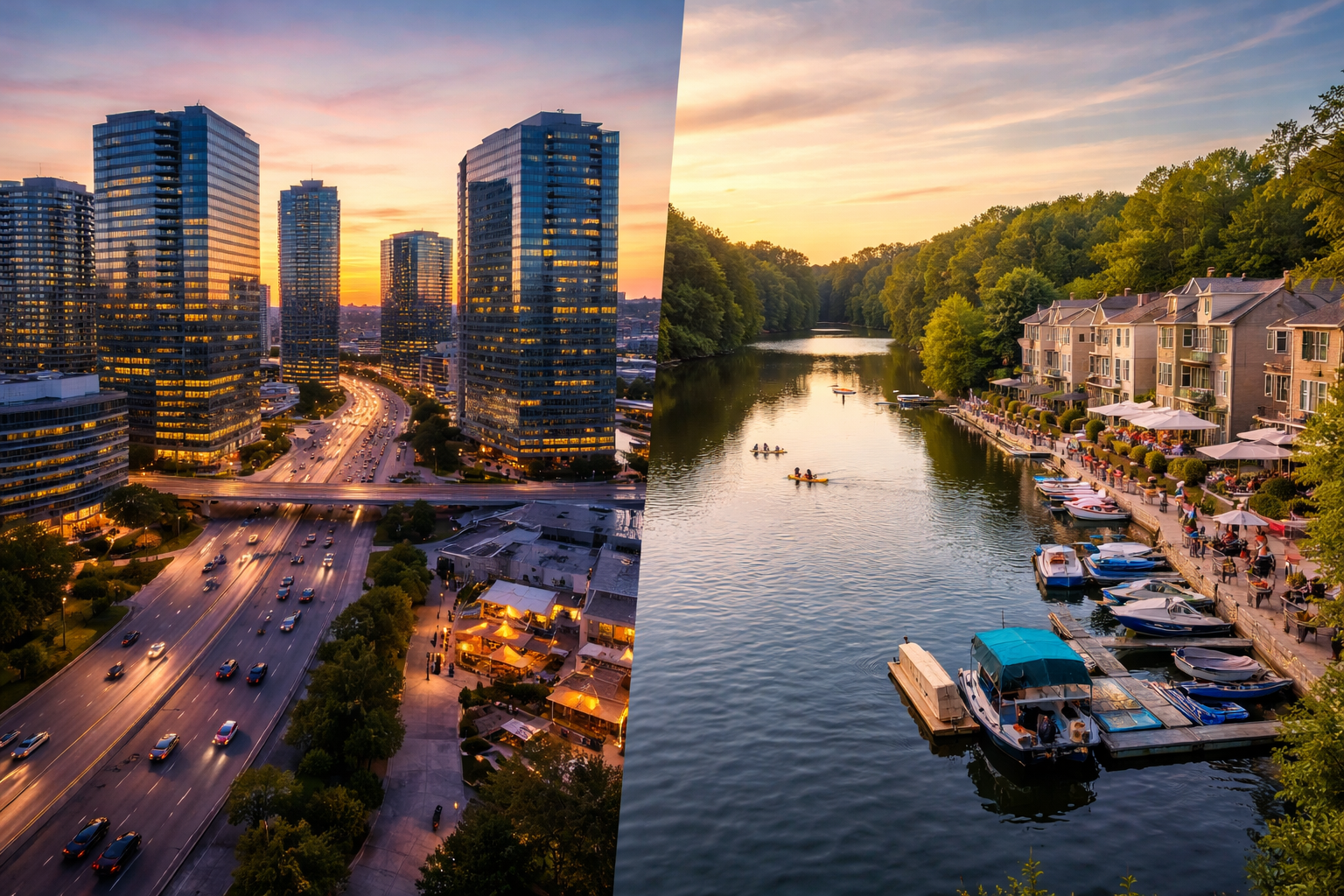
Whether you're relocating to the DMV, upgrading from a starter home, or weighing investment options, the Tysons-versus-Reston question comes down to what kind of life you want to live. This guide breaks down both communities across the metrics that actually matter: commute, home prices, dining, development trajectory, and long-term real estate potential.
📌 Quick Facts at a Glance
- Tysons median home price (all types): ~$488,000 (heavily weighted by condos); single-family homes range $1M–$3.5M
- Reston median home price (all types): ~$600,000; detached homes averaging above $900,000
- Silver Line Metro stations in Tysons: 4 (Tysons, McLean, Greensboro, Spring Hill)
- Silver Line Metro stations in Reston: 2 (Wiehle-Reston East, Reston Town Center)
- Metro ride to Metro Center (DC): ~25–30 min from Tysons, ~35–40 min from Reston
- Reston trail network: 55+ miles of pathways connecting neighborhoods and lakes
- Tysons Corner Center renovation: $100 million transformation into open-air lifestyle district
- Average rent (1BR): ~$2,450 in Tysons; ~$2,200–$2,400 in Reston
📋 Table of Contents
- What Defines Tysons and Reston Today
- Lifestyle & Vibe: Urban Energy vs. Nature-First Living
- Commute & Transit Access
- Home Prices & Housing Stock
- Dining, Shopping & Entertainment
- Development Trajectory & What's Coming
- Real Estate & Investment Implications
- The Northern Virginia Connection
- Pros & Cons Comparison
- How to Decide: Which Area Fits You?
🏙️ What Defines Tysons and Reston Today
Tysons is Virginia's largest employment center. Home to approximately 27,600 full-time residents, the area's population swells to over 100,000 during business hours as workers pour into its office towers. The skyline is anchored by the headquarters of Capital One, Booz Allen Hamilton, SAIC, and a growing roster of tech companies and government contractors. Over the past decade, the arrival of four Silver Line Metro stations has accelerated Tysons' transition from a car-dependent commercial corridor into something closer to a walkable urban district — though that transformation is still very much in progress.
Reston tells a fundamentally different story. Founded in 1964 by Robert E. Simon Jr. (the "RES" in Reston), it was one of America's first planned communities. The founding principles — that people of all income levels should be able to live in the same community, that beauty matters in daily life, and that nature should be integrated into the built environment — still shape the community today. With a population exceeding 63,000, Reston is built around four man-made lakes, a network of village centers, and a community association (Reston Association) that manages pools, tennis courts, nature programs, and over 1,300 acres of open space.
🌿 Lifestyle & Vibe: Urban Energy vs. Nature-First Living
If you want to step out of your building and immediately be within walking distance of high-end retail, a rooftop bar, and a Broadway-caliber show at Capital One Hall, Tysons delivers that experience — increasingly so as new mixed-use developments come online. The Boro, Scotts Run, and the area around the McLean Metro station have created pockets of genuine urban walkability. But move a few blocks in any direction, and you'll find yourself on a six-lane road without a sidewalk. Tysons' urban identity is concentrated, not uniform.
Reston's lifestyle revolves around outdoor access. Residents use the trail system the way city dwellers use sidewalks. Lake Anne, the original village center, hosts a Saturday farmers market, public art installations, and a craft beer scene. Lake Thoreau, Lake Audubon, and Lake Newport each anchor surrounding neighborhoods with swimming, fishing, and kayaking. The Reston Association's $24 million budget for 2026 reflects continued reinvestment in pools, courts, and nature programming.
For families, Reston's South Lakes and Langston Hughes Middle School feeder systems are highly regarded. Tysons falls primarily within the McLean High School pyramid, which is also well-rated — but the school experience in Tysons skews more toward high-rise living with limited yard space, while Reston offers a broader mix of townhomes and single-family neighborhoods with more traditional family layouts.
🚇 Commute & Transit Access
Both communities benefit from the Silver Line, but Tysons has a clear edge in transit density. With four Metro stations (Tysons, McLean, Greensboro, and Spring Hill), much of the commercial core is within walking distance of a platform. The ride to Metro Center in downtown D.C. takes roughly 25 to 30 minutes, making Tysons one of the fastest suburban-to-downtown commutes in the region.
Reston's two Silver Line stations — Wiehle-Reston East and Reston Town Center — serve the eastern and central portions of the community. The ride to Metro Center runs approximately 35 to 40 minutes. While that's only a few extra minutes compared to Tysons, the real difference is last-mile access: unless you live within walking distance of the stations, you'll likely need a car, bus, or bike to reach the platform. Fairfax Connector buses fill some of that gap, and development clustering around the stations is improving walkability.
For drivers, both areas provide strong highway access. Tysons sits at the intersection of the Capital Beltway (I-495) and Route 7, with the Dulles Toll Road minutes away. Reston is centered along the Dulles Toll Road corridor with direct access to the Fairfax County Parkway. Drive times to Dulles Airport are roughly 15 minutes from Reston and 20–25 minutes from Tysons.
| Category | Tysons | Reston |
|---|---|---|
| Metro Stations | 4 stations | 2 stations |
| Metro to DC (Metro Center) | ~25–30 min | ~35–40 min |
| Drive to Dulles Airport | ~20–25 min | ~15 min |
| Major Highway Access | I-495, Route 7, Route 123 | Dulles Toll Rd, Fairfax Co. Pkwy |
| Walkability (Metro area) | Moderate–High (pockets) | Moderate (station-adjacent) |
| Trail Network | Limited, improving | 55+ miles of connected paths |
| Median Home Price (All Types) | ~$488K (condo-heavy mix) | ~$600K (balanced mix) |
| Single-Family Home Range | $1M–$3.5M | $700K–$1.5M+ |
💰 Home Prices & Housing Stock
The price comparison between Tysons and Reston requires context. Tysons' housing stock is overwhelmingly condominiums and apartments — approximately 66% of households are renters. The median sale price of around $488,000 reflects this condo-heavy inventory. Single-family homes in the Tysons area (which bleeds into McLean) command significantly higher prices, with listings commonly ranging from $1 million to $3.5 million. New construction luxury homes from builders like Sekas Homes are delivering 7,000+ square-foot residences priced well above $2 million.
Reston offers a more balanced housing mix. The median sold price across all property types sits near $600,000, with detached homes averaging above $900,000 and condos typically falling between $325,000 and $425,000. Townhomes — Reston's bread-and-butter product — range from approximately $520,000 to $650,000 depending on size and location. In 2025, Reston recorded roughly 1,005 sales: 184 detached homes, 403 townhomes, and 418 condominiums.
If you're looking to search homes across Fairfax County, understanding these micro-market differences is critical. A $600,000 budget in Reston might land you a well-located townhome, while the same budget in Tysons likely means a modern condo in a high-rise with resort-style amenities.
🍽️ Dining, Shopping & Entertainment
Tysons is the region's retail heavyweight. Tysons Corner Center and Tysons Galleria together represent one of the largest shopping destinations on the East Coast. The ongoing $100 million renovation of Tysons Corner Center is converting the Bloomingdale's and Macy's wings into an open-air lifestyle district. Level99, a 40,000-square-foot gaming and entertainment venue, is already open. Maggiano's Little Italy is relocating from the Galleria into a new first-floor space. A reimagined Apple Store and expanded Zara are part of the next wave. Capital One Hall — the 1,600-seat performing arts venue at the McLean Metro station — brings Broadway-caliber shows, concerts, and comedy to Tysons along with The Perch rooftop experience.
Reston's dining and entertainment scene is more distributed but no less interesting. Reston Town Center remains the community's central gathering point, with restaurants, a movie theater, an ice rink in winter, and regular community events on the plaza. The opening of Virginia's first JW Marriott at Reston Station has elevated the area's hospitality profile, and new dining concepts are filling in around Reston Row — including Noku Sushi and the anticipated Ebbitt House American grill. Lake Anne's waterfront offers a more intimate, village-market atmosphere with cafes, art galleries, and the popular Saturday farmers market.
For everyday shopping, both areas are well-served. Tysons has Whole Foods, Trader Joe's, and the full mall ecosystem. Reston benefits from the Wegmans-anchored Plaza America area, plus the Halley Rise development adding retail along Sunrise Valley Drive. Reston's advantage is that these amenities feel integrated into the neighborhood fabric rather than separated by parking lots and arterial roads.
🏗️ Development Trajectory & What's Coming
Both Tysons and Reston are in the middle of generational development cycles, but the nature and scale differ significantly.
Tysons is effectively being rebuilt. Fairfax County's long-term vision calls for transforming the area into a walkable urban center that could house over 100,000 residents. Major projects approved or underway include the Piazza at Tysons — a mixed-use development near Spring Hill Metro featuring three towers up to 33 stories, over 2 acres of parkland, and a potential arts center — and The Mile, a $3 billion development on a former 38-acre business campus that is now pivoting to include up to 250 modern townhouses alongside apartments and retail. The Tysons Corner Center renovation will roll out in phases through 2026 and beyond.
Reston is adding density strategically around its two Metro stations while preserving the established residential neighborhoods. Reston Station's Midline district is the next major phase, bringing senior housing, a Fresh Market-anchored retail component, and additional residential units. The Reston Gateway project near the Reston Town Center Metro will add roughly 2,010 residences and 4.8 million square feet of mixed-use development across 33 acres. The NOVA campus at 1821 Michael Faraday Drive is being converted into 92 housing units as Northern Virginia Community College vacates by 2027. Meanwhile, the Reston Comprehensive Plan Study Task Force continues to meet, shaping the community's next chapter with input from residents.
📈 Real Estate & Investment Implications
From a pure investment perspective, both areas offer compelling cases — but the profiles are different.
Tysons is a growth-and-transformation play. If Fairfax County's urban vision materializes over the next 10–15 years, early buyers in well-located properties near Metro stations could see meaningful appreciation. The risk is that Tysons' transformation is still in its early chapters. Not every planned project will be built on schedule, and the area's condo market already faces saturation concerns from the sheer volume of luxury apartments built in recent years. Single-family homes near Tysons (technically in McLean) remain a strong store of value, but they command premium pricing.
If you currently own a home in either Tysons or Reston and are curious about its position in the current market, you can get a free home valuation here to understand your equity and options.
Reston is a stability-and-demand play. The community has demonstrated consistent appreciation over decades, supported by employment anchors like CACI International (which recently completed a $2.6 billion acquisition), Google, Leidos, and a deep base of federal contractors. Reston's housing market in 2025 showed roughly 2% year-over-year appreciation, with well-priced, move-in-ready homes near trails, Metro stations, and top schools selling in under 40 days. The diversity of housing stock — from $325,000 condos to $1.5 million-plus detached homes — gives investors and buyers multiple entry points.
🗺️ The Northern Virginia Connection
Both Tysons and Reston sit in the heart of the Dulles Corridor — the economic engine of Northern Virginia. The Silver Line connects them not just to each other and to downtown D.C., but now directly to Dulles International Airport, Herndon, and Loudoun County's growing communities in Ashburn.
Tysons functions as NoVA's commercial downtown — the place where corporate headquarters cluster and regional retail anchors. Its gravitational pull affects home values in surrounding communities like McLean, Vienna, and Falls Church, which benefit from Tysons' employment base without sharing its traffic and density challenges.
Reston, as the second-largest employment center in Virginia, drives its own economic ecosystem. The concentration of tech and defense contractors — combined with the planned community's quality of life — creates a self-reinforcing cycle of demand. Workers hired at Reston-based companies often choose to live in Reston or nearby Herndon, keeping housing demand strong across all price points. The Reston Town Center Metro station's opening in 2022 further cemented the connection between Reston's residential neighborhoods and the broader regional economy.
For buyers comparing the two, the broader Northern Virginia context matters. Both communities outperform national averages in home value stability, employment, and household income. The question isn't whether either is a "good" place to buy — it's which one aligns with your priorities.
⚖️ Pros & Cons Comparison
| Tysons | Reston |
|---|---|
| ✅ Pros | |
| 4 Metro stations — best Silver Line transit density | 55+ miles of trails, 4 lakes, nature-integrated community |
| Major employment hub (Fortune 500 HQs) | Balanced housing mix at multiple price points |
| Massive development pipeline = appreciation potential | Strong, established community with 60-year track record |
| Premier shopping & entertainment destination | Reston Association pools, courts, programs included |
| ⚠️ Cons | |
| Walkability inconsistent — pockets of urban, lots of arterials | Longer Metro commute to DC (~35–40 min) |
| Limited single-family inventory; mostly condos | RA assessment fees on top of property taxes/HOA |
| Condo market saturation risk from new development | Some older housing stock requires updates |
| Heavy traffic on Route 7, Route 123, and Beltway | Less nightlife/entertainment compared to Tysons |
🎯 How to Decide: Which Area Fits You?
Choose Tysons if: You want the fastest Metro commute to D.C., prefer condo or high-rise living with resort-style amenities, work in the Tysons employment corridor, value proximity to premier shopping and entertainment, or see long-term upside in an area undergoing major urban transformation.
Choose Reston if: You prioritize outdoor access and trail connectivity, want a broader range of housing types (especially townhomes and single-family), value an established community with programming and events, need access to Dulles Airport, or prefer a more balanced lifestyle pace with walkable village centers and lake access.
Consider both if: You're flexible on location and want to compare specific properties. The Silver Line means living in Reston and working in Tysons — or vice versa — is a realistic, comfortable commute. Many buyers tour both areas and find that the right home matters more than the right zip code.
The best way to start is with real data on real properties. Browse available homes in Tysons and Reston to compare listings, pricing, and neighborhoods side by side — or reach out to the Jamil Brothers team for a personalized walkthrough of both markets.
Ready to Find the Right Fit in Northern Virginia?
Whether you're buying, selling, or exploring your options, the Jamil Brothers Realty Group is here to help you make a confident move in Tysons, Reston, or anywhere in the DMV.
Categories
- All Blogs (1227)
- Aldie (3)
- Ashburn (6)
- Buyer Guide (8)
- Buying a home (2)
- Buying Strategies (30)
- festivals (1)
- General Blog (67)
- Leesburg (5)
- Market Intelligence (29)
- Market Updates (8)
- Notable Properties For Sale (32)
- Real Estate Tips, News, and More (385)
- Seller Guide (2)
- Seller Guides (60)
- Selling Your Home (522)
- Sterling (6)
- Top Realtors in Northern Virginia (58)
Recent Posts
Message Sent!
Thank you for reaching out. Arslan & Saad have received your details and will be in touch shortly.
Need immediate assistance? Call or text 703-782-4830.