
The Potomac Sewage Spill: What Northern Virginia Homeowners and Buyers Need to Know
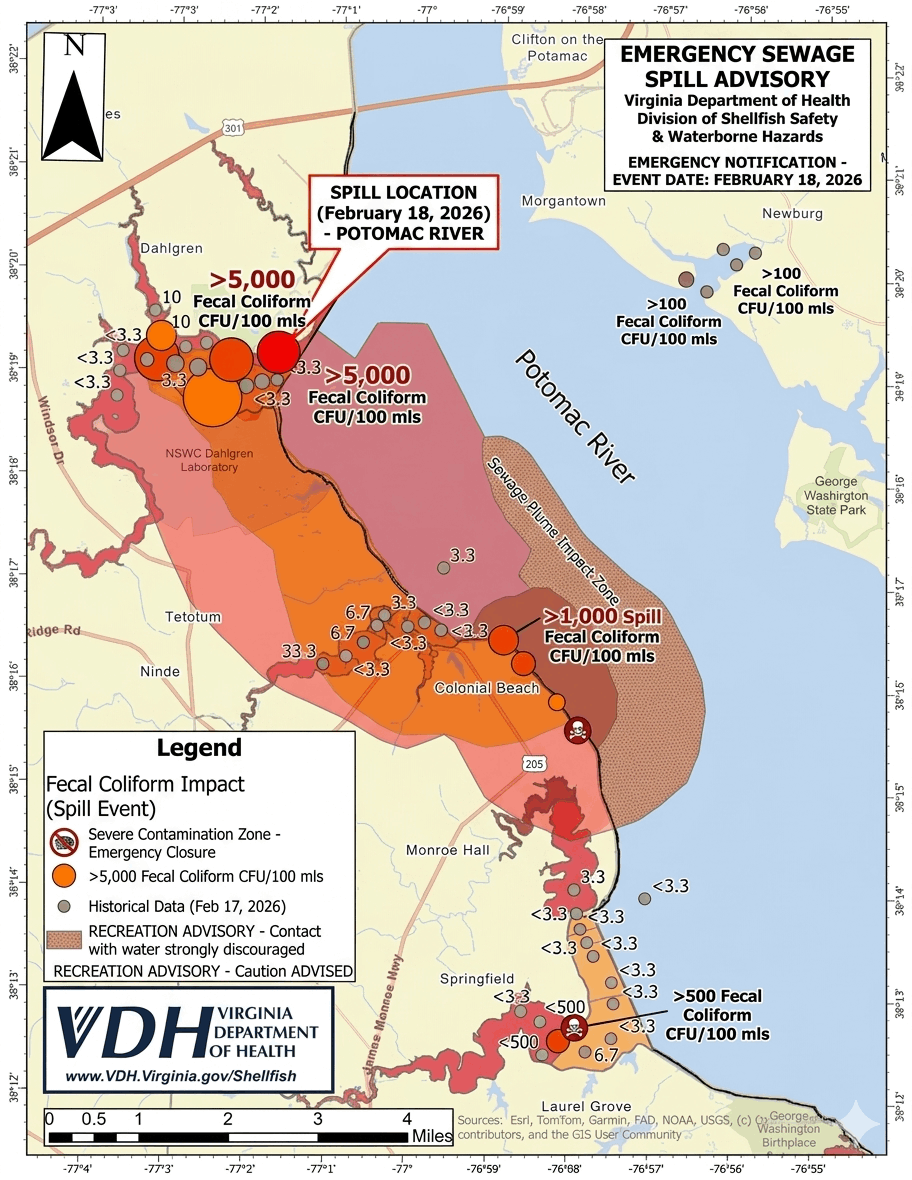
On January 19, 2026, part of the Potomac Interceptor sewer pipeline collapsed near the Clara Barton Parkway and I-495 interchange in Montgomery County. Approximately 240 million gallons of untreated wastewater entered the Potomac River before the bypass system and additional controls stopped further overflows. Emergency repairs were completed on March 14, restoring wastewater flow through the interceptor. EPA
For Northern Virginia residents, the most important distinction is between river conditions and household drinking water. Authorities reported that regional drinking water remained safe because the affected water intakes are upstream of the collapse. Monitoring also indicated that contamination was relatively localized, and the Virginia recreational health advisory was later lifted. EPA, WSSC Water
This guide explains what happened, how officials responded, and what homeowners and prospective buyers should know about drinking water, river recreation, environmental monitoring, cleanup, and long-term infrastructure work. If you are considering buying a home in Northern Virginia, use verified agency updates when evaluating the incident rather than assuming that the spill directly affected drinking water or property values across the entire region.
⚡ Quick Facts at a Glance
- Date of collapse: January 19, 2026
- Location: Clara Barton Parkway, Montgomery County, MD (approx. 5 miles upstream of D.C.)
- Volume spilled: ~240–300 million gallons of untreated sewage
- Pipe age: Primarily constructed in 1962 — over 60 years old
- Daily capacity: Up to 60 million gallons/day from Virginia and Maryland
- Emergency repairs completed: March 14, 2026
- Long-term rehab timeline: 9–10 months of additional pipe work
- Estimated emergency repair cost: $20 million+, with cost allocation being worked out among DC Water and its county customers — including Fairfax and Loudoun in Virginia
- Drinking water status: NOT affected — all Virginia and D.C. intakes are upstream of the spill site
- Current recreation status: Most advisories lifted as of mid-March; limited Maryland shoreline advisory remains near spill site
📋 Table of Contents
- What Happened: The Potomac Interceptor Collapse
- Why This Matters to the DMV Region
- Environmental & Health Impact
- Timeline: From Collapse to Current Status
- Which Northern Virginia Areas Are Most Affected?
- Real Estate Implications: Buying, Selling & Investing
- The Northern Virginia Connection: Infrastructure, Costs & Waterfront Living
- Is Your Drinking Water Safe? The Facts
- What the Spill Reveals: Aging Infrastructure Risks
- What Homeowners and Buyers Should Do Now
🔩 What Happened: The Potomac Interceptor Collapse
The Potomac Interceptor (PI) is a 54-mile sewer pipeline built primarily in 1962. It originates in Northern Virginia — carrying wastewater from as far west as Dulles International Airport and surrounding communities — and runs through Montgomery County, Maryland, before terminating at the Blue Plains Advanced Wastewater Treatment Plant in Southwest Washington, D.C., which is owned and operated by DC Water (the District of Columbia Water and Sewer Authority).
On January 19, 2026, a 72-inch section of this aging pipe collapsed near the Clara Barton Parkway, inside the C&O Canal National Historical Park in Montgomery County. The collapse sent untreated sewage surging into the Potomac River, with peak discharge estimated at approximately 40 million gallons per day during the initial breach — before bypass pumping systems were activated on January 24. Researchers at the University of Maryland School of Public Health and the Potomac Riverkeeper Network have both characterized this as one of the worst — if not the single worst — sewage spills in United States history.
A complicating factor emerged in early February when crews discovered a rock blockage inside the ruptured pipe, which significantly slowed emergency repair work. DC Water used the C&O Canal as a temporary holding and bypass channel — routing sewage through approximately 2,700 feet of the historic waterway and back into the undamaged section of the interceptor. The last confirmed overflow event reaching the Potomac occurred on February 8, 2026. Emergency repairs were ultimately completed on March 14, and full flow was restored to the interceptor.
📍 Why This Matters to the DMV Region
The Potomac River is not a distant body of water for Northern Virginia residents — it is the region's backbone. It defines the western boundary of Fairfax and Loudoun counties, hosts some of the area's most celebrated parks and trails (Great Falls, Scott's Run, C&O Canal), and is a core part of why people choose to live and invest in the DMV. When the river is compromised, the ripple effects touch recreation, ecosystem health, property desirability, and even public costs that eventually reach ratepayers and taxpayers.
This spill also has very direct Northern Virginia connections beyond geography: Fairfax County and Loudoun County are two of DC Water's four county customers. That means the financial cost of emergency repairs — already estimated at over $20 million and climbing — is being worked out among those four jurisdictions. The long-term rehabilitation of the broken pipe section is a 9-to-10-month project using advanced sliplining and geopolymer lining methods. How that final bill is divided, and whether it results in higher utility rates for Virginia residents, is still being determined.
🌿 Environmental & Health Impact
The health and ecological consequences of a spill this size are significant. Initial water quality testing found E. coli concentrations thousands of times above EPA recreational safety thresholds at the overflow site. Researchers from the Potomac Riverkeeper Network documented bacteria levels roughly 10,000 times over the safe recreational limit in the days immediately following the collapse. Beyond E. coli, Johns Hopkins public health researchers noted the presence of antibiotic-resistant bacteria (MRSA) in water samples, as well as pharmaceuticals and chemical compounds that can settle into river sediment and affect fish reproduction and aquatic habitats over an extended period.
The cold January temperatures actually helped contain some of the immediate damage — bacteria do not thrive as readily in frigid water. However, environmental scientists have warned that as spring and summer bring warmer temperatures, frozen bacterial deposits in the river could unfreeze and re-release, and algae blooms fueled by nutrient-rich sewage could harm fish populations and further affect the Chesapeake Bay downstream. DC Water, the Virginia DEQ, Maryland, and D.C. agencies are all conducting ongoing water quality monitoring, with fish and wildlife surveys planned for spring 2026.
A group of land and vessel owners filed a lawsuit against DC Water in March 2026 for damages related to the spill, citing unpleasant conditions, floating debris on properties, and concerns about lasting contamination near waterfront areas.
🔬 What Was in the Spill?
Raw sewage is not simply water. The Potomac spill contained harmful bacteria including E. coli and antibiotic-resistant pathogens, viruses, pharmaceuticals flushed down drains, and chemical compounds from household and commercial sources. These substances can contaminate river sediment, harm aquatic life, and pose risks to anyone in contact with the water — including pets. Anyone who had contact with the Potomac between mid-January and mid-March is encouraged to monitor for symptoms and consult a health provider if concerned.
📅 Timeline: From Collapse to Current Status
| Date | Event |
|---|---|
| Jan. 19, 2026 | 72-inch Potomac Interceptor collapses near Clara Barton Pkwy, Montgomery County, MD. Raw sewage begins flowing into Potomac River. |
| Jan. 23–24, 2026 | DC Water begins installing bypass pumps. Sewage rerouted through C&O Canal and back into undamaged pipe section. |
| Jan. 25, 2026 | Maryland closes downstream shellfish harvesting area in Charles County as precaution. |
| Jan. 29, 2026 | DC Water begins daily E. coli monitoring at 6 river locations. |
| Feb. 6, 2026 | Rock blockage discovered inside pipe. Revised repair approach adds 4–6 weeks to timeline. |
| Feb. 8, 2026 | Last confirmed overflow event reaching the Potomac River. |
| Feb. 16–19, 2026 | President Trump announces federal involvement; EPA leads response. FEMA and Army Corps of Engineers engaged. |
| Feb. 17, 2026 | Arlington County confirms drinking water is safe. Virginia DEQ expands water quality monitoring. |
| March 2, 2026 | Environmental cleanup begins at directly impacted overflow areas. |
| March 10, 2026 | Maryland DEQ lifts partial shellfish harvesting closure in Potomac River. |
| March 14, 2026 | Emergency repairs completed. Full flow restored to Potomac Interceptor. Bypass pumps turned off. |
| Ongoing through 2026 | Long-term pipe rehabilitation (9–10 months). C&O Canal draining and remediation. Environmental monitoring continues. Cost allocation among DC Water and county partners unresolved. |
🏘️ Which Northern Virginia Areas Are Most Affected?
While the collapse occurred on the Maryland side of the river, the impact on Northern Virginia is both direct and indirect. Key areas to understand:
- McLean & Great Falls (Fairfax County): Residents and trail users near the Potomac — particularly at Great Falls Park and Scott's Run Nature Preserve — faced recreational advisories. Scott's Run was temporarily closed for urgent sewer work in February. The trail corridors along the river are among the most valued amenities for McLean and Great Falls homeowners.
- Arlington County: Downstream from the spill, Arlington issued a county-wide advisory in mid-January recommending residents avoid contact with the Potomac. Arlington Water confirmed on February 17 that drinking water was safe — its intakes are upstream at Great Falls.
- Alexandria & Mount Vernon: Located further downstream, these areas saw recreational advisories due to the southward flow of contaminated river water. The Virginia Department of Health recommended avoiding the Potomac between the American Legion Bridge and Chain Bridge at the peak of the crisis.
- Loudoun County: As one of DC Water's four county customers (alongside Fairfax, Montgomery, and Prince George's), Loudoun has a financial stake in how repair and rehabilitation costs are ultimately distributed among the utility's customers.
- Fairfax County overall: Fairfax Water's Potomac River intake is located several miles upstream of the spill site and was confirmed as unimpacted. The county's drinking water was never at risk. However, river-adjacent parks and the lifestyle amenities that make riverside neighborhoods in Fairfax so desirable were significantly disrupted through early March.
🏡 Real Estate Implications: Buying, Selling & Investing
For buyers and sellers currently active in the Northern Virginia market, the Potomac spill raises several real estate considerations worth understanding clearly — with both short-term and longer-term dimensions.
Waterfront and River-Adjacent Properties: Homes with direct Potomac River frontage — or whose value is closely tied to river access — may face near-term perception challenges in buyer conversations. Attorneys have begun investigating potential claims for decreased property values near affected areas, and a lawsuit against DC Water has already been filed by waterfront landowners. Sellers of river-adjacent properties should be prepared to document water quality status and current advisories in their disclosures. If you're considering listing a home near the Potomac, find out what your home is worth with a current market evaluation — pricing strategy will matter.
Buyers in Fairfax, Loudoun, and Downstream Areas: For buyers searching for homes in Northern Virginia, context is important. Most of the region's drinking water was never at risk. The spill primarily affected recreational river use — kayaking, swimming, shoreline activities — and was concentrated in a specific corridor near the MD/VA border. The overwhelming majority of Northern Virginia neighborhoods are not directly adjacent to the river and face no material change in their property fundamentals from this event.
Infrastructure Costs and Utility Rates: The most underappreciated real estate angle here is the potential long-term cost impact. DC Water's Potomac Interceptor rehabilitation program — a 10-year, $625 million investment already underway before this collapse — will almost certainly accelerate and expand. Fairfax and Loudoun county residents who are DC Water customers may see rate adjustments over time as the financial burden is worked out. For buyers evaluating total cost of homeownership, this is worth factoring into long-term budgeting.
💡 Buyer's Insight: Don't Over-Correct on Risk
Environmental events like this historically create temporary buyer hesitation around certain corridors, followed by a return to fundamentals once the situation resolves. Northern Virginia's housing market — with its strong employment base, Silver Line accessibility, and persistent inventory constraints — remains among the most resilient in the country. Buyers who let short-term noise drive long-term decisions often miss strong opportunities. The data matters more than the headlines.
🔗 The Northern Virginia Connection: Infrastructure, Costs & Waterfront Living
The Potomac Interceptor doesn't start in Maryland — it originates in Northern Virginia. The pipeline collects wastewater from Dulles International Airport, surrounding Loudoun and Fairfax communities, and funnels it northeast toward D.C. for treatment. The pipe that failed has been in service since 1962, serving communities that have grown dramatically since it was built. The infrastructure was already tagged for rehabilitation before the January collapse, meaning this was not an entirely unpredictable failure — it was aging infrastructure under strain.
This carries a broader message for Northern Virginia residents: the quality of life that makes this region so attractive — river trails, parks, natural amenities — depends on aging underground infrastructure that requires sustained investment. According to engineering reporting, DC Water's full 10-year interceptor rehabilitation program was already estimated at $625 million before this event added urgency and scope to the work. The federal government — through the EPA and Army Corps of Engineers — stepped in during February, and congressional members have called for infrastructure funding to prevent similar failures nationwide.
For real estate purposes, the key takeaway is that Northern Virginia's long-term value proposition hasn't changed — but buyers and homeowners are increasingly well-served by understanding the infrastructure layers beneath the quality of life they're purchasing. Communities with modern sewer infrastructure, upstream water intakes, and well-funded utility programs carry lower long-term risk than those dependent on aging regional systems.
💧 Is Your Drinking Water Safe? The Facts
This deserves direct, unambiguous treatment — because the concern is widespread and the answer is clear: drinking water across Northern Virginia and Washington, D.C. was not affected by this spill.
| Area / Utility | Drinking Water Status | Why |
|---|---|---|
| Fairfax Water | ✅ Safe — Unaffected | Intake is located upstream of the spill site on the Potomac |
| Arlington County | ✅ Safe — Unaffected | Washington Aqueduct intake at Great Falls is upstream; Little Falls intake was shut off before the spill |
| DC Water (Drinking) | ✅ Safe — Unaffected | Drinking water and wastewater are separate systems; intake at Great Falls is upstream |
| WSSC (Montgomery County, MD) | ✅ Safe — Unaffected | Montgomery County water intake is located upstream of the spill |
| Recreational River Use | ⚠️ Advisories Largely Lifted | Most advisories lifted as of mid-March; residual advisory near MD shoreline within 200ft of spill site remains; continue monitoring for updates |
⚖️ What the Spill Reveals: Aging Infrastructure Risks
The Potomac Interceptor collapse is not an isolated incident — it's a high-profile example of a national problem. Sewer systems built in the 1950s and 1960s to serve far smaller populations are now under enormous stress from decades of growth. Population expansion in Northern Virginia has been relentless over the past 30 years, and the infrastructure beneath the ground has not always kept pace.
Environmental scientists and engineers have noted that the problem is systemic: sewer systems — especially combined systems that handle both wastewater and stormwater — frequently overflow during heavy rain events. The Potomac spill was worsened by back-to-back winter storms that increased flow volume while freezing the bypass pumps. A 14-member group of regional U.S. House members sent a letter in February 2026 calling on Congress to fund national wastewater infrastructure upgrades, framing the Potomac failure as a regional crisis with national implications.
📌 What This Means for Northern Virginia's Housing Market
- Near-term: Waterfront and river-corridor properties may face buyer questions and modest valuation pressure until monitoring data confirms the Potomac's restoration. Sellers in those corridors should work with an experienced agent to proactively frame the current status accurately.
- Medium-term: Fairfax and Loudoun county residents should monitor DC Water rate announcements as cost allocation for the $20M+ emergency repair and 9–10 month rehabilitation is finalized.
- Long-term: Northern Virginia's core demand drivers — federal employment, Dulles tech corridor, Silver Line Metro, top-ranked schools — remain fully intact. Environmental incidents of this type, when properly remediated, historically have limited lasting impact on broad regional market values.
✅ What Homeowners and Buyers Should Do Now
Whether you're currently a homeowner in Northern Virginia or in the process of buying, here are the practical steps to take in light of the Potomac spill:
- Follow official monitoring updates: DC Water (dcwater.com), the Virginia Department of Health, and the Virginia DEQ are all publishing ongoing sampling data. Bookmark these sources if you live or recreate near the river.
- Understand your water source: If you're in Fairfax County, Loudoun County, or Arlington, your drinking water was not and is not at risk. Your utility's intake is upstream of the spill. This is not a drinking water crisis for Northern Virginia.
- Buyers doing due diligence: If you're evaluating a home near the Potomac River — particularly in the Great Falls, McLean, or Mount Vernon corridors — ask your agent for the specific environmental advisory status for that area. Current sampling data shows bacteria levels outside the immediate spill zone are within safe recreational ranges, but ongoing monitoring is continuing.
- Sellers near the river: Work with an agent who understands how to accurately represent the current situation without underselling your property. Full, fact-based disclosure builds buyer confidence. Get a current home valuation to understand where your property stands in today's market context.
- Investors: Environmental events create short-term uncertainty that can occasionally open buying opportunities in strong markets. Northern Virginia's fundamentals — low inventory, strong employment, high demand — haven't changed. Informed buyers who act on data rather than headlines often position themselves well.
- Everyone: Continue avoiding direct contact with Potomac River water near the Maryland shoreline within 200 feet of the spill site until Maryland's residual advisory is lifted. Follow VDH guidance for your specific county.
Navigate Northern Virginia Real Estate With Confidence
Environmental events, shifting market conditions, infrastructure developments — the Northern Virginia real estate market moves fast. The Jamil Brothers Realty Group knows this region inside and out. Whether you're buying, selling, or simply evaluating your position, we're here to help you make informed decisions.
Serving Fairfax County · Loudoun County · Prince William County · Arlington · Alexandria · The Greater DMV
Categories
- All Blogs (1227)
- Aldie (3)
- Ashburn (6)
- Buyer Guide (8)
- Buying a home (2)
- Buying Strategies (30)
- festivals (1)
- General Blog (67)
- Leesburg (5)
- Market Intelligence (29)
- Market Updates (8)
- Notable Properties For Sale (32)
- Real Estate Tips, News, and More (385)
- Seller Guide (2)
- Seller Guides (60)
- Selling Your Home (522)
- Sterling (6)
- Top Realtors in Northern Virginia (58)
Recent Posts



Message Sent!
Thank you for reaching out. Arslan & Saad have received your details and will be in touch shortly.
Need immediate assistance? Call or text 703-782-4830.