
Mortgage Rates Are Creeping Back Toward 7% — What Northern Virginia Buyers Need to Know Now
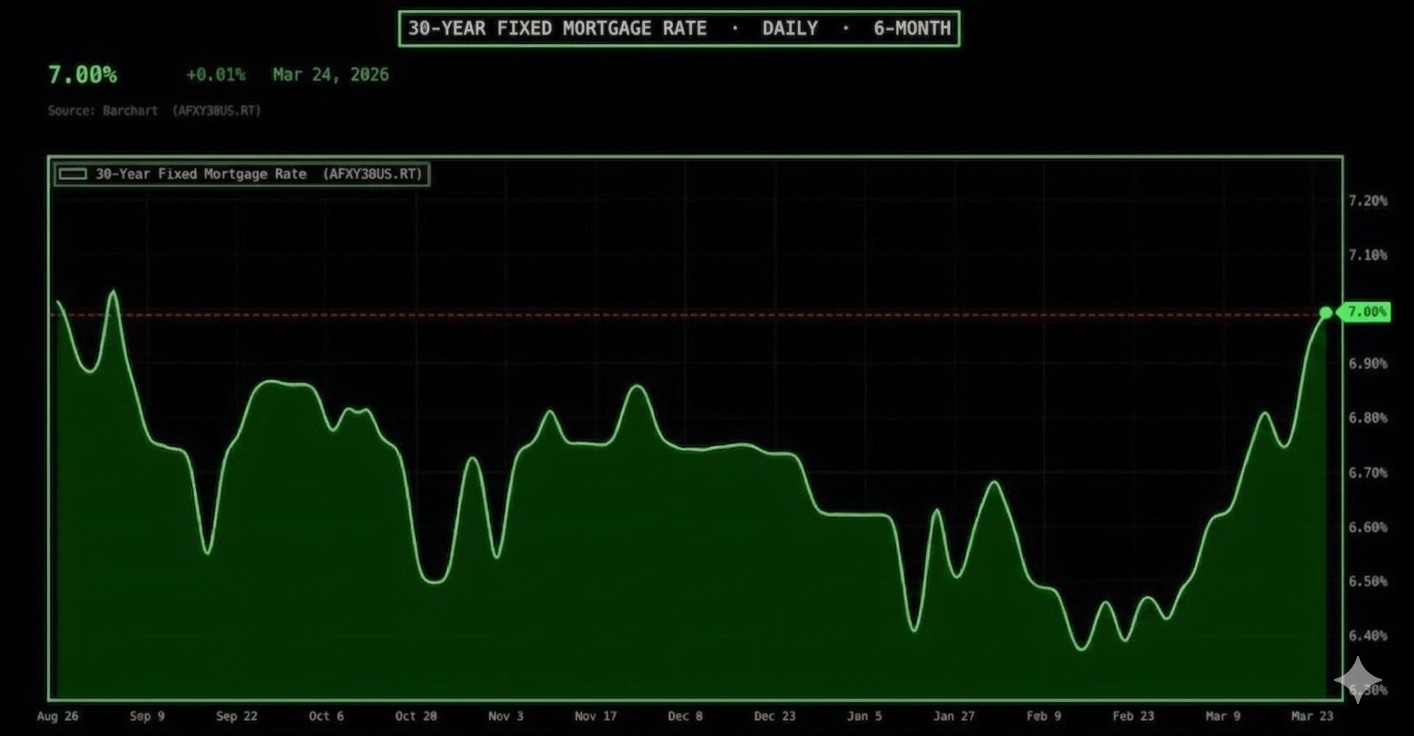
For a brief period in February 2026, Northern Virginia buyers received some welcome relief when the average 30-year fixed mortgage rate dipped below 6% for the first time since 2022, according to Freddie Mac’s Primary Mortgage Market Survey. That decline improved purchasing power and encouraged some buyers to restart searches they had paused. Since then, rates have moved higher as bond markets react to inflation expectations, economic data, and global uncertainty—putting 7% back into the housing conversation.
Even a one-percentage-point increase can materially change a buyer’s budget. On a $600,000, 30-year fixed mortgage, the principal-and-interest payment rises by approximately $395 per month when the rate moves from 6% to 7%. That calculation does not include property taxes, homeowners insurance, HOA dues, or mortgage insurance, which can further affect affordability. Your actual rate will also depend on factors such as credit score, down payment, loan type, points, and lender.
The impact is not identical across the Northern Virginia real estate market. Buyers in Fairfax County may need to reconsider property type or proximity to Metro, while those exploring Loudoun County or Prince William County may trade a longer commute for additional space. Higher rates can also reduce competition in some price ranges, creating opportunities to negotiate the sale price, closing-cost assistance, or a temporary rate buydown.
This guide explains what the renewed movement toward 7% means for monthly payments, purchasing power, local competition, and negotiation strategy. Rather than trying to predict the perfect day to lock a rate, buyers can use current numbers to establish a comfortable payment range, compare multiple loan estimates, and explore Northern Virginia communities where their budget provides the right balance of location, space, and lifestyle.
📌 Quick Facts at a Glance
- National 30-year fixed rate (March 23, 2026): ~6.43% avg. APR (Bankrate)
- Virginia 30-year fixed rate: 6.62% (Bankrate, March 23, 2026)
- Freddie Mac weekly average (March 19, 2026): 6.22%
- Recent intraweek spike (HousingWire): Rates hit 6.41% as spreads widened
- February 2026 low: 5.98% — the first sub-6% reading in 3.5 years
- 30-year jumbo loan rate: ~6.47% nationally
- Northern Virginia median home value (Fairfax): ~$768,000 (Zillow/Jan 2026)
- NoVA region median sold price: ~$675,000–$715,000
- Key risk factor: Iran conflict + inflation revision pushing 10-year Treasury toward yearly highs
📋 Table of Contents
- What Just Happened to Mortgage Rates
- Why This Rate Rebound Matters Right Now
- What's Actually Driving Rates Back Up
- What 7% Does to Your Monthly Payment
- Which Northern Virginia Areas Feel It Most
- Buying and Selling Implications for NoVA
- The Northern Virginia Connection: High Prices, High Stakes
- Where Rates Are Headed: Expert Forecasts
- How to Position Yourself Right Now
📈 What Just Happened to Mortgage Rates
The 2026 housing market opened with a storyline that felt almost too good to be true. The 30-year fixed mortgage rate — the benchmark most buyers and real estate professionals watch most closely, dropped to 5.98% in late February, according to Freddie Mac's Primary Mortgage Market Survey. That was the first time rates had printed below 6% in roughly three and a half years. Buyers who had spent 2023, 2024, and most of 2025 waiting on the sidelines finally had their signal.
Then came March. Geopolitical instability involving Iran rattled financial markets. Inflation forecasts were revised higher by the Federal Reserve, with the Fed raising its 2026 inflation projection to 2.7%. Bond investors, who are the real price-setters for mortgage rates, sold off Treasuries, pushing the all-important 10-year yield toward the top of its yearly range. Mortgage spreads, which had been a stabilizing force for housing earlier in the year, widened sharply on a single trading day. By mid-to-late March, the national 30-year fixed average had climbed back to the 6.22%–6.43% range depending on the data source. and Virginia borrowers were seeing rates as high as 6.62%.
The window was short. The opportunity was real. And for buyers who didn't act, the math has shifted again.
🏠 Why This Rate Rebound Matters Right Now
The housing market is hypersensitive to mortgage rate movement, and 2026 has been a sharp reminder of just how quickly conditions can reverse. HousingWire's Logan Mohtashami put it directly: prior cycles show that whenever rates approach 7%, demand measurably fades. Purchase applications that had been climbing year-over-year may begin to cool if the upward trend continues. That's not just a national phenomenon, it's something Northern Virginia buyers and sellers need to track in real time.
For sellers, a rate spike doesn't necessarily destroy your market — but it shrinks your buyer pool. Buyers who were pre-approved at 6.0% may find they no longer qualify for the same loan amount at 6.5% or higher. For buyers, the case for acting before rates climb further is real, but so is the risk of rushing into a purchase without understanding exactly how your monthly payment changes with each quarter-point move. If you want to search available homes across Northern Virginia, knowing your rate-adjusted budget upfront is the most important first step in today's environment.
💡 The February Window Is Closed — For Now
Buyers who locked rates in late February at or near 5.98% saved an estimated $300–$320 per month compared to financing the same $600K Northern Virginia home a year earlier. That same buyer shopping today at 6.62% (Virginia's current average) faces a meaningfully higher monthly payment. Every 25 basis points matters on a $700K+ loan.
📊 What's Actually Driving Rates Back Up
Mortgage rates don't move because the Federal Reserve raises or cuts its benchmark rate — that's one of the most persistent misconceptions in real estate. Mortgage rates are priced off the 10-year U.S. Treasury yield plus a "spread" that reflects lender risk, prepayment risk, and broader credit conditions. When any of those inputs change, mortgage rates move — sometimes without the Fed doing anything at all.
Here's what's driving the current upward pressure in early spring 2026:
| Driver | What It Means for Rates |
|---|---|
| Iran Conflict Escalation | Geopolitical risk spikes inflation fears, pushing Treasury yields and spreads higher |
| Fed Revised Inflation Forecast (2.7%) | Higher inflation outlook delays expected rate cuts and pressures the 10-year yield |
| Widening Mortgage Spreads | Lender risk premium added on top of Treasury yield; a bad spread day can add 20–40bps overnight |
| Fed "Wait and See" Stance | Fed held rates steady at its first 2026 meeting; markets pricing in fewer near-term cuts |
| Stubborn National Debt Costs | Rising debt service costs keep Treasury yields elevated structurally, providing a floor for rates |
💰 What 7% Does to Your Monthly Payment
Abstract percentages don't tell the full story. In Northern Virginia, where the median sold price hovers around $675,000–$715,000 depending on the submarket, the difference between 5.98% and 7.0% isn't a rounding error — it's a budget-breaking gap for many households. The table below shows what happens to a principal-and-interest payment as rates climb on a $640,000 loan (representing a 10% down payment on a $711K home — close to the NoVA median).
| Rate | Monthly P&I Payment | vs. 5.98% Low |
|---|---|---|
| 5.98% (Feb 2026 low) | ~$3,831 | Baseline |
| 6.22% (Freddie Mac, Mar 19) | ~$3,929 | +$98/mo |
| 6.62% (Virginia avg, Mar 23) | ~$4,095 | +$264/mo |
| 7.00% (projected risk scenario) | ~$4,260 | +$429/mo |
*Estimates based on a $640,000 loan, 30-year fixed, principal & interest only. Does not include taxes, insurance, or HOA. For personalized figures, speak with a licensed lender.*
That $429 monthly difference between the February low and a potential 7% scenario represents over $5,100 per year in additional housing costs — money that directly affects how much home a buyer can afford, and which price tier they can realistically compete in.
📍 Which Northern Virginia Areas Feel It Most
Not all of Northern Virginia experiences rate pressure the same way. The impact of rising rates plays out differently depending on price point, product type, and buyer profile in each submarket.
- Fairfax County: With average home values around $768,000 (Zillow, January 2026), Fairfax buyers are among the most rate-sensitive in the region. Even small rate increases price out a meaningful slice of the buyer pool, particularly first-time buyers and those without large down payments. Townhomes and condos are gaining attention as more affordable entry points.
- Loudoun County: A 36% projected inventory increase in 2026, combined with a median single-family price forecast to rise 3.3%, means Loudoun's market is in relative balance — but rising rates could temper that activity, especially for buyers in the $700K–$900K range who are still financing the majority of their purchase.
- Prince William County: Offers more accessible price points than inner-ring NoVA, making it more resilient to rate spikes. First-time buyer programs, including county-level down payment assistance for residents and workers, provide an additional buffer. Still, any move toward 7% will slow the pace of purchase applications here as well.
- Arlington and Alexandria: The most insulated from rate pressure due to high average incomes, proximity to federal employment, and strong all-cash and move-up buyer activity. Arlington's single-family segment is still forecast to appreciate 3.8% in 2026 despite rate headwinds. That said, condo buyers — who often have tighter margins — will feel the squeeze more directly.
🔑 Buying and Selling Implications for NoVA
Rising rates create different urgencies for buyers and sellers — and both groups need a clear-eyed view of the current environment to make smart decisions.
For buyers: The math still works in Northern Virginia — but only if you're strategic. Waiting for 5% rates isn't a plan; it's wishful thinking. Experts at major housing agencies broadly project rates will remain between 6% and 7% for the foreseeable future, and a quarter of surveyed buyers were waiting for rates below 5%, which isn't expected in the near term. The buyers who win in this environment are the ones who get pre-approved, understand their rate-adjusted purchasing power, and move decisively when the right home appears. It's also worth exploring seller credits toward a rate buydown — a strategy that effectively lowers your interest rate at closing using funds negotiated from the seller.
For sellers: Your window to capture strong buyer competition may narrow if rates continue climbing. Pricing accurately is more critical than ever — overpriced homes in a higher-rate environment sit, and sitting inventory loses leverage fast. If you're curious about what your home is worth in today's market, get a professional home valuation from The Jamil Brothers before deciding your next move.
🏷️ Rate Buydowns Are Back in Play
In a higher-rate environment, negotiating seller-paid mortgage rate buydowns is one of the most effective tools for buyers. A 1-0 or 2-1 buydown can lower your effective rate in the early years of ownership, reducing monthly payments during the period when most buyers are adjusting financially to a new home. Ask your agent about including this in your offer strategy — it's something we actively negotiate for our clients.
🗺️ The Northern Virginia Connection: High Prices, High Stakes
Northern Virginia is structurally different from most U.S. housing markets — and that difference becomes a double-edged sword when mortgage rates climb. On one hand, the region's employment base (federal government, defense contracting, cloud computing, cybersecurity, and professional services) provides a floor under demand that most markets simply don't have. The NVAR/George Mason University 2026 Regional Housing Market Forecast points to continued moderate price appreciation across every major NoVA jurisdiction — even in a higher-rate environment.
On the other hand, Northern Virginia's high home prices mean that rate sensitivity here is amplified compared to lower-priced markets. In a market where a $650K townhome is an entry-level product and single-family homes in Fairfax average north of $768K, every quarter-point of rate increase removes a measurable share of the qualified buyer pool. The lock-in effect — where homeowners with sub-3% pandemic-era mortgages refuse to sell and trade up into a 6.5%+ rate — also remains a factor, limiting the resale inventory that would otherwise give buyers more choices.
The Northern Virginia Association of Realtors® noted that inventory is rising — active listings jumped 34.7% year-over-year heading into fall 2025 — but supply is still structurally insufficient relative to the region's long-term demand. That imbalance is what keeps prices stable even as affordability erodes. For buyers relocating from lower-cost markets, the sticker shock is real. For those already in the market, it's an argument for acting rather than waiting.
🔭 Where Rates Are Headed: Expert Forecasts
The range of expert forecasts for the remainder of 2026 is wide — which itself tells you something important about the uncertainty baked into the current environment. Here's where the major housing authorities stood as of early spring 2026:
- Fannie Mae (March 2026 forecast): Projects 30-year rates at 5.9% in Q2, 5.8% in Q3, and 5.7% in Q4 — based on a weaker GDP growth outlook and a lower projected 10-year Treasury yield.
- Mortgage Bankers Association: More cautious than Fannie Mae; projects rates will remain elevated near the mid-6% range through much of the year.
- Wells Fargo: Forecasts an average of 6.14% for the full year 2026, with a floor around 6.1% in Q1.
- National Association of Realtors: Projects rates at approximately 6% for 2026, calling 2026 a year of "reawakening" for home sales with a projected 14% national increase in transactions.
- Bankrate expert poll (March 2026): Exactly half of polled experts believe rates will rise in the near term; the other half expect them to stay flat. The split itself signals genuine uncertainty.
The most honest read: rates will likely remain between 6% and 7% for most of 2026, with the path depending heavily on inflation data, geopolitical developments, and Fed signaling. A return to the 5% range is not expected within the year. The historical average 30-year rate dating back to 1971 sits around 7.8% — meaning today's rates, while painful relative to pandemic lows, remain below the long-run norm.
✅ How to Position Yourself Right Now
Whether you're buying, selling, or evaluating your options in Northern Virginia, a near-7% rate environment calls for a specific game plan — not paralysis.
If you're buying: Get pre-approved immediately so you know exactly where you stand at today's rates. Run your budget at 6.5%, 6.75%, and 7.0% so there are no surprises. Consider rate lock options — a 45-to-60-day lock can protect you if rates spike between your accepted offer and closing. Explore FHA and VA loans if you qualify; FHA rates are currently running near 6.06% nationally, a meaningful discount to conventional. And don't dismiss rate buydown negotiations with sellers — in today's environment, many sellers will contribute to closing costs to keep deals together. You can search current Northern Virginia homes for sale to see what's available at your adjusted budget.
If you're selling: Price strategically from day one. Overpricing in a rising-rate environment is one of the fastest ways to sit on the market, reduce your negotiating power, and ultimately net less than you would have with a sharp opening price. Consider offering seller concessions for rate buydowns as a marketing tool — it can attract more buyers without formally reducing your list price. If you're thinking about listing, our team offers a competitive 1.5% listing commission that keeps more of your equity in your pocket regardless of market conditions.
If you're waiting: Understand what you're waiting for. If it's sub-5% rates, that outcome is not forecasted by any major housing authority in the near term. If it's price drops, Northern Virginia's structural supply deficit and employment fundamentals make a significant correction unlikely. The buyers who waited through 2023, 2024, and 2025 largely watched prices rise around them while rates stayed high. Acting with a clear strategy beats waiting with an unclear one.
📌 The "Date the Rate, Marry the House" Strategy Still Applies
If Fannie Mae's forecast proves accurate and rates drop to 5.7%–5.9% by late 2026, buyers who purchased earlier in the year with a plan to refinance will benefit on both ends — locking in today's prices before further appreciation, then refinancing into a lower rate later. This only works if you buy a home you can afford at today's rates without financial strain.
Ready to Navigate This Market With Confidence?
Rates are moving fast. Inventory is shifting. The Northern Virginia market rewards buyers and sellers who act with a clear strategy — not those who wait and hope. Our team has helped hundreds of DMV families buy and sell smarter, and we're ready to help you do the same.
The Jamil Brothers Realty Group · Serving Fairfax, Loudoun & Prince William Counties · 📞 703-951-3800
Categories
- All Blogs (1227)
- Aldie (3)
- Ashburn (6)
- Buyer Guide (8)
- Buying a home (2)
- Buying Strategies (30)
- festivals (1)
- General Blog (67)
- Leesburg (5)
- Market Intelligence (29)
- Market Updates (8)
- Notable Properties For Sale (32)
- Real Estate Tips, News, and More (385)
- Seller Guide (2)
- Seller Guides (60)
- Selling Your Home (522)
- Sterling (6)
- Top Realtors in Northern Virginia (58)
Recent Posts


Message Sent!
Thank you for reaching out. Arslan & Saad have received your details and will be in touch shortly.
Need immediate assistance? Call or text 703-782-4830.