
Tapping Into Home Equity in Fairfax: HELOC, Cash-Out Refi & Sale Options
Tapping Into Home Equity in Fairfax: HELOC, Cash-Out Refi & Sale Options
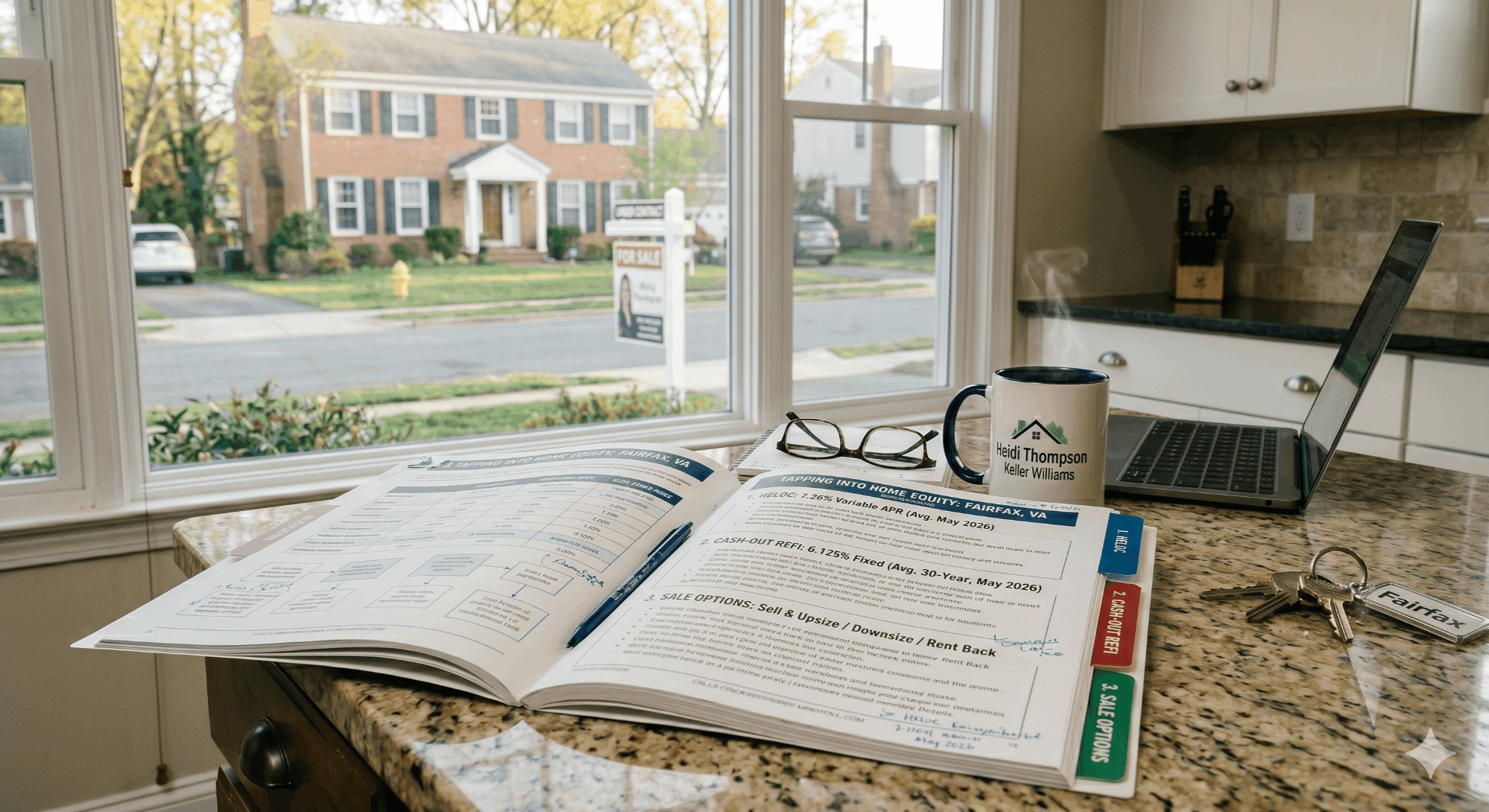
If you've owned a home in Fairfax for more than a few years, you're sitting on equity that has likely doubled since 2019 — and you have three meaningful ways to put it to work. A HELOC lets you borrow against your home like a credit line. A cash-out refinance replaces your existing mortgage with a larger one and gives you the difference in cash. Selling liquidates your full equity at once. Each path comes with different costs, tax treatment, and trade-offs against today's interest rate environment.
This guide breaks down the math for a Fairfax homeowner — including local property values across Mantua, Fair Lakes, Mosby Woods, and Country Club View — so you can decide whether borrowing against equity, refinancing into a new loan, or selling outright is the right move for your situation.
Quick Answer: For Fairfax homeowners with low-rate mortgages (under 4%), a HELOC is usually the cheapest way to access $50K–$200K of equity without disturbing the first mortgage. A cash-out refi only makes sense if current rates are at or below your existing rate — otherwise the math turns negative quickly. Selling unlocks your full equity tax-free up to $250K single / $500K married under IRS Section 121, and on a typical $850K Fairfax home, switching from a 3% listing agent to The Jamil Brothers' 1.5% full-service program keeps an extra $12,750 in your pocket at closing.
Key Takeaways
- The median Fairfax single-family home value rose from roughly $640K in 2019 to $880K+ in 2026, creating record tappable equity for long-tenured owners.
- HELOCs in Northern Virginia carry variable rates indexed to the Prime Rate (currently around 7.5%) and typically cost $0–$500 to open at credit unions.
- Cash-out refinances replace your full mortgage — only attractive when current rates beat your existing rate or you're consolidating high-interest debt.
- Selling unlocks 100% of your equity and qualifies for the IRS Section 121 capital gains exclusion ($250K single / $500K married filing jointly).
- Closing costs to sell in Fairfax County include Virginia grantor's tax (0.10%), the NOVA Congestion Relief Fee (0.15%), HOA transfer fees, and listing commission — total seller-side costs typically run 6–8% on a traditional sale.
- The Jamil Brothers' 1.5% full-service listing program saves the average Fairfax seller $12,000–$22,000 versus a traditional 3% listing agent with no reduction in marketing or service.
In This Guide
- Why Fairfax Homeowners Have Record Equity in 2026
- The Three Paths Compared at a Glance
- HELOC: Borrowing Without Touching Your First Mortgage
- Cash-Out Refinance: Replacing Your Existing Loan
- Selling: The Highest-Equity Path
- Fairfax County Closing Costs Broken Down
- Compare 3% vs 1.5% on Your Fairfax Home
- When Each Option Makes Sense — A Decision Framework
- Tax Implications: Section 121, Interest Deductions, & More
- Common Mistakes Fairfax Homeowners Make
- How to Choose a Listing Agent in Fairfax
- Frequently Asked Questions
- Glossary
Why Fairfax Homeowners Have Record Equity in 2026
Fairfax County has been one of the steadiest appreciating real estate markets in the United States over the past decade. According to BrightMLS, the median single-family home in the City of Fairfax and the surrounding Fairfax County zip codes (22030, 22031, 22032, 22033) climbed from approximately $640,000 in 2019 to $880,000+ in early 2026 — a 37% increase that translates into substantial tappable equity for anyone who bought before 2021.
The combination of strong school districts (Woodson, Robinson, and Lake Braddock pyramids), proximity to federal employers in Tysons and the Pentagon, and limited buildable land has kept inventory tight and prices climbing even during the higher-rate environment of 2023–2025. For long-tenured owners with sub-4% mortgage rates locked in during the pandemic, the question is no longer "do I have equity?" — it's "what's the smartest way to use it?"
| Fairfax Sub-Area | 2019 Median | 2026 Median | Equity Built |
|---|---|---|---|
| Mantua / Pickett (22031) | $685,000 | $925,000 | +$240,000 |
| City of Fairfax (22030) | $620,000 | $865,000 | +$245,000 |
| Fair Lakes / Fair Oaks (22033) | $655,000 | $895,000 | +$240,000 |
| Burke Centre / Robinson Pyramid (22032) | $605,000 | $835,000 | +$230,000 |
| Country Club View / Mosby Woods | $595,000 | $820,000 | +$225,000 |
Source: BrightMLS, NVAR market reports, Fairfax County Department of Tax Administration assessment data, 2026.
The Three Paths Compared at a Glance
Before going deep on each option, here's how the three equity-access strategies compare side-by-side on the factors that matter most: cost, speed, tax exposure, and how much of your equity you actually receive.
| Factor | HELOC | Cash-Out Refi | Sale |
|---|---|---|---|
| Equity Accessed | Up to 80–85% of value minus existing balance | Up to 80% of value minus existing balance | 100% of equity (less selling costs) |
| Closing Costs | $0–$500 (often waived) | 2–4% of new loan amount | 6–8% traditional / 4.5–6.5% at 1.5% |
| Interest Rate | Variable (Prime + margin, ~7.5%+) | Fixed (current 30-year market rate) | N/A — no debt |
| Timeline | 2–4 weeks | 30–45 days | 30–60 days |
| Tax Treatment | Interest deductible only if used for home improvement | Same as HELOC (improvement-only) | Up to $500K gain tax-free (Section 121) |
| Affects 1st Mortgage Rate | No | Yes — replaces it | N/A — mortgage paid off |
| Best For | Renovations, college, emergency fund | Debt consolidation, when rates favorable | Downsizing, relocating, major life change |
Before you choose between HELOC, refi, or sale, you need an accurate current market value for your Fairfax home. The Jamil Brothers provide a street-level comparable analysis — not an algorithm — within 24 hours, free.
HELOC: Borrowing Without Touching Your First Mortgage
A Home Equity Line of Credit (HELOC) is the most popular way for Fairfax homeowners with locked-in low pandemic-era mortgage rates to access equity in 2026. Unlike a refinance, a HELOC sits in second position behind your existing mortgage — your 3.25% loan stays untouched, and you only borrow what you need, when you need it.
How a HELOC Works
A HELOC is a revolving credit line secured by your home. Most Virginia lenders allow you to borrow up to 80% (sometimes 85%) of your home's appraised value minus your first-mortgage balance. The credit line has two phases: a draw period (usually 10 years) during which you can borrow, repay, and re-borrow, followed by a repayment period (typically 20 years) when no further draws are allowed and you pay down principal plus interest.
Typical Fairfax HELOC Math
| Item | Amount |
|---|---|
| Current home value | $880,000 |
| 85% loan-to-value ceiling | $748,000 |
| Existing first mortgage balance | −$380,000 |
| Maximum HELOC available | $368,000 |
| Estimated rate (Prime + 0.5%) | ~8.0% variable |
| Typical opening costs | $0–$500 |
HELOC Pros & Cons for Fairfax Owners
| ✓ Pros | ✗ Cons |
|---|---|
| Doesn't disturb your low-rate first mortgage | Variable rate — payments rise if Prime increases |
| Low or zero closing costs at most credit unions | Lender can freeze or reduce the line if values drop |
| Only pay interest on what you actually draw | Interest only deductible for home-improvement use |
| Reusable credit line during draw period | Payment shock when repayment phase begins |
| Closes in 2–4 weeks | Home is collateral — default risks foreclosure |
ℹ️ Northern Virginia HELOC Tip: Local credit unions including Apple Federal, Northwest Federal, NIH FCU, and Pentagon Federal frequently waive appraisal and closing fees on HELOCs in Fairfax County. Compare at least three lenders before signing — margins above Prime can vary by a full percentage point.
Cash-Out Refinance: Replacing Your Existing Loan
A cash-out refinance replaces your existing mortgage with a new, larger one and pays you the difference at closing. It made enormous sense in 2020–2021 when rates dipped below 3%, and it makes very little sense in 2026 for most Fairfax homeowners who locked in those rates and now face current 30-year fixed rates in the mid-6% range.
The Math Against You in 2026
Consider a Fairfax homeowner with a $380,000 balance at 3.25% who needs $100,000 cash. A cash-out refi for $480,000 at today's 6.5% would replace that 3.25% loan entirely. Their monthly principal-and-interest payment would jump from roughly $1,654 to $3,034 — a $1,380/month increase. Over 30 years, that's nearly $500,000 in extra interest just to access $100,000 today.
| Loan Detail | Current Loan | Cash-Out Refi |
|---|---|---|
| Balance | $380,000 | $480,000 |
| Interest Rate | 3.25% (pandemic) | 6.5% (current) |
| Monthly P&I | $1,654 | $3,034 |
| Monthly Increase | — | +$1,380 |
| Closing Costs (2.5% of new loan) | — | $12,000 |
| Net Cash Received | — | $88,000 |
When a Cash-Out Refi Still Makes Sense
There are narrow situations where a cash-out refi is still the right call in 2026: when your current rate is already at or above today's market rate (uncommon but possible for owners who bought between 2007–2014), when you're consolidating high-interest credit card debt above 18% and the new mortgage rate is meaningfully lower, or when you're using the proceeds for a major home improvement that will materially raise the property's value before sale.
⚠️ Watch the Break-Even Math: Cash-out refis carry closing costs of 2–4% of the new loan amount. On a $480,000 loan, that's $9,600–$19,200 paid at closing. Make sure your monthly savings (if any) recoup those costs in a reasonable timeframe — and that you actually plan to stay in the home long enough to benefit.
Selling: The Highest-Equity Path
Selling your Fairfax home unlocks 100% of your equity in a single transaction — no monthly debt service, no variable rate exposure, no interest paid over decades. For homeowners who are downsizing, relocating, moving up to a larger property, or simply ready for a change, selling is mathematically the cleanest way to access the value you've built.
How Much Cash You Actually Walk Away With
On a typical $880,000 Fairfax sale with a $380,000 remaining mortgage, your equity before transaction costs is $500,000. The question is how much of that survives the closing table — and that depends almost entirely on what listing commission you pay.
| Line Item | Traditional 3% Agent | Jamil Brothers 1.5% |
|---|---|---|
| Sale Price | $880,000 | $880,000 |
| Listing Commission | −$26,400 | −$13,200 |
| Buyer's Agent (negotiable, 2.5% typical) | −$22,000 | −$22,000 |
| VA Grantor's Tax (0.10%) | −$880 | −$880 |
| NOVA Congestion Fee (0.15%) | −$1,320 | −$1,320 |
| Title, Settlement, HOA Transfer | −$3,500 | −$3,500 |
| Mortgage Payoff | −$380,000 | −$380,000 |
| Net Cash to Seller | $445,900 | $459,100 |
Difference: +$13,200 in your pocket by listing with The Jamil Brothers' 1.5% full-service program versus a traditional 3% agent — same marketing, same negotiation, same MLS exposure.
Fairfax County Closing Costs Broken Down
Fairfax County sellers pay several Virginia-specific fees that don't exist in other states. Knowing these in advance prevents surprises at the settlement table.
| Fee | Rate or Amount | Who Pays |
|---|---|---|
| Virginia Grantor's Tax (state) | $1 per $1,000 of sale price (0.10%) | Seller |
| NOVA Congestion Relief Fee | $0.15 per $100 (0.15%) on sale price over $100K | Seller |
| Listing Commission | 3% traditional / 1.5% with Jamil Brothers | Seller |
| Buyer's Agent Commission | Negotiable post-NAR settlement (often 2–3%) | Negotiable |
| Settlement Agent / Title | $1,200–$2,500 depending on attorney | Split typically |
| HOA / Condo Resale Disclosure Packet | $150–$650 statutory limit | Seller |
| Deed Recording & Misc. | $50–$150 | Seller |
| Property Tax Proration | Per-diem from last paid date | Seller (credit to buyer) |
Source: Virginia Department of Taxation, Code of Virginia § 58.1-802 (state grantor tax), § 58.1-802.2 (NOVA regional congestion tax), Fairfax County Circuit Court Clerk fee schedule.
ℹ️ Section 121 Capital Gains Exclusion: If you've owned and used the home as your primary residence for at least 2 of the last 5 years, the IRS allows you to exclude up to $250,000 in capital gains if single or $500,000 if married filing jointly. For most Fairfax owners whose homes appreciated $200K–$400K, this means the entire gain is federally tax-free at sale — making the after-tax math on selling vastly more favorable than HELOC interest costs.
Our seller net sheet calculator breaks down every Fairfax County cost — commission, transfer taxes, congestion fee, settlement fees — so you know your real bottom line before you list.
Compare 3% vs 1.5% on Your Fairfax Home
Select your home's estimated value below to see exactly how much more you keep with The Jamil Brothers' 1.5% full-service listing program — same marketing, same negotiation, lower fee.
Seller Savings Calculator
How much more do you keep with our 1.5% listing fee?
Select your home's estimated value to see your real net proceeds — side by side.
Traditional Agent — 3%
| Sale price | $400,000 |
| Listing fee (3%) | −$12,000 |
| Buyer's agent (2.5%) | −$10,000 |
| Est. closing (1%) | −$4,000 |
| Net Proceeds | $374,000 |
Our Fee — Only 1.5%
| Sale price | $400,000 |
| Listing fee (1.5%) | −$6,000 |
| Buyer's agent (2.5%) | −$10,000 |
| Est. closing (1%) | −$4,000 |
| Net Proceeds | $380,000 |
Extra in your pocket
$6,000
vs. a traditional 3% listing agent — with zero reduction in service or marketing.
Traditional Agent — 3%
| Sale price | $500,000 |
| Listing fee (3%) | −$15,000 |
| Buyer's agent (2.5%) | −$12,500 |
| Est. closing (1%) | −$5,000 |
| Net Proceeds | $467,500 |
Our Fee — Only 1.5%
| Sale price | $500,000 |
| Listing fee (1.5%) | −$7,500 |
| Buyer's agent (2.5%) | −$12,500 |
| Est. closing (1%) | −$5,000 |
| Net Proceeds | $475,000 |
Extra in your pocket
$7,500
vs. a traditional 3% listing agent — with zero reduction in service or marketing.
Traditional Agent — 3%
| Sale price | $600,000 |
| Listing fee (3%) | −$18,000 |
| Buyer's agent (2.5%) | −$15,000 |
| Est. closing (1%) | −$6,000 |
| Net Proceeds | $561,000 |
Our Fee — Only 1.5%
| Sale price | $600,000 |
| Listing fee (1.5%) | −$9,000 |
| Buyer's agent (2.5%) | −$15,000 |
| Est. closing (1%) | −$6,000 |
| Net Proceeds | $570,000 |
Extra in your pocket
$9,000
vs. a traditional 3% listing agent — with zero reduction in service or marketing.
Traditional Agent — 3%
| Sale price | $750,000 |
| Listing fee (3%) | −$22,500 |
| Buyer's agent (2.5%) | −$18,750 |
| Est. closing (1%) | −$7,500 |
| Net Proceeds | $701,250 |
Our Fee — Only 1.5%
| Sale price | $750,000 |
| Listing fee (1.5%) | −$11,250 |
| Buyer's agent (2.5%) | −$18,750 |
| Est. closing (1%) | −$7,500 |
| Net Proceeds | $712,500 |
Extra in your pocket
$11,250
vs. a traditional 3% listing agent — with zero reduction in service or marketing.
Traditional Agent — 3%
| Sale price | $1,000,000 |
| Listing fee (3%) | −$30,000 |
| Buyer's agent (2.5%) | −$25,000 |
| Est. closing (1%) | −$10,000 |
| Net Proceeds | $935,000 |
Our Fee — Only 1.5%
| Sale price | $1,000,000 |
| Listing fee (1.5%) | −$15,000 |
| Buyer's agent (2.5%) | −$25,000 |
| Est. closing (1%) | −$10,000 |
| Net Proceeds | $950,000 |
Extra in your pocket
$15,000
vs. a traditional 3% listing agent — with zero reduction in service or marketing.
Estimates only. Closing costs vary. Buyer's agent commission is negotiable.
TheJamilBrothers.com · (703) 782-4830
When Each Option Makes Sense — A Decision Framework
Here's a practical framework for matching the right equity-access tool to your specific situation.
Choose a HELOC if…
Signals That Point to a HELOC
- You have a sub-4% first mortgage you don't want to disturb
- You need flexible access (renovation, college tuition spread over years, emergency reserve)
- The amount you need is under $250,000
- You can stomach variable-rate exposure or expect to pay it off within 2–5 years
- You plan to stay in the home for at least another 3–5 years
Choose a Cash-Out Refi if…
Signals That Point to a Cash-Out Refi
- Your existing rate is at or above the current 30-year fixed rate
- You're consolidating high-interest debt above 15–18%
- You need a large lump sum ($200K+) at a fixed rate
- You plan to stay long enough to recoup the closing costs (typically 5+ years)
- You don't want variable-rate exposure
Choose to Sell if…
Signals That Point to Selling
- You're downsizing, relocating, or moving up to a different property
- You need the full equity (over $500K) and don't want long-term debt
- The home no longer fits your life (empty nest, divorce, job change, retirement)
- You've met the IRS Section 121 2-of-5-year residency requirement
- You want to redeploy capital — into another property, retirement, or investments
- You don't want the ongoing cost, maintenance, or tax burden of the current home
Relative Effective Cost — Visual Comparison
The chart below shows the relative all-in cost of accessing $100,000 of equity using each method, assuming the borrower holds the loan or sells within 5 years.
Illustrative figures: HELOC assumes ~8% variable rate over 5 years; cash-out refi assumes the spread between a 3.25% existing rate and a new 6.5% rate on a $480K balance. Sale costs assume an $850K Fairfax home with full transaction costs prorated to the $100K equity slice.
Professional photography, drone video, 3D tours, expert negotiation, and full MLS marketing — all included at 1.5%. On an $880K Fairfax home, you keep an extra $13,200 versus a traditional 3% listing agent.
Tax Implications: Section 121, Interest Deductions & More
Taxes are often the deciding factor in which path to take. Here are the rules every Fairfax homeowner should understand before deciding.
HELOC & Cash-Out Refi Interest Deductibility
Under the 2017 Tax Cuts and Jobs Act (TCJA), interest on HELOCs and cash-out refinances is only deductible when the borrowed funds are used to "buy, build, or substantially improve" the home that secures the loan. Money used for college tuition, debt consolidation, vehicle purchases, or general living expenses is no longer deductible. This rule is in effect through 2025 and is widely expected to be extended.
IRS Section 121 — The Best Tax Break in Real Estate
If you sell your primary residence after owning and using it as your main home for at least 2 of the previous 5 years, you can exclude up to $250,000 in capital gains if you file single, or $500,000 if you're married filing jointly. There is no age limit and no requirement to reinvest in another home. For most Fairfax sellers, this single rule shelters the entire gain from federal tax.
ℹ️ Section 121 Example — Fairfax Couple: Married couple bought a Mantua home in 2014 for $580,000 and is now selling for $920,000 in 2026. Adjusted basis (after capital improvements and selling costs) is $620,000. Taxable gain: $300,000. Section 121 exclusion: $500,000. Federal tax owed: $0. Virginia state tax owed: $0 (Virginia conforms to the federal exclusion).
Virginia State Considerations
Virginia conforms to the federal Section 121 exclusion, meaning gains excluded federally are also excluded from Virginia income tax. The grantor's tax (0.10%) and NOVA Congestion Relief Fee (0.15%) are paid at closing by the seller and are not income taxes — they are transaction taxes baked into the closing settlement statement.
⚠️ Not Tax Advice: This article summarizes IRS rules in plain English. Before making a final decision, consult a CPA familiar with Virginia real estate transactions to confirm your basis calculation, capital improvement records, and exclusion eligibility.
Common Mistakes Fairfax Homeowners Make
Watch Out For These Costly Errors
- Refinancing out of a sub-4% rate to access cash when a HELOC would have done the job for a fraction of the long-term cost
- Using HELOC funds for non-deductible purposes (cars, tuition) without realizing the interest will no longer reduce taxable income
- Ignoring the variable-rate risk on a HELOC — Prime Rate adjustments can push payments 30–50% higher
- Selling without verifying Section 121 eligibility (2-of-5-year occupancy rule)
- Forgetting to subtract Virginia transaction taxes (grantor + congestion fee) when calculating expected net proceeds
- Failing to interview multiple listing agents and assuming 3% is the only available commission structure
- Underestimating staging, repair, and pre-listing costs — which average $3K–$10K on a Fairfax single-family home
- Not running a side-by-side comparison of HELOC vs. cash-out refi vs. sale before committing to a path
How to Choose a Listing Agent in Fairfax
If selling turns out to be your best path, choosing the right listing agent has more impact on your final check than almost any other decision. Use objective criteria — not flashy marketing — to evaluate candidates.
Objective Criteria for Evaluating a Fairfax Listing Agent
- Local production volume: how many homes have they sold in Fairfax County in the past 12 months?
- List-to-sale price ratio: are their listings closing at, above, or below list?
- Average days on market vs. the local average for similar properties
- Marketing package: 4K photography, drone, 3D tour, video walkthrough, MLS syndication
- Commission structure: total fee, what's included, and whether there are referral or admin fees
- Review quality and quantity across Google, Zillow, and Realtor.com — and recency
- Negotiation experience with multiple-offer situations and contingency removals
- Direct partner-level access (not handed off to a junior agent or assistant)
The Jamil Brothers Realty Group has closed 840+ homes and over $500M in volume across Northern Virginia, ranks among NVAR's Lifetime Top Producers, and holds 500+ five-star reviews across Google, Zillow, and Realtor.com. The 1.5% full-service listing program includes professional 4K photography, drone aerial video, 3D Matterport tours, full MLS and syndication marketing, and partner-led negotiation handled directly by Saad Jamil or Arslan Jamil.
If timing, condition, or certainty matters more than maximum price — for example, an inherited Fairfax property or a relocation deadline — a cash offer may be the right fit. We'll walk you through your full range of options. No pressure.
Frequently Asked Questions
Is it better to HELOC, cash-out refinance, or sell my Fairfax home in 2026?
It depends on three things: your current mortgage rate, how much cash you need, and whether you want to stay in the home long-term. Fairfax owners with sub-4% pandemic-era rates almost always favor a HELOC over a cash-out refi because the refi replaces the low-rate first mortgage. If you want to liquidate full equity, no longer need the home, and qualify for the IRS Section 121 exclusion, selling typically nets the highest after-tax dollars — especially with a 1.5% listing fee instead of the traditional 3%.
How much equity can I borrow on a HELOC in Fairfax, Virginia?
Most Northern Virginia lenders allow combined loan-to-value (CLTV) up to 80–85%. That means your first mortgage plus the HELOC together can equal up to 85% of your home's appraised value. On an $880,000 Fairfax home with a $380,000 first mortgage, your maximum HELOC line is typically $368,000 (at 85% CLTV). Some local credit unions, including Apple Federal and Pentagon Federal, offer higher CLTVs to members with strong credit profiles.
What does it cost to sell a home in Fairfax County, Virginia?
Total seller costs in Fairfax County typically run 6–8% of the sale price with a traditional 3% listing agent, or 4.5–6.5% with The Jamil Brothers' 1.5% full-service program. Costs include listing commission, buyer's agent commission (negotiable post-NAR settlement), Virginia grantor's tax of 0.10%, the Northern Virginia Congestion Relief Fee of 0.15%, settlement and title fees of $1,200–$2,500, HOA resale disclosure packet fees of $150–$650, and property tax prorations. On an $880,000 home, this means closing costs around $52,800 (traditional) or $39,600 (Jamil Brothers 1.5%).
How long does it take to sell a home in Fairfax versus closing a HELOC?
A typical Fairfax sale takes 30–60 days from listing to closing — about 10–14 days on market in 2026's tight inventory environment, plus 30–45 days for settlement. A HELOC closes in 2–4 weeks at most banks and credit unions; a cash-out refinance takes 30–45 days. If speed is the deciding factor and you need cash quickly without selling, a HELOC is fastest.
Do I owe capital gains tax when I sell my Fairfax home?
If the home has been your primary residence for at least 2 of the last 5 years, IRS Section 121 lets you exclude up to $250,000 in gain if you file single, or $500,000 if married filing jointly. For most Fairfax owners, this single exclusion makes the entire gain federally tax-free. Virginia conforms to the federal exclusion, so no state tax is owed either. Investment properties, second homes, and rentals don't qualify and require either a Section 1031 exchange or paying long-term capital gains tax of 15–20% federal plus 5.75% Virginia.
What changed for buyer's agent commissions after the NAR settlement?
Following the August 2024 NAR settlement, buyer's agent compensation is no longer pre-advertised on the MLS as part of the listing agreement. Sellers are no longer required to offer compensation to a buyer's agent — though most still choose to in order to remain competitive. In Northern Virginia, sellers commonly offer 2–2.5% to buyer's agents, but this is fully negotiable on each transaction. Your listing agent should walk you through the math on whether to offer a buyer-agent concession and at what level.
Is HELOC interest tax-deductible in Virginia?
HELOC interest is federally deductible only when the borrowed funds are used to "buy, build, or substantially improve" the home that secures the loan, per the 2017 Tax Cuts and Jobs Act. Funds used for personal expenses, debt consolidation, college tuition, or vehicle purchases are not deductible. Virginia conforms to the federal rule on the state income tax side. Keep clear records of how HELOC proceeds are spent — your CPA will need them to support any deduction claim.
What's the current Fairfax County housing market doing in 2026?
The Fairfax County market in 2026 remains a seller's market on most price points under $1.2M. According to BrightMLS data, median single-family homes in zip codes 22030, 22031, 22032, and 22033 are selling in 10–18 days at 99–101% of list price. Townhome and condo inventory has loosened slightly, but well-prepared single-family listings still see multiple offers. Pricing slightly below market value with strong photography and staging continues to drive the best results.
How do I avoid HOA delays when selling in Fairfax?
Virginia's Property Owners' Association Act requires sellers to deliver an HOA resale disclosure packet within 14 days of buyer request. Order yours from the HOA management company the moment you list — many Fairfax HOAs charge $150–$650 (statutory cap) and take 7–14 days to produce. If your community has a condo association rather than an HOA, the Virginia Condominium Act applies and the packet requirements differ slightly. Delays here are one of the most common reasons Fairfax closings slip past the contracted settlement date.
What mistakes should I avoid when tapping home equity?
Five mistakes come up repeatedly: (1) refinancing a sub-4% first mortgage just to access cash when a HELOC would do the job, (2) using HELOC or refi proceeds for non-deductible purposes without understanding the tax impact, (3) ignoring variable-rate risk on a HELOC, (4) underestimating selling closing costs (especially the NOVA congestion fee), and (5) defaulting to a 3% listing agent without evaluating full-service alternatives like the 1.5% program. Each can cost five to six figures over the life of the decision.
How do I choose the right listing agent in Fairfax County?
Evaluate listing agents on objective criteria: 12-month Fairfax County production volume, list-to-sale price ratio, average days on market, marketing package depth (4K photography, drone, 3D tour), commission structure transparency, recency and quantity of five-star reviews, and whether the agent is partner-level or hands you off to a junior team member. The Jamil Brothers Realty Group operates as a partner-led team with 840+ homes sold, $500M+ in closed volume, and a 1.5% full-service listing program that includes all professional marketing assets and direct partner negotiation.
Can I use a HELOC to buy my next home before selling my current Fairfax home?
Yes — this is a common strategy called "bridging" your purchase. Open a HELOC on your current Fairfax home while it still has the lower CLTV, use the line to fund a down payment on the next home, then pay off the HELOC when your current home sells. The benefits are avoiding a contingent offer and competing for the next home as a cash-equivalent buyer. The risk is carrying two mortgages plus the HELOC if the current home takes longer to sell than expected, so this strategy is best executed with a clear timeline and a strong listing plan.
Glossary
HELOC
Home Equity Line of Credit — a revolving credit line secured by your home, sitting in second position behind your first mortgage. Variable rate, low closing costs.
Cash-Out Refinance
A new mortgage that replaces your existing one for a larger balance, paying you the difference at closing. Fixed rate but typically 2–4% in closing costs.
Section 121 Exclusion
IRS rule allowing exclusion of up to $250K (single) or $500K (married filing jointly) in capital gains on the sale of a primary residence, provided the 2-of-5-year ownership and use test is met.
Grantor's Tax
Virginia state transfer tax of $1 per $1,000 of sale price (0.10%), paid by the seller at closing.
NOVA Congestion Relief Fee
Northern Virginia regional transportation tax of $0.15 per $100 (0.15%) on home sales above $100K, paid by the seller.
CLTV (Combined Loan-to-Value)
The total of all loans secured by the home (first mortgage + HELOC) divided by the home's appraised value. Most lenders cap CLTV at 80–85%.
Prime Rate
The benchmark short-term interest rate banks charge their most creditworthy customers. Most HELOCs are priced as Prime plus a margin (e.g., Prime + 0.5%).
Net Proceeds
The amount of cash a seller actually receives at closing after subtracting commission, transfer taxes, settlement fees, mortgage payoff, and prorations from the sale price.
Conclusion: Match the Tool to the Goal
The right way to tap into Fairfax home equity depends entirely on what you're trying to accomplish. If you love your house, your rate, and your life there — and you need flexible access to a portion of your equity — a HELOC is almost always the best fit. If current rates favor your existing rate and you need a large, fixed-rate lump sum, a cash-out refinance can work. If your life is moving on, the home no longer fits, or you simply want to liquidate the equity you've built with no debt and no monthly cost, selling is the cleanest, highest-return path — especially when paired with a 1.5% full-service listing fee.
Before you decide, run the numbers all three ways. Get a current valuation, calculate your real net proceeds, and compare the all-in cost of borrowing against your equity versus liquidating it. The team at The Jamil Brothers provides all of this — free, no obligation — for Fairfax homeowners considering their options.
Know your real Fairfax equity, understand your costs, and see exactly what you'd walk away with at sale — before you make any decisions. The Jamil Brothers provide a full seller consultation at no cost or obligation.
Explore More Fairfax & Northern Virginia Guides
Fairfax McLean Vienna Reston Herndon Centreville Chantilly Ashburn 1.5% Listing Program Seller Net Sheet Free Home ValuationCategories
- All Blogs (1243)
- Buyer Guide (8)
- Buying a home (2)
- Buying Strategies (31)
- festivals (1)
- General Blog (67)
- Market Intelligence (29)
- Market Updates (8)
- Notable Properties For Sale (32)
- Real Estate Tips, News, and More (395)
- Seller Guide (2)
- Seller Guides (60)
- Selling Your Home (527)
- Top Realtors in Northern Virginia (58)
Recent Posts






Let's Connect