
Workhouse Arts Center & Laurel Hill: How Lorton Went From Prison Town to Hot Market
For most of the twentieth century, Lorton had one association, and it was not a good one. This is where Washington, D.C. sent its prisoners, on a site that eventually sprawled to 3,500 acres and ran for ninety-one years. If you grew up in Northern Virginia before 2001, "Lorton" meant the prison, full stop.
That prison closed, the county bought the land for a price that still looks like a typo, and what replaced it is one of the most complete reinventions any American suburb has pulled off. Today the cell blocks are apartments, the workhouse is an arts centre, the farmland is a golf course, and there is a high school on the site. This guide covers what actually happened, what Lorton is now, and what it costs to live there, from us as Fairfax County real estate agents who list homes here for a 1.5% full-service fee rather than the traditional 3%.
Quick Answer: Lorton is in southern Fairfax County, ZIP 22079, about 20 miles from Washington. From 1910 to 2001 it housed the D.C. Workhouse and Reformatory, which peaked around 3,500 acres. The last prisoners left in November 2001.
In July 2002 Fairfax County bought 2,324 acres of it for $4.2 million. Roughly 1,200 acres became parkland. The rest became three public schools, new housing, and the Workhouse Arts Center, a 55-acre cultural campus in the old workhouse buildings.
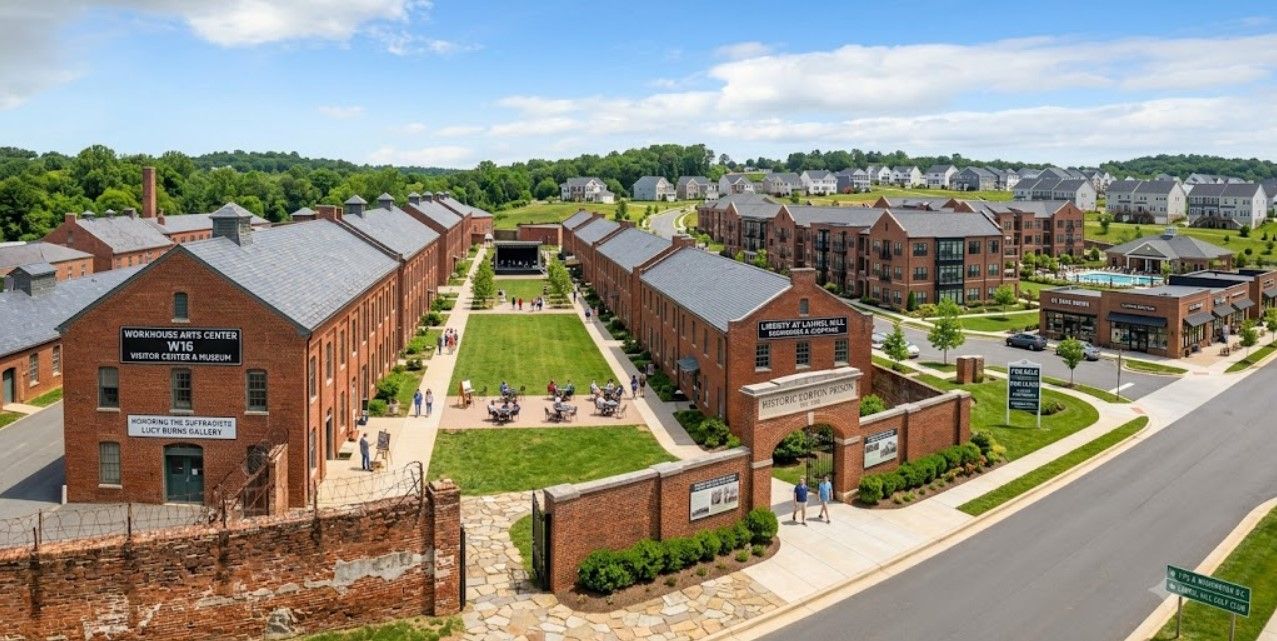
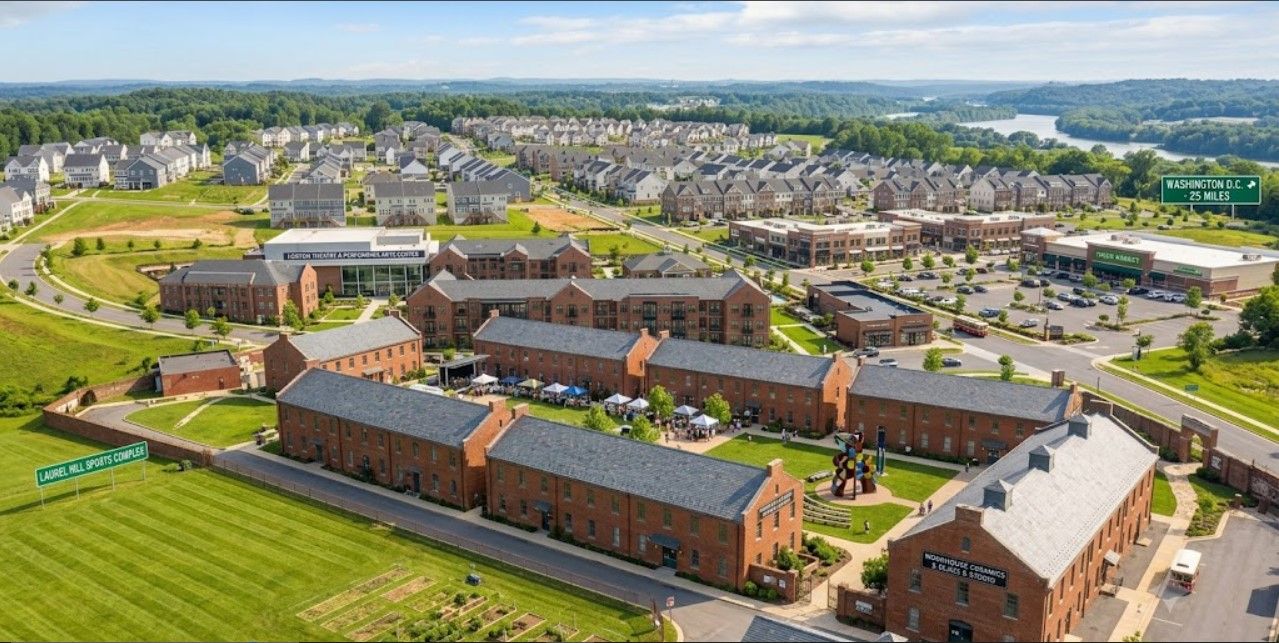
That land is now Laurel Hill: a golf course, an equestrian centre, roughly 10 miles of trails, disc golf, community gardens. South County High School opened on the former prison site in 2005. In 2017 the old reformatory and penitentiary buildings reopened as Liberty, a residential community inside the actual prison walls.
Recent data puts the Lorton median sale price around $715,000, up modestly year over year. Housing runs from 1960s cottages to 2000s townhomes and new construction. Schools are the South County pyramid, which is unusually clean: no split feeders. Verify any specific figure and address before acting on it.
Key Takeaways
- Ninety-one years a prison: the D.C. Workhouse and Reformatory ran here from 1910 until November 2001.
- Fairfax County paid $4.2 million for 2,324 acres in 2002. It is arguably the best land deal in county history.
- About 1,200 acres became parkland, which is why Laurel Hill has a golf course and 10 miles of trails.
- The suffragists were imprisoned here in 1917. The Night of Terror happened on this ground.
- You can live inside the old prison: Liberty opened in the reformatory buildings in 2017.
- South County pyramid has no split feeders, which is rare in Fairfax and genuinely simplifies buying.
- Liberty Market brought a Lidl and a climbing gym to the old prison grounds, with 352 new homes around it.
- Median around $715,000, with VRE, the Auto Train, I-95 and Fort Belvoir all shaping demand.
On This Page
- What Lorton was: 1910 to 2001
- The Night of Terror
- The $4.2 million land deal
- Prison to park: the timeline
- What Laurel Hill is now
- The Workhouse Arts Center
- Liberty: living in the old prison
- Liberty Market: Lidl, climbing, retail
- What the Lorton market looks like
- What you can actually buy
- South County: the pyramid with no split feeders
- Commuting: VRE, I-95, Fort Belvoir
- Who Lorton actually suits
- Selling a home in Lorton
- Frequently asked questions
- Glossary
What Lorton Was: 1910 to 2001
The story starts with prison reform, which surprises people. The Occoquan Workhouse opened in 1910 as a prison farm for the District of Columbia, built for nonviolent offenders serving short sentences. The original idea was progressive for its era: open land, work, air, no high walls. D.C. added an adjacent reformatory in 1914.
The idealism did not hold. Between 1931 and 1938 inmates built a ten-acre walled penitentiary on the site, a maximum-security division of the reformatory, and the complex grew from there. At its peak it covered roughly 3,500 acres.
The strangest fact about it is jurisdictional. This was the District of Columbia's prison, sitting in Fairfax County, Virginia. D.C. shipped its incarcerated population twenty miles south into another jurisdiction for ninety-one years. Fairfax got the traffic, the reputation, and none of the say, which is a large part of why the county wanted the land so badly when the end finally came.
Congress ordered it closed in the late 1990s. The last prisoners were transferred out in November 2001.
The Night of Terror
Before anything about golf courses and townhomes, this part deserves to be said plainly, because it happened on the ground people now walk their dogs across.
Between June and November 1917, women arrested for picketing the White House were sent here. They were the Silent Sentinels, most of them from the National Woman's Party, and roughly 168 of them passed through the Occoquan Workhouse. They were political prisoners in every meaningful sense: their crime was standing outside the White House with banners asking for the vote.
On the night of 14 November 1917, on the orders of workhouse superintendent W. H. Whittaker, guards attacked them. Lucy Burns was handcuffed with her hands above her head and left standing all night. Dora Lewis was thrown into a cell hard enough that her head struck an iron bed frame and knocked her unconscious. It became known as the Night of Terror, and the reporting of it moved public opinion on suffrage in a way years of polite argument had not.
It is not buried history: the Lucy Burns Museum sits at the Workhouse Arts Center today, and the Turning Point Suffragist Memorial is nearby at Occoquan Regional Park. If you live in Lorton, this is your local history, and it is worth an afternoon.
Hold that alongside what the site is now. A place built to hold people who could not vote is currently a public park with an arts centre and a museum about the women who were beaten there. That is a genuinely unusual thing for a suburb to be built on top of, and it is why Lorton's story is not really a real estate story with history attached; it is a history story that produced a housing market.
The $4.2 Million Land Deal
Here is the number that makes Fairfax County officials smile.
In 1998 Representative Tom Davis introduced legislation to close the prison and transfer the site to the Fairfax County Board of Supervisors. On 15 July 2002, after surveying and covenants, 2,324 acres transferred to Fairfax County for $4.2 million.
Do the arithmetic on that. Roughly $1,800 an acre, inside Fairfax County, twenty miles from Washington, in 2002. A single quarter-acre building lot in this county can sell for many multiples of that today. The county acquired an area larger than most towns for less than the price of a decent house in McLean.
The deal, in short: 2,324 acres · transferred 15 July 2002 · $4.2 million total · roughly 1,200 acres set aside as parkland · remainder for three public schools, housing, and the Workhouse Arts Center · the whole site listed as the D.C. Workhouse and Reformatory Historic District in February 2006
The decision that shaped everything afterwards was setting aside roughly half of it as parkland rather than selling it all to builders. That single choice is why Lorton today has a golf course, an equestrian centre and ten miles of trails instead of another six thousand houses, and it is a large part of what people are actually buying when they buy here.
Prison to Park: The Timeline
Ninety-one years of prison and twenty-odd years of reinvention, in order.
From Occoquan Workhouse to Laurel Hill
How a 3,500-acre prison became a Fairfax County suburb
Dates and figures from Fairfax County, the National Park Service and public records. Development phases continue; confirm current status before relying on any detail.
What Laurel Hill Is Now
The name is older than the prison. Laurel Hill was the home of William Lindsay, a Revolutionary War patriot, dating to 1766, and the county reached back past the twentieth century for a name rather than keep the one everybody associated with barbed wire. That was a deliberate act of rebranding and, commercially, it worked.
What roughly 1,200 acres of parkland bought the area is a list most Fairfax communities cannot match:
- Laurel Hill Golf Club, a public course widely rated among the better ones in the region.
- Around 10 miles of trails, including the Cross County Trail through the property.
- An equestrian centre, which is not a phrase you expect inside the Beltway's orbit.
- A disc golf course, a central green, and community gardens.
- Athletic fields and open space, with more phased in over time.
That mix also makes Lorton one of the few places in the county where you can move to something newer and smaller without leaving the area you already know, which is the whole problem our guide to downsizing in Fairfax is built around.
Then the housing went in around it. That sequencing matters and is the opposite of how most suburbs happen: here the park came first, by policy, and the homes were fitted around it. Buyers feel the difference even when they cannot articulate it, and it is a big part of why Lorton reads differently from subdivisions of the same vintage elsewhere in the county. If you want to see how it compares with the rest of the region, our communities across Northern Virginia lay the options side by side.
The Workhouse Arts Center
The Workhouse Arts Center occupies fifty-five acres of the original workhouse buildings off Workhouse Road, and it is the piece of this story that does the most cultural work.
It houses working artist studios, galleries, performance and theatre space, classes, and events through the year. Crucially, it is a real, functioning arts campus rather than a plaque on a wall. The buildings are the prison buildings; you walk the same corridors, and the brickwork does not let you forget what it was.
The Lucy Burns Museum sits within it, telling the story of the workhouse and the suffragists directly. That combination, working artists inside a preserved prison with a museum about political prisoners at its centre, is unusual anywhere and unique in Northern Virginia.
Why a real estate guide cares: an arts centre is not a granite countertop, but it is the reason Lorton has a cultural identity to point at instead of just an interstate exit. Places with an identity hold value differently from places without one, and that is a quieter, more durable advantage than any single amenity.
Liberty: Living in the Old Prison
This is the part that stops people mid-sentence at a dinner party. You can live in the prison.
Phase I of the adaptive reuse of the historic reformatory and penitentiary buildings completed and opened in spring 2017, under the name Liberty, with the residential piece including Liberty Crest Apartments. The historic structures were preserved, because the Historic District listing required it, and converted into homes.
The numbers behind it are worth knowing. Fairfax County brought in the Alexander Company, a Wisconsin developer specialising in historic preservation, back in 2008. The conversion ran roughly $64 million and took the better part of two years, funded largely through historic tax credits, bond financing and low-income housing tax credits.
What that produced is 165 apartments — 84 one-bedroom and 81 two-bedroom — with rents that have run roughly $1,372 to $2,700. And because of how it was financed, 44 of those 165 units are designated affordable. In a ZIP with a $715,000 median, that is a genuinely unusual thing to exist, and it is a direct consequence of the tax-credit structure that made preserving the buildings viable in the first place.
The result is genuinely distinctive housing stock: original brick laid by prisoners in the 1920s, unusual proportions, a courtyard layout that came from a prison rather than a pattern book. There is no other product like it in Fairfax County. It attracts people who want somewhere with a story, and it repels people who find the idea unsettling, which is worth knowing on both sides of a transaction.
As a market matter, distinctive is a double-edged asset. It narrows your buyer pool and deepens it at the same time: fewer people want it, but the ones who do want it specifically and cannot get it anywhere else. Pricing that correctly requires understanding which effect is dominant at the moment, which is exactly the kind of judgement your agent should be able to explain to you rather than guess at.
Liberty Market: Lidl, Climbing, and the Retail That Followed
Housing and an arts centre do not, by themselves, make a market move. Groceries do. This is the part of the Lorton story that gets least attention and probably matters most to daily life.
Liberty Market is a commercial development on the old prison grounds, at Silverbrook Road and White Spruce Way, being built out by Elm Street Development. It is the same adaptive-reuse trick as the rest of the site: historic prison buildings re-used as retail, mixed with new Class A construction rather than replaced by it.
- Roughly 50,000 square feet of Class A retail, plus about 35,000 square feet of office and flex space in the historic buildings.
- A 30,000-square-foot Lidl anchors it. A full-size grocery on site is the single biggest quality-of-life change the redevelopment has delivered.
- Sportrock Climbing took the P-12 building — the reformatory's former dining hall, now a climbing gym. It had originally been earmarked for a brewery or restaurant.
- 352 upscale residential units surround the commercial piece. Sales have concluded and construction is complete.
- Under a mile from I-95 at Exit 163 and the Express Lanes.
The demographics the developers market to tell you who Lorton is now: within a three-mile radius, roughly 68,000 people and average household incomes above $150,000. That is the profile retailers underwrite against, and it is not the profile anyone would have written for Lorton in 2001.
Why this belongs in a real estate guide: grocery anchors are one of the most reliable leading indicators in residential real estate. A national chain committing to a 30,000-square-foot box is a bet on rooftops and incomes within a few miles, made by people with money at stake. When the grocery arrives, the market has already been validated by someone other than a listing agent.
There is a further irony worth sitting with. You can now buy your groceries, climb a wall in the old mess hall, and drive home to an apartment in a cell block, all on land that was a working prison farm inside living memory.
What the Lorton Market Looks Like
Let us be careful with the word "hot," because it is doing a lot of work in headlines and not much in reality.
Recent data puts Lorton's median sale price around $715,000, up roughly 3% year over year. That is not a frenzy. What it is, is a market that has completely re-rated over two decades: an area that carried a genuine stigma in 2001 now sits at a median a good way above the national picture, in the same county as McLean and Great Falls, with about 40% of households having children.
There is a quieter consequence of that re-rating. Anyone who bought in Lorton before the prison closed, or in the first years of Laurel Hill, is sitting on an amount of equity they may not have tracked, and selling is not the only way to reach it. Our guide to home equity loans in Lorton, VA covers the rates, LTV limits and the application process.
Shop that rate, though. Whoever holds your mortgage is rarely the best offer on the table, and our comparison of Lorton bank equity rates against competitors is worth ten minutes before you sign anything.
The honest version of "hot market" is not that Lorton is spiking this quarter. It is that Lorton stopped being discounted. The prison discount is gone, and what replaced it is a normal, well-amenitised southern Fairfax market priced on schools, commute and parkland like everywhere else.
On that median: $715,000 is a snapshot from recent public data, not a valuation of your home, and medians move. A 1960s cottage and a new Laurel Hill single-family are both "Lorton" and are not remotely the same sale. Treat it as directional and get a real figure for your address.
The 22079 ZIP covers the whole of it, Laurel Hill included, which means ZIP-level statistics blend several genuinely different housing types into one number. It is the same problem we flag across the county in our Fairfax County ZIP code guide: the ZIP is a mail route, not a market.
What You Can Actually Buy
Lorton's inventory splits into three distinct products, and knowing which one you are shopping changes everything about the transaction.
| Type | Roughly when | What to know |
|---|---|---|
| Older Lorton cottages and ramblers | 1960s onward | The pre-prison-closure housing. Smaller, more attainable, most likely to need systems work. |
| 1980s and 90s subdivisions | 1978–1995ish | Solid, established, and squarely in the polybutylene plumbing window. |
| Laurel Hill new construction | 2000s onward | Single-family and townhomes built around the park. The bulk of the modern market. |
| Liberty / adaptive reuse | 2017 onward | Homes inside the historic prison buildings. Unique, polarising, thin comps. |
That second row deserves attention if you are buying or selling one. Homes plumbed between roughly 1978 and the mid-1990s can contain polybutylene pipe, which insurers dislike and inspectors flag immediately, and Lorton has plenty of housing from exactly that era. Our guide to polybutylene pipes in 1980s and 90s homes covers how to identify it and what it does to a sale.
Those same cottages are the entry point into Fairfax County for a lot of people, which is why so many of them turn over as somebody's first sale rather than their fifth. If that is you, selling your first home in Fairfax walks through the parts nobody warns you about.
The older cottages carry a different risk. Decades of owner improvements on modest houses is precisely the profile where finished basements and additions went in without permits, and that surfaces at the worst possible moment. If you are selling one, read our guide to selling a house with unpermitted work before you list, not after the inspection.South County: The Pyramid With No Split Feeders
We spend a lot of words across this blog warning people that Fairfax school boundaries split neighbourhoods and that you must verify the address. Lorton is the pleasant exception, and it is worth saying so.
South County High School opened in 2005 on the site of the former reformatory. The South County pyramid is one of the newest in FCPS and one of the most straightforward in the county: every elementary school feeds cleanly into South County Middle School and then South County High School, with no split feeders. If you have shopped elsewhere in Fairfax and been driven mad by streets that split between two high schools, you will appreciate what that means.
South County has been recognised as Distinguished under state and federal performance measures and ranks well among Northern Virginia high schools. For a school built two decades ago on a prison site, that is a remarkable trajectory in itself.
Still verify, but breathe easier: a clean pyramid reduces the risk, it does not eliminate it. Boundaries can be redrawn as enrolment shifts, and parts of greater Lorton sit near edges. Check the specific address against the official FCPS boundary lookup before you offer, and again near closing.
Interactive · Commission Savings
Selling in Lorton? Keep More With a 1.5% Listing Fee
Pick your Lorton home value:
Typical 3% Listing Fee
Your Estimated Savings
$6,000
Kept in your pocket versus a traditional 3% listing fee.
Typical 3% Listing Fee
Your Estimated Savings
$7,500
Kept in your pocket versus a traditional 3% listing fee.
Typical 3% Listing Fee
Your Estimated Savings
$9,000
Kept in your pocket versus a traditional 3% listing fee.
Typical 3% Listing Fee
Your Estimated Savings
$11,250
Kept in your pocket versus a traditional 3% listing fee.
Typical 3% Listing Fee
Your Estimated Savings
$15,000
Kept in your pocket versus a traditional 3% listing fee.
Estimates compare a 3% listing-side fee to our 1.5% listing fee. Full-service representation either way. Buyer's-agent compensation is separate and negotiable.
Commuting: VRE, I-95, Fort Belvoir
Lorton's location is the quiet engine under the whole market, and it is more interesting than "it is on I-95."
| Option | What it gives you |
|---|---|
| Lorton VRE station | Fredericksburg line, weekday commuter rail to Crystal City, Alexandria and Washington Union Station. Roughly 40 to 50 minutes to D.C., with free parking. |
| I-95 | The spine north to Alexandria, Arlington and D.C., south toward Woodbridge and Fredericksburg. |
| Fort Belvoir | Immediately adjacent. A major, stable employment anchor and a large share of the local buyer pool. |
| Richmond Highway (Route 1) | The surface alternative north, and a corridor under long-term revitalisation. |
| Amtrak Auto Train | Lorton is the northern terminus of the only Auto Train in the country, running to Sanford, Florida. About a mile from the VRE station. |
The Auto Train is a genuine curiosity worth knowing. You drive your car onto the train in Lorton and collect it in Florida the next morning. It is a piece of national transportation infrastructure whose northern end is, of all places, here. Retirees with a second home in Florida find that a meaningful amenity, and it quietly widens the Lorton buyer pool in a way no other Fairfax community shares.
Fort Belvoir matters more than the trains, though. A large adjacent installation means steady demand from people who cannot easily choose to live somewhere else, and military and federal buyers behave differently from discretionary ones: less cyclical, more schedule-driven. That underpins the market here in ways a median price does not show.
It cuts the other way too. Orders move people out of Lorton on someone else's schedule, which is a very different sale from a discretionary one, and our guide to selling a Fairfax home when relocating covers how to run a listing you cannot personally attend.
Who Lorton Actually Suits
Being honest about fit, including where it does not fit.
- The I-95 or Fort Belvoir commuter. If you work south of Alexandria, this location does something no amount of charm elsewhere can.
- Families who want a clean school pyramid. No split feeders is a real, rare simplification in this county.
- People who want newer construction in Fairfax. Laurel Hill is among the county's youngest inventory, which is scarce inside Fairfax.
- The outdoors household. A golf course, ten miles of trails, an equestrian centre and disc golf, all from one land decision in 2002.
- Buyers who want a story. Liberty is the only place in the county where "we live in the old prison" is a true sentence.
- Not for you if you need Metro rail, a walkable town centre of the Vienna or Reston sort, or an inside-the-Beltway commute. Lorton is southern Fairfax and does not pretend otherwise.
If you are weighing the county as a whole rather than this one corner of it, our honest run at the pros and cons of living in Fairfax, VA covers the trade-offs that apply everywhere here, taxes and traffic included.
And if Lorton is on your list mainly for the I-95 access, compare it against the Springfield market just up the road before you commit. Springfield trades some of Lorton's parkland for a shorter run north, and which way that lands depends entirely on where you work.
Selling a Home in Lorton
Selling here has one specific complication, and it comes straight out of the history above: the housing stock is not uniform, so comparable sales are messier than the ZIP-level numbers suggest.
A 1965 cottage, a 1988 colonial, a 2010 Laurel Hill single-family and a converted cell block in Liberty are all "Lorton, 22079." An automated valuation blends them. An appraiser has to pick among them. If your home is the unusual one, particularly anything in the adaptive-reuse buildings, the comp pool thins fast and appraisal risk rises with it. Our guide to the appraisal gap and how Fairfax buyers and sellers handle low appraisals covers what happens when the number comes in short.
The upside is that Lorton sells a story better than most Fairfax markets, if you tell it. Laurel Hill's park access, the arts centre, the schools and the VRE are all concrete, marketable things. Generic listing copy wastes that entirely.
Before you price anything, look at what you actually keep rather than what you list for. Our seller net sheet itemises every cost between sale price and final proceeds.
Then go line by line. Our breakdown of Fairfax home sale fees and commissions walks through each cost individually, so you know which ones are fixed, which are negotiable, and which you can remove entirely.
It is also worth knowing what goes wrong before it goes wrong. The ten mistakes Fairfax home sellers make are all avoidable, and mispricing an unusual property is near the top of the list, which is exactly the Lorton risk.
The single biggest line you control is the commission. On a $715,000 Lorton home, a traditional 3% listing fee is around $21,450, while our 1.5% full-service listing is about $10,725, for identical marketing, exposure and negotiation. That difference is roughly what a Laurel Hill seller would spend on a kitchen refresh, and it is entirely within your control before you sign anything.
Explore Nearby Communities
Comparing Lorton With Southern Fairfax?
Frequently Asked Questions
Was Lorton really a prison?
Yes. The D.C. Workhouse and Reformatory operated in Lorton from 1910 until November 2001, when the last prisoners were transferred out. It began as the Occoquan Workhouse, a prison farm for nonviolent offenders, and grew to roughly 3,500 acres, including a walled penitentiary built by inmates between 1931 and 1938. Unusually, it was Washington D.C.'s prison sitting in Fairfax County, Virginia.
What is Laurel Hill in Lorton?
Laurel Hill is the name given to the former prison land after Fairfax County acquired it. The name comes from the 1766 home of William Lindsay, a Revolutionary War patriot. Roughly 1,200 of the 2,324 acres became parkland, now home to Laurel Hill Golf Club, around 10 miles of trails, an equestrian centre, a disc golf course, community gardens and athletic fields, with housing and schools built around it.
How much did Fairfax County pay for the Lorton prison land?
Fairfax County acquired 2,324 acres for $4.2 million on 15 July 2002. Legislation introduced by Representative Tom Davis in 1998 set the closure and transfer in motion. That works out to roughly $1,800 an acre inside Fairfax County, which is why the deal is often described as the best land purchase in the county's history.
What is the Workhouse Arts Center?
It is a 55-acre cultural arts campus in the original workhouse buildings off Workhouse Road, converted after the prison closed. It houses working artist studios, galleries, theatre and performance space, classes and year-round events. The Lucy Burns Museum sits within it, telling the story of the workhouse and the suffragists imprisoned there in 1917.
What happened at the Night of Terror?
On 14 November 1917, guards at the Occoquan Workhouse attacked suffragist prisoners on the orders of superintendent W. H. Whittaker. Lucy Burns was handcuffed with her hands above her head and left standing all night; Dora Lewis was thrown into a cell so hard that her head struck an iron bed frame and knocked her unconscious. Roughly 168 women, mostly from the National Woman's Party, were held there in 1917 after picketing the White House. Public reaction to the reporting helped shift opinion on women's suffrage.
Can you actually live in the old Lorton prison?
Yes. Phase I of the adaptive reuse of the historic reformatory and penitentiary buildings opened in spring 2017 under the name Liberty, including Liberty Crest Apartments. Because the site is a listed historic district, the original structures were preserved and converted rather than demolished. The result is housing with original brick and a courtyard layout that exists nowhere else in Fairfax County.
What ZIP code is Lorton, VA?
Lorton uses ZIP code 22079, in southern Fairfax County, roughly 20 miles from Washington D.C. The ZIP covers the older Lorton housing as well as Laurel Hill and the newer construction around it, which is why ZIP-level price statistics blend several very different housing types into a single number.
Is Lorton, VA a good place to live?
It suits a specific buyer well. If you commute on I-95, work at or near Fort Belvoir, want newer construction inside Fairfax County, value parkland and trails, or want a clean school pyramid, Lorton is strong. It is less suitable if you need Metro rail, a walkable town centre of the Vienna or Reston type, or an inside-the-Beltway commute.
What is the average home price in Lorton, VA?
Recent public data puts the median sale price around $715,000, up roughly 3% year over year. Treat that as directional rather than precise: the 22079 ZIP contains 1960s cottages, 1980s and 90s subdivisions, 2000s Laurel Hill construction and converted prison buildings, and a median blends all of them. Get a specific valuation for a specific address.
What schools serve Lorton?
Lorton is served by the South County pyramid: elementary schools feeding South County Middle School and then South County High School, which opened in 2005 on the former reformatory site. It is one of the newest pyramids in FCPS and one of the most straightforward, with no split feeders, which is unusual for the county. Still verify a specific address with the official FCPS boundary lookup, since boundaries can change.
Does Lorton have a Metro station?
No. Lorton has no Metrorail service. It has the Lorton VRE station on the Fredericksburg line, offering weekday commuter rail to Crystal City, Alexandria and Washington Union Station in roughly 40 to 50 minutes with free parking. It also has I-95 access and Richmond Highway as a surface alternative. If Metro is essential to you, Lorton is not the right market.
What is the Lorton Auto Train?
Lorton is the northern terminus of Amtrak's Auto Train, which carries passengers and their vehicles between Lorton and Sanford, Florida. You load your car onto the train here and collect it in Florida. It is the only service of its kind in the country, and the station sits about a mile from the Lorton VRE station. For owners of a second home in Florida it is a genuine, unusual convenience.
Is Lorton still affected by the prison's reputation?
Far less than it once was, and the numbers show it. An area that carried a real stigma in 2001 now sits at a median around $715,000 with a well-regarded school pyramid, a golf course and an arts centre. The honest framing is not that Lorton is suddenly booming, but that the prison discount has gone and it is now priced on schools, commute and parkland like any other southern Fairfax market.
Do homes in Lorton have polybutylene pipes?
Some may. Polybutylene was installed in homes plumbed roughly between 1978 and the mid-1990s, and Lorton has a meaningful amount of housing from that era alongside its newer Laurel Hill construction. It matters because insurers dislike it and buyers' inspectors flag it on sight. Newer Laurel Hill homes and the 2017 adaptive-reuse buildings are outside that window. Check any 1980s or 90s home before listing or offering.
What was the Occoquan Workhouse?
The Occoquan Workhouse was the original 1910 institution on the Lorton site: a District of Columbia prison farm for nonviolent offenders serving short sentences. The concept was progressive for its era, built around open land and work rather than cells and walls. It is the name most associated with 1917, when suffragists arrested for picketing the White House were imprisoned there. Over time the site expanded well past the workhouse idea, adding a reformatory in 1914 and a walled penitentiary between 1931 and 1938.
Why is Lorton called the prison of terror?
That phrase traces back to the Night of Terror on 14 November 1917, when guards at the Occoquan Workhouse beat suffragist prisoners on the orders of superintendent W. H. Whittaker. Lucy Burns was handcuffed with her hands above her head for the night and Dora Lewis was knocked unconscious against an iron bed frame. The name stuck to the site through its later decades, when the Lorton complex also carried a difficult reputation for violence and overcrowding before its closure in 2001.
Where did the Lorton prisoners go when it closed?
Congress ordered the D.C. correctional system restructured in the late 1990s, and responsibility for D.C.'s sentenced felons moved to the Federal Bureau of Prisons. Lorton's population was transferred out to federal and contract facilities, many well outside the region, with the last prisoners leaving in November 2001. The land itself transferred to Fairfax County the following July.
Can you tour the old Lorton prison?
Yes, in part. The Workhouse Arts Center occupies the historic buildings and is open to the public, and the Lucy Burns Museum there covers the site's 91-year history and the events of 1917. You can walk the grounds, see the original brickwork and visit artist studios. The residential buildings at Liberty Crest are private homes and the wider Laurel Hill parkland is open as public park, so what you can access depends on which part of the 2,324 acres you mean.
Is the Workhouse Arts Center free to visit?
General admission to the Workhouse Arts Center campus and its galleries is free, and visitors can walk the grounds and see working artist studios. Ticketed events, theatre performances, and the extensive class programme are paid. Check the Workhouse Arts Center directly for current hours, ticketing and museum access before visiting, since programming changes.
Where is the Workhouse Arts Center located?
The Workhouse Arts Center sits on Workhouse Road in Lorton, Virginia 22079, on 55 acres of the former D.C. Workhouse and Reformatory site in southern Fairfax County. It is close to I-95 and roughly 20 miles from Washington, D.C. The wider Laurel Hill area, Liberty Market and the Laurel Hill Golf Club are all on the same former prison grounds.
What is Liberty Market in Lorton?
Liberty Market is the commercial development on the former prison grounds at Silverbrook Road and White Spruce Way, built out by Elm Street Development. It combines roughly 50,000 square feet of Class A retail with about 35,000 square feet of office and flex space inside the historic buildings. A 30,000-square-foot Lidl anchors it, and Sportrock Climbing occupies the reformatory's former dining hall. Around 352 upscale residential units surround it, and it sits under a mile from I-95 at Exit 163.
How many apartments are in the old Lorton prison?
Liberty Crest Apartments comprises 165 units in the converted reformatory and penitentiary buildings: 84 one-bedroom and 81 two-bedroom. Rents have run roughly $1,372 to $2,700. Notably, 44 of the 165 are designated affordable, a direct result of the low-income housing tax credits that helped fund the roughly $64 million conversion alongside historic tax credits and bond financing.
Glossary
Occoquan Workhouse: The 1910 D.C. prison farm that started the complex, and where the suffragists were held in 1917.
Lorton Reformatory: The wider D.C. prison complex, operating 1910 to 2001 and peaking at roughly 3,500 acres.
Night of Terror: 14 November 1917, when guards beat suffragist prisoners at the workhouse on the superintendent's orders.
Silent Sentinels: The National Woman's Party members who picketed the White House and were imprisoned here.
Laurel Hill: The name of the redeveloped site, taken from William Lindsay's 1766 home rather than the prison era.
Workhouse Arts Center: The 55-acre arts campus in the old workhouse buildings, home to the Lucy Burns Museum.
Liberty: The residential community created inside the historic reformatory and penitentiary buildings, opened 2017.
Adaptive Reuse: Converting historic buildings to new uses rather than demolishing them. Required here by the historic district listing.
School Pyramid: In FCPS, the schools feeding a high school. South County's is unusual in having no split feeders.
Auto Train: Amtrak's Lorton-to-Sanford service carrying passengers and their cars. Lorton is its northern terminus.
The Bottom Line on Lorton
Lorton is the most literal transformation story in Fairfax County. A prison that ran for ninety-one years, that held suffragists and beat them in 1917, closed in 2001. The county bought 2,324 acres of it for $4.2 million, set aside half as parkland, put a high school where the reformatory stood, turned the workhouse into an arts centre, and let people move into the cell blocks.
The market followed, and the honest description is not that Lorton is red hot this quarter. It is that the discount is gone. What you buy here now is southern Fairfax priced on its merits: a clean school pyramid, VRE, Fort Belvoir, newer construction, and an amount of parkland almost nowhere else in the county can offer, because of one decision made in 2002.
If you are buying into that, or selling a home you bought before the rest of the region caught on, we would rather you had the real story than the brochure. That is what we do as a real estate agency working across the DMV.
And when you sell, our Sell My Home page explains how a 1.5% full-service listing keeps thousands more of a Lorton-sized equity where it belongs.
Ready to Make a Move?
List for 1.5%. Keep the Difference.
Lorton's housing stock is genuinely mixed, so pricing it takes someone who knows a 1965 cottage from a Laurel Hill build from a converted cell block. Same full service, half the traditional listing fee.
Free, no-obligation consult. Buying instead? We will tell you what a specific Lorton address really carries, schools included.
Disclaimer: This article is an independent educational guide for informational purposes only and is not legal, tax, or financial advice. The Jamil Brothers Realty Group is not affiliated with, endorsed by, or sponsored by Fairfax County, the Fairfax County Park Authority, Fairfax County Public Schools, the Workhouse Arts Center, the Lucy Burns Museum, Amtrak, VRE, or the U.S. Department of Defense. Historical details are drawn from publicly available sources including Fairfax County and the National Park Service and are summarised in general terms. Market figures, including the median sale price cited, are snapshots of recent public data, are directional only, and are not appraisals, valuations, or price quotes; the 22079 ZIP contains widely varying housing types and a median blends all of them. Development phases, amenities, transit schedules and school boundaries change over time. School attendance boundaries are set by FCPS and must be verified for a specific address using the official FCPS boundary lookup. Always confirm current details with the relevant authority before making any decision. The Jamil Brothers Realty Group is a licensed real estate team with Samson Properties serving Fairfax County and the greater DMV. Equal Housing Opportunity.
Explore More
Browse Every Corner of the DMV Market
Whether you're searching by budget, neighborhood, or buying situation — find exactly what you need below.
Virginia Homes by Budget
Washington DC Homes by Budget
Maryland Homes
Explore Fairfax County & Surrounding Northern Virginia
Ready to Make a Move?
Full-Service · No Tradeoffs
List for 1.5% & Keep More Equity
Professional photography, drone video, 3D tours, and expert negotiation — all included. On an $800K home, that's $12,000 more in your pocket vs. a 3% agent.
See the 1.5% Program →Need Speed or Certainty?
Get a No-Obligation Cash Offer
Skip the showings, skip the contingencies. If timing or condition matters more than top dollar, a cash offer may be the right fit. We'll walk you through every option.
Explore Cash Offers →
Categories
- All Blogs (1207)
- Aldie (3)
- Ashburn (6)
- Buyer Guide (8)
- Buying a home (2)
- Buying Strategies (30)
- festivals (1)
- General Blog (66)
- Leesburg (5)
- Market Intelligence (29)
- Market Updates (8)
- Notable Properties For Sale (29)
- Real Estate Tips, News, and More (378)
- Seller Guide (2)
- Seller Guides (60)
- Selling Your Home (514)
- Sterling (6)
- Top Realtors in Northern Virginia (58)
Recent Posts
Message Sent!
Thank you for reaching out. Arslan & Saad have received your details and will be in touch shortly.
Need immediate assistance? Call or text 703-782-4830.