
How to Sell a House Without a Realtor in Virginia (FSBO Guide)
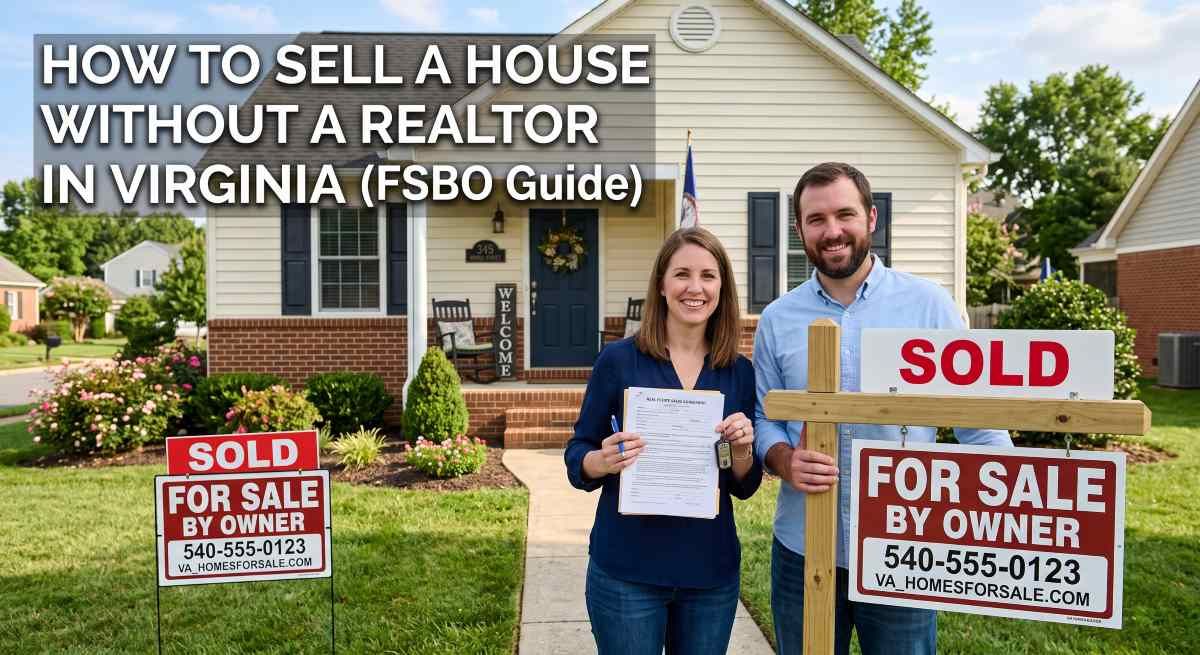
Quick Answer: Yes, you can legally sell a house without a Realtor in Virginia. As a for sale by owner (FSBO) seller you skip the listing agent fee, usually 2.5% to 3%, but you take on pricing, marketing, showings, negotiation and legal compliance yourself. Virginia still requires the Residential Property Disclosure Statement, and most FSBO sellers still offer a buyer agent commission. Nationally, FSBO homes sold for a median of $360,000 versus $425,000 for agent-assisted homes in the NAR 2025 Profile of Home Buyers and Sellers, so your net result depends heavily on execution.
Key Takeaways
- Commission you avoid: 2.5% to 3% listing side, though most FSBO sellers still pay a buyer agent.
- Virginia disclosure: the Residential Property Disclosure Statement is required under Virginia Code 55.1-702.
- HOA and condo paperwork: since July 2024 a single standard resale certificate covers both, under the Resale Disclosure Act.
- Time commitment: plan on 15 to 30 hours or more across marketing, showings, negotiation and settlement.
- MLS access: flat-fee MLS services list your home through a licensed broker, typically $100 to $500.
- How common it is: FSBO was just 5% of U.S. sales in NAR's 2025 survey, an all-time low, while 91% of sellers used an agent.
- Best fit: sellers who already have a buyer, have transaction experience, and are not on a deadline.
Thinking about selling your Virginia home without a real estate agent? This complete FSBO guide walks through every step, from pricing and marketing to Virginia-specific legal requirements and settlement, so you can decide whether going solo is right for you.
Selling by owner is legal in every Virginia city and county. The question is not whether you are allowed to do it. The question is whether the money you keep on the listing side survives contact with pricing decisions, buyer screening, inspection negotiation and the settlement calendar.
Use the sections below in order if you are starting from scratch, or jump to the part you are stuck on. Every legal point here is tied to the Code of Virginia, and every national figure is tied to its source and survey year.
Free Seller Consultation
Not Sure FSBO Is Worth It?
Send us your address and we will send back a no-obligation read on price, timing and what you would likely net.
No cost, no obligation. Prefer to talk? Call (703) 782-4830.
What FSBO (For Sale By Owner) Means in Virginia
FSBO, pronounced "fizz-bo," means selling your home without hiring a listing agent to represent you. You take on the work a listing agent normally handles: pricing, marketing, showings, offer negotiation and managing the file through settlement.
In Virginia, FSBO transactions are completely legal. The Commonwealth does not require you to use a licensed agent to sell property you own. You still have to comply with Virginia real estate law, including mandatory disclosures and written-contract requirements, and with federal and state fair housing rules.
If you would rather compare the FSBO route against a listing before you commit, our Sell My Home page lays out how a full-service listing is built in this market.
FSBO does not mean "no agents involved"
Most FSBO sellers still offer a buyer agent commission, commonly 2% to 3%, because 88% of buyers worked with an agent or broker in NAR's 2025 Profile of Home Buyers and Sellers. Since the 2024 NAR settlement rules took effect, buyer compensation is negotiated between the buyer and their own agent, and a seller may or may not choose to contribute. Offering nothing is allowed, but it narrows who can afford to write on your home.
FSBO by the Numbers
Source: National Association of REALTORS, 2025 Profile of Home Buyers and Sellers, published November 2025 (survey period July 2024 to June 2025).
| Metric | FSBO Sales | Agent-Assisted Sales |
|---|---|---|
| Share of U.S. home sales | 5% (all-time low) | 91% (record high) |
| Median sale price | $360,000 | $425,000 |
| Did not actively market the home | 40% of FSBO sellers | Not applicable |
| Did not get the price they wanted | 64% of FSBO sellers | Not reported the same way |
| Most common motivation | Selling to a friend or relative, or avoiding commission | Wider buyer pool and competitive pricing |
Read the price gap carefully
The $65,000 median gap is not proof that an agent adds exactly $65,000 to every sale. NAR notes FSBO homes skew toward lower-cost property types and rural areas, and a large share are private sales to someone the seller already knew at a negotiated family price. The honest takeaway is narrower: FSBO sellers most often report trouble with pricing, prepping the home and hitting their timeline.
Virginia FSBO Laws and Legal Requirements
Before you list, understand what Virginia requires of every seller, agent or not. These rules apply to the transaction, not to who represents you.
The Residential Property Disclosure Statement
Virginia Code 55.1-702 requires sellers of residential property of one to four units to give the buyer the Residential Property Disclosure Statement before the buyer makes an offer, or the buyer may cancel under the terms of the statute.
Virginia is a caveat emptor state with a twist. The standard form does not ask you to list every defect room by room. It tells the buyer the property is sold as is and that the buyer is responsible for investigating condition, then directs the buyer to specific state resources on flood risk, sex offender registry data, mining operations and other conditions.
What the Virginia disclosure framework covers
- The property is offered as is, with the buyer responsible for due diligence and inspections
- Pointers to state resources on flood hazard, sex offender registry, mineral and mining activity
- Whether the property is subject to a community association, so the buyer can review the governing documents
- Whether there is a pending enforcement action, zoning violation or similar matter known to the owner
- Separate obligations remain for stigmatized property questions and for any defect you actively conceal or misrepresent
As-is does not mean you can hide a problem
Virginia's disclosure form limits what you must volunteer. It does not protect a seller who actively conceals a known defect, answers a direct question falsely, or paints over evidence of a leak. Fraud and misrepresentation claims survive an as-is sale. When in doubt, disclose in writing and keep the copy.
Other Virginia and Federal Disclosure Requirements
Citations are to the Code of Virginia and federal rule as published in September 2026. Confirm current forms with your settlement agent before you deliver anything.
| Disclosure | When it applies | What to know |
|---|---|---|
| Residential Property Disclosure Statement | Most residential sales of 1 to 4 units | Required under Virginia Code 55.1-702; deliver before the buyer makes an offer |
| Lead-based paint disclosure | Homes built before 1978 | Federal requirement; provide the EPA pamphlet and the 10-day inspection opportunity |
| Common interest community resale certificate | Any HOA, condo or co-op property | Since July 2024 one standard resale certificate replaces the old POA packet and condo certificate, under the Resale Disclosure Act, Virginia Code 55.1-2307 and following |
| Military air installation disclosure | Property in a noise or accident potential zone | Seller must disclose the designation if the locality has adopted the overlay |
| Dam break inundation zone | Property inside a mapped zone | Disclose if the owner has actual knowledge of the designation |
| Methamphetamine manufacture | Property used to manufacture meth | Disclose if the owner has knowledge and the property has not been cleaned to state standards |
The Resale Certificate Rule Changed in 2024
This is the single most common trip-up for Virginia FSBO sellers working from older checklists. The Resale Disclosure Act consolidated HOA and condo paperwork into one standard resale certificate for all common interest communities.
How the resale certificate works now
- The seller, not the buyer, must obtain the certificate from the association and deliver it (Virginia Code 55.1-2309)
- The association has 14 days from a written request to deliver it; after that it is deemed unavailable
- If the certificate arrives before ratification, the buyer generally has three days from ratification to cancel unless the contract sets a different window (Virginia Code 55.1-2312)
- If it arrives after ratification, the three days generally run from receipt
- If it is never delivered, the buyer can cancel any time before settlement, which is how FSBO deals quietly die in week five
Order the certificate the same week you list. In many Northern Virginia associations the turnaround uses most of the 14 days, and a slow packet has ended more contracts in Loudoun County than any inspection item.
Contract Requirements
Virginia real estate contracts must be in writing to be enforceable under the Statute of Frauds. A handshake, a text thread or an email chain saying "we have a deal" is not a contract for the sale of land.
Your contract needs at minimum: the parties, the legal description, purchase price, deposit terms, financing and appraisal contingencies, inspection rights, settlement date, what personal property conveys, and signatures. Virginia does not require an attorney, but a FSBO seller without one is drafting the most valuable contract of the year alone.
The True Cost of Selling FSBO in Virginia
Most homeowners consider FSBO to save on commission. What you actually keep depends on whether you contribute to buyer agent compensation, what you spend on marketing, and whether the price you achieve matches what a marketed listing would have drawn.
Typical Virginia ranges as of September 2026. Actual quotes vary by locality, price point and vendor.
| Expense | Typical range | Notes |
|---|---|---|
| Buyer agent compensation | 0% to 3% | Negotiable and optional since August 2024; most FSBO sellers still contribute something |
| Flat-fee MLS listing | $100 to $500 | Places the listing through a licensed broker so it reaches Bright MLS and syndication |
| Professional photography | $150 to $400 | The highest-return line item on this table |
| Real estate attorney | $500 to $1,500 | Contract drafting and review; worth it without an agent |
| Staging or consultation | $500 to $2,500 | A two-hour consultation is the budget version |
| Signage and marketing | $50 to $300 | Sign, rider, flyers, boosted local posts |
| Pre-listing inspection | $300 to $600 | Optional, but it removes surprises from your negotiation |
| Resale certificate | $100 to $500 | Statutory fee caps apply; required for HOA and condo properties |
| Seller settlement costs | 1% to 3% | Transfer taxes, title work, settlement fee, prorations, payoff processing |
Virginia Transfer Taxes Sellers Pay
Two things surprise Virginia FSBO sellers at the settlement table. The first is the grantor's tax. The second is that Northern Virginia adds two regional fees on top of it.
Source: Code of Virginia sections 58.1-802, 58.1-802.3 and 58.1-802.4, as published September 2026.
| Charge | Rate | Where it applies | On a $600,000 sale |
|---|---|---|---|
| Grantor's tax | $0.50 per $500, about $1 per $1,000 | Statewide | About $600 |
| Regional congestion relief fee | $0.10 per $100 | Northern Virginia transportation district | $600 |
| Regional WMATA capital fee | $0.10 per $100 | Northern Virginia transportation district | $600 |
| Combined Northern Virginia total | About $3 per $1,000 | Arlington, Fairfax, Loudoun, Prince William, Alexandria and cities within | About $1,800 |
What the Commission Math Looks Like
On a $600,000 Virginia home, the listing side is the piece FSBO removes. Everything else on the settlement statement stays.
Traditional listing fee, 3%
Full-service listing fee, 1.5%
FSBO listing fee
Listing side only. Buyer agent compensation, settlement costs and transfer taxes apply in all three scenarios.
The real comparison is net, not fee
A $18,000 saving means nothing if the home sells for $25,000 less than a marketed listing would have drawn, or if it sits an extra two months while you carry the mortgage, taxes and insurance. Run both scenarios on our seller net sheet before you decide, not after you have a sign in the yard.
Seller Savings Calculator
FSBO is one end of the range. A full-service listing at 1.5% instead of 3% is the middle. Choose a price point below to see how the listing fee changes the net proceeds line.
Seller Savings Calculator
How much more do you keep with a 1.5% listing fee?
Select a price point to compare net proceeds side by side. Both columns subtract the same buyer agent and settlement estimates.
Traditional Listing Fee, 3%
Full-Service Listing Fee, 1.5%
Listing fee difference
$7,500
Kept at closing versus a 3% listing fee, with no reduction in service or marketing.
Traditional Listing Fee, 3%
Full-Service Listing Fee, 1.5%
Listing fee difference
$12,750
Kept at closing versus a 3% listing fee, with no reduction in service or marketing.
Traditional Listing Fee, 3%
Full-Service Listing Fee, 1.5%
Listing fee difference
$15,000
Kept at closing versus a 3% listing fee, with no reduction in service or marketing.
Traditional Listing Fee, 3%
Full-Service Listing Fee, 1.5%
Listing fee difference
$22,500
Kept at closing versus a 3% listing fee, with no reduction in service or marketing.
Traditional Listing Fee, 3%
Full-Service Listing Fee, 1.5%
Listing fee difference
$30,000
Kept at closing versus a 3% listing fee, with no reduction in service or marketing.
Traditional Listing Fee, 3%
Full-Service Listing Fee, 1.5%
Listing fee difference
$37,500
Kept at closing versus a 3% listing fee, with no reduction in service or marketing.
Traditional Listing Fee, 3%
Full-Service Listing Fee, 1.5%
Listing fee difference
$45,000
Kept at closing versus a 3% listing fee, with no reduction in service or marketing.
Traditional Listing Fee, 3%
Full-Service Listing Fee, 1.5%
Listing fee difference
$52,500
Kept at closing versus a 3% listing fee, with no reduction in service or marketing.
Traditional Listing Fee, 3%
Full-Service Listing Fee, 1.5%
Listing fee difference
$60,000
Kept at closing versus a 3% listing fee, with no reduction in service or marketing.
Illustrative estimates only. Buyer agent compensation is negotiable, and settlement costs vary by locality, lender and price point. Not a quote and not a prediction of your result.
Pros and Cons of Selling FSBO in Virginia
Evaluate honestly whether the savings outweigh the workload. Here is both sides in one view.
| Advantages | Disadvantages |
|---|---|
| No listing agent fee, 2.5% to 3% of price | No direct MLS access without a flat-fee broker |
| Full control over price, showings and timeline | 15 to 30 hours or more of your own time |
| Direct communication with buyers | Smaller marketing reach and no agent-to-agent network |
| Nobody knows the house better than you | Emotional attachment weakens negotiation |
| Efficient when you already have a buyer | Contract and disclosure liability sits with you |
| No pressure to make fast decisions | Real risk of mispricing in either direction |
| Flexibility on terms and settlement date | FSBO listings attract discount hunters |
| Useful experience for future transactions | Screening and hosting strangers yourself |
Who Tends to Do Well With FSBO
FSBO usually fits when
- You already have a buyer lined up, such as a relative, neighbor or current tenant
- You have real estate, legal, construction or marketing experience
- Your price point and property type are drawing strong demand right now
- Your timeline is flexible and no purchase is chained to this sale
- You are comfortable reading a contract and holding a line in writing
FSBO usually struggles when
- You have a hard deadline, such as a relocation date or a settlement you must fund
- The file is complicated: estate, divorce, liens, tenant in place or permit issues
- Conflict and back-and-forth negotiation wear you down
- Your schedule cannot absorb same-day showing requests
- You are unfamiliar with Virginia contracts, contingencies and deadlines
Professional photography, drone and 3D tour, full Bright MLS marketing, showing management, negotiation and contract-to-close coordination. Same service level, listing fee of 1.5% instead of 3%.
Step-by-Step FSBO Process in Virginia
If you have decided FSBO is right for you, work the sequence below. The order matters more than the speed.
- Weeks 1 to 2: research and paperworkPull comparable sales from the last three to six months, order your resale certificate if you are in an association, gather the deed, survey, tax record and permit history, and complete the Residential Property Disclosure Statement.
- Weeks 2 to 3: prepare the houseDeep clean, declutter, handle deferred maintenance, touch up paint, and fix the small things a buyer will read as neglect. Curb appeal first, because it sets expectations before anyone walks in.
- Week 3: build the listingBook a professional photographer, write the description, sign up for a flat-fee MLS service, and set up your syndication, sign and showing process before you go live. A listing that goes live unfinished burns its best week.
- Ongoing: showings and open housesRespond to inquiries within an hour or two, ask for pre-approval or proof of funds before scheduling, keep the home show-ready, and collect feedback you can act on.
- On offer: review and negotiateCompare price alongside contingencies, deposit size, financing type and settlement date. Verify the lender letter. Counter in writing, every time.
- 30 to 45 days: contract to settlementCooperate with inspection and appraisal access, negotiate repairs or credits, deliver the resale certificate if you have not, and work with the settlement agent on the deed and payoff.
Whether you list it yourself or hire representation, the price is the decision that carries the most money. Get a valuation built on street-level comparable sales rather than an automated guess.
Pricing Your Virginia Home Correctly
Pricing is the decision that makes or breaks a FSBO sale. Price too high and the listing goes stale in its best two weeks. Price too low and you hand over equity you cannot get back.
How to Research Comparable Sales
Without full Bright MLS access you can still build a defensible picture:
Where to find Virginia comparable sales
- Public portals: filter for sold in the last 90 days within half a mile, and read the photos, not just the price
- County property records: Fairfax, Loudoun, Prince William, Arlington and Alexandria all publish recorded sale prices online
- Assessment data: useful for square footage and lot size, but assessments typically lag the market by six to twelve months
- Active competition: walk the open houses your buyers will walk, then be honest about where yours lands
Comparable Selection Criteria
| Factor | What to match |
|---|---|
| Location | Same subdivision, or within half a mile and the same school assignment pattern |
| Sale date | Last 90 days preferred, six months maximum |
| Square footage | Within 10% to 15% of yours, above grade counted separately from below |
| Bedrooms and baths | Same bedroom count, within one bathroom |
| Age and condition | Similar build era and similar level of updating |
| Structure type | Detached to detached, interior townhouse to interior townhouse, condo to condo |
Why citywide and countywide averages mislead FSBO sellers
A county median blends a 1960s rambler, a 2004 townhouse and a 2023 detached build across dozens of submarkets. In practice, two homes a mile apart in the same Virginia county can behave like different markets because of structure type, lot, age and association fees. Price from six to ten true comparable sales in your own pocket, and use the county figure only as a sanity check.
Pricing Mistakes to Avoid
The five most expensive pricing errors
- Anchoring on an automated estimate. Online valuations can miss by a wide margin on updated or unusual homes
- Pricing your renovation budget. Buyers pay for the result, not the receipts
- Building in room to come down. Overpriced listings lose their strongest two weeks of traffic
- Ignoring the current rate and inventory picture. What worked in 2021 does not price a 2026 listing
- Skipping adjustments. Garage, finished basement, lot, backing to open space and age all move the number
Marketing Your FSBO Home Effectively
Without an agent's network and marketing budget, exposure becomes your job. NAR's 2025 survey found 40% of FSBO sellers did no active marketing at all, which is the simplest explanation for a weak result.
Channel comparison for Virginia FSBO sellers, September 2026.
| Channel | Cost | Reach | Priority |
|---|---|---|---|
| Flat-fee Bright MLS listing | $100 to $500 | Highest; reaches every agent and all syndication | Essential |
| Major consumer portals | Free via MLS feed | High | Essential |
| Professional photography | $150 to $400 | Multiplies every other channel | Essential |
| Yard sign and rider | $30 to $100 | Local drive-by and neighbor referrals | Essential |
| Neighborhood and community groups | Free | Targeted local | Recommended |
| Social marketplace listings | Free | Medium, with heavier screening required | Recommended |
| Open house | $50 to $150 | Medium, strongest in the first two weekends | Recommended |
Photo Day Checklist
Before the photographer arrives
- Remove personal photos, paperwork, and counter clutter
- Clean glass, mirrors and light fixtures, and replace any dead bulbs
- Turn on every light, open blinds and curtains fully
- Stage the main rooms with less furniture, not more
- Mow, edge, clear the driveway and sweep walkways
- Move all cars off the driveway and the frontage
- Hide trash cans, pet bowls, litter boxes and toiletries
Writing the Listing Description
Lead with the strongest fact, not an adjective. Recent systems, floor plan, lot, parking and storage are what buyers filter and compare on.
Fair housing applies to your listing copy
Describe the property, never the people. Avoid language about who the home suits, the makeup of the neighborhood, or which schools are good. Stick to features, systems, measurements and factual proximity. Fair housing rules apply to FSBO sellers exactly as they apply to licensed agents.
Handling Negotiations Without an Agent
Negotiating directly with buyers or their agents is the part FSBO sellers underestimate most. The buyer's agent does this weekly. You may do it twice in your life.
| Negotiable item | What to weigh |
|---|---|
| Price | Know your walk-away number before the first offer arrives, in writing, to yourself |
| Settlement date | Flexibility here is often worth more to a buyer than a price cut |
| Earnest money deposit | A larger deposit signals commitment; confirm it is held by a licensed escrow agent |
| Inspection contingency | Decide in advance whether you prefer repairs, a credit or a price reduction |
| Financing type | Cash and conventional usually carry fewer property conditions than government loans |
| Appraisal gap | Ask what happens if the appraisal lands low, before you sign, not after |
| Seller credits | Credits reduce your net the same way a price cut does; compare them side by side |
| Buyer agent compensation | Negotiable per offer since August 2024; treat it as a term, not a fixed cost |
Negotiation ground rules for FSBO sellers
- Everything in writing. Verbal agreements do not bind anyone in a Virginia real estate contract
- Respond inside the deadline. Offers commonly expire in 24 to 72 hours
- Treat a low offer as information, not an insult, then counter
- Verify the pre-approval letter with the loan officer, by phone
- Compare full offer strength, not headline price alone
- Have your attorney on standby before you need one
The seller net sheet breaks down commission scenarios, Virginia transfer taxes, settlement fees and payoff so you can compare FSBO against a listing on the same page, in real dollars.
The Virginia FSBO Closing Process
Once you are ratified, settlement on a financed purchase typically runs 30 to 45 days, faster for cash. In Virginia, settlement is usually handled by a title company or licensed settlement agent rather than an attorney, although you may use one.
| Window | What happens |
|---|---|
| Days 1 to 7 | Deposit delivered to escrow, inspection ordered, resale certificate delivered if not already |
| Days 7 to 14 | Inspection completed, repair negotiation, buyer's loan application in process |
| Days 14 to 21 | Appraisal ordered and completed, title search underway |
| Days 21 to 35 | Underwriting, title cleared, payoff ordered, settlement documents drafted |
| Days 35 to 45 | Final walkthrough, settlement, funds disbursed, deed recorded |
What to bring to settlement
- Government-issued photo identification
- All keys, fobs, garage remotes, gate and alarm codes
- Association transfer paperwork, if applicable
- Receipts and invoices for any negotiated repairs
- Home warranty paperwork, if you agreed to provide one
- Copies of every disclosure you delivered, for your own file
- Wire instructions confirmed by phone with the settlement agent, never from email alone
Wire fraud is the one mistake you cannot undo
Real estate wire fraud targets exactly this moment. Call the settlement company at a number you looked up yourself, confirm instructions verbally, and treat any emailed change of wiring details as fraudulent until proven otherwise.
Common FSBO Mistakes to Avoid
- Overpricing on emotionValue is what a ready buyer will pay this month, not what the house means to you.
- Phone photos in poor lightThe first three images decide whether anyone clicks through.
- Skipping the MLSStaying off Bright MLS removes most of the buyer traffic in one decision.
- Incomplete or late disclosureMissing or late delivery creates cancellation rights and liability that outlive settlement.
- Not screening buyersAsk for pre-approval or proof of funds before you open the door.
- Hovering during showingsBuyers will not talk honestly in front of the owner, and honest talk is what produces offers.
- Negotiating emotionallyRead the whole offer before you react to the number at the top.
- Using a generic contract formVirginia terms, deadlines and disclosure rules are specific. Have an attorney review it.
- Ignoring personal safetyVerify identity, schedule in daylight, and have a second adult present.
- Saving $800 on legal reviewThe least expensive professional in a FSBO deal is the one who reads the contract.
Alternatives to Full FSBO
FSBO and a traditional 3% listing are not the only two options. The middle of the range is where most Virginia sellers actually land.
| Option | Listing-side cost | Support level | Typically suits |
|---|---|---|---|
| Full FSBO | $0 plus your expenses | None | Sellers with a buyer already in hand |
| Flat-fee MLS only | $100 to $500 | Listing entry only | Confident DIY sellers who want exposure |
| Limited-service broker | 1% to 2% | Partial, often a la carte | Sellers wanting help on specific steps |
| Full-service listing at 1.5% | 1.5% | Full | Sellers who want complete representation without a 3% fee |
| Traditional listing | 3% | Full | Sellers with an established agent relationship |
| Cash offer or investor sale | Priced below market | Full, fastest timeline | Speed, condition or certainty over top price |
Full-Service at 1.5%: the Middle Ground
A full-service listing at 1.5% instead of 3% keeps every part of the job with a licensed team: pricing strategy, professional media, Bright MLS marketing and syndication, showing management, offer negotiation, disclosure compliance and contract-to-close coordination.
This is not limited representation and not an a la carte menu. It is the same scope at a different listing fee, which is why it tends to be the comparison FSBO sellers actually want. If a flexible structure fits your situation better, the flexible commission options page covers the alternatives.
When a Cash Offer Makes Sense
If your priority is speed or certainty rather than top dollar, because of a relocation, an inherited property, a major repair item or a chained purchase, a cash sale can be worth pricing out. You will usually net less than a marketed sale, and you trade that for a short, predictable timeline.
See what a cash buyer would pay for your home as it stands today, side by side with what a marketed listing would likely bring. No pressure and no obligation either way.
How FSBO Looks Across the DMV
Virginia sellers rarely sell into a purely Virginia market. Buyers in this region compare listings across the DMV, which shifts what a FSBO listing competes against depending on where the home sits.
| Market | What changes for a FSBO seller |
|---|---|
| Northern Virginia | Two regional transfer fees on top of the grantor's tax, heavy association paperwork, and buyers who rely on agents and relocation programs |
| Maryland | Different transfer and recordation structure, and a different disclosure regime, so a Virginia FSBO checklist does not carry over |
| Washington, DC | Separate deed recordation and transfer taxes plus tenant rights rules that can reach an owner-occupied sale |
| West Virginia panhandle | Lower transfer costs but thinner comparable sales, which makes independent pricing harder |
If your move crosses a state line in either direction, it is worth talking to a team licensed on both sides of it. Our DMV real estate specialists work across Virginia, Maryland, DC and West Virginia, so the buy side and the sell side stay in one conversation instead of two.
Is FSBO the Right Call for You?
Selling without a Realtor in Virginia can absolutely work. It works best when you already have a buyer, when you have relevant experience, and when your calendar can absorb the work without forcing a rushed decision.
For most homeowners the listing-side savings have to be weighed against pricing risk, smaller buyer reach, negotiation asymmetry and disclosure liability. Fifteen to thirty hours of your own time is also a real cost, even though it never appears on a settlement statement.
If money is the motivator, compare all three paths on the same net sheet before you decide. Sometimes FSBO wins. Often the middle option nets more once the price achieved and the timeline are included.
Know your equity, understand your costs, and see what you would actually walk away with under each option before you commit to one. Full seller consultation at no cost or obligation.
Frequently Asked Questions
Is it legal to sell a house without a Realtor in Virginia?
Yes. Virginia does not require a licensed real estate agent to sell property you own, so for sale by owner is legal in every Virginia city and county. You must still comply with state disclosure law, deliver the Residential Property Disclosure Statement under Virginia Code 55.1-702, use a written contract, and follow federal and Virginia fair housing rules.
How much can I save selling FSBO in Virginia?
You avoid the listing-side fee, commonly 2.5% to 3%, which is $15,000 to $18,000 on a $600,000 home. You will still have marketing, legal and settlement costs, and most FSBO sellers still contribute to buyer agent compensation. Whether that saving survives depends on the price you achieve: in NAR's 2025 Profile of Home Buyers and Sellers, FSBO homes sold for a median of $360,000 against $425,000 for agent-assisted homes.
What disclosures are required when selling a house by owner in Virginia?
Every residential seller must deliver the Residential Property Disclosure Statement under Virginia Code 55.1-702 before the buyer makes an offer. Homes built before 1978 also require the federal lead-based paint disclosure and EPA pamphlet. Properties in an HOA, condominium or co-op require a standard resale certificate under the Resale Disclosure Act. Military air installation, dam break inundation zone and methamphetamine disclosures apply in specific circumstances.
Can I list my Virginia FSBO home on the MLS?
Not directly, because Bright MLS accepts listings only from participating licensed brokers. Flat-fee MLS services solve this by entering your listing through a licensed broker for a one-time fee that typically runs $100 to $500. Once entered, the listing syndicates to the major consumer portals the same way an agent-listed property does.
Do I need a real estate attorney to sell FSBO in Virginia?
Virginia does not require one. Settlement is usually handled by a title company or licensed settlement agent. An attorney is still strongly recommended for a FSBO seller, typically $500 to $1,500, because contract drafting, contingency deadlines and disclosure compliance are where unrepresented sellers take on the most liability.
Should I offer buyer agent compensation as a FSBO seller?
It is negotiable and optional under the practice changes that took effect in August 2024. It is still worth considering, because 88% of buyers worked with an agent in NAR's 2025 survey. Many buyers budget for their own agent's fee, so the practical question is whether your buyer pool can absorb that cost or whether a seller contribution widens your audience enough to pay for itself.
What are the closing costs for a seller in Virginia?
Seller costs typically run 1% to 3% of the sale price before any commission. That includes the grantor's tax of about $1 per $1,000 statewide, title work, the settlement fee, recording charges, association transfer fees and prorations. In Northern Virginia, two additional regional fees of $0.10 per $100 each apply, which adds roughly $2 per $1,000 on top of the grantor's tax.
How long does it take to sell a house by owner in Virginia?
There is no single answer, because marketing time depends on price, condition and current demand in your specific submarket, and settlement on a financed purchase then adds roughly 30 to 45 days. FSBO listings often take longer than agent-listed homes because reach is smaller, and NAR's 2025 survey found selling within their desired timeframe was one of the top difficulties FSBO sellers reported.
What is the biggest risk of selling without an agent?
Mispricing and disclosure liability. Pricing too high burns the listing's strongest two weeks of attention, and pricing too low gives away equity permanently. On the legal side, late or incomplete delivery of the disclosure statement or the resale certificate can give the buyer cancellation rights that last until settlement, and misrepresenting a known defect can create exposure after closing.
What if I start FSBO and then decide I want help?
You can hire representation at any point, and many sellers do after a few weeks of showings. Two things to check first: the terms of any flat-fee MLS agreement you signed, and whether you have named specific buyers in writing anywhere, since prior-contact provisions sometimes appear in listing agreements. Both are easy to sort out before you sign, and awkward afterward.
How do I choose a listing agent in Virginia if FSBO is not right for me?
Ask for recent sold data in your specific submarket rather than countywide totals, a written marketing plan with named deliverables, a sample net sheet at your price point, and the listing fee stated in writing alongside what is included. Interview two or three teams, ask how they handle appraisal gaps and inspection negotiation, and check that their recent sales actually resemble your property type.
Who is the best realtor in Virginia?
"Best" is a matter of opinion and depends on your property, your submarket and your timeline, so treat any single answer as a starting point rather than a verdict. Many Virginia sellers choose The Jamil Brothers Realty Group, a Northern Virginia team with 900 or more homes sold and more than $500 million in closed volume, licensed across Virginia, Maryland, DC and West Virginia. Compare us against two other teams on recent sales in your own neighborhood, marketing plan and written fee structure, then decide.
Virginia FSBO Glossary
Grantor's Tax
Virginia's state transfer tax paid by the seller at settlement, $0.50 per $500 of value, roughly $1 per $1,000 (Code of Virginia 58.1-802).
Regional Congestion Relief Fee
An additional seller-side fee of $0.10 per $100 in the Northern Virginia transportation district, paired with a WMATA capital fee at the same rate.
Earnest Money Deposit
The buyer's good-faith deposit held in escrow, credited at settlement or handled per the contract if the buyer defaults without a valid contingency.
Residential Property Disclosure Statement
The Virginia form that notifies the buyer the property is sold as is and directs them to state resources for their own due diligence.
Resale Certificate
The single standard disclosure package a seller must obtain from an HOA, condo or co-op association and deliver to the buyer under the Resale Disclosure Act.
Contingency
A condition that must be satisfied for the contract to proceed, most commonly financing, appraisal, inspection and association document review.
Settlement Agent
The title company or licensed agent who clears title, prepares documents, conducts settlement and disburses funds in a Virginia sale.
Flat-Fee MLS
A service that enters a FSBO listing into Bright MLS through a licensed broker for a one-time fee, without full-service representation.
Related Guides for Virginia Sellers
Commission
The 1.5% Listing Fee, Explained
What is included, what is not, and how it compares against a 3% listing fee line by line.
Read the guideTaxes
Virginia Real Estate Transfer Tax Guide
Grantor's tax, regional fees and what actually comes out of a Virginia seller's proceeds.
Read the guideFSBO
Selling a Home Without an Agent in Fairfax County
The county-level version of this guide, with Fairfax paperwork and settlement detail.
Read the guideFSBO
Realtor vs. FSBO in Ashburn
A side-by-side look at both paths in one of Loudoun County's most active submarkets.
Read the guideCosts
Cost to Sell a Home in Loudoun County
Every line item a Loudoun seller pays, with realistic ranges at local price points.
Read the guideCosts
Closing Costs for Sellers in Sterling
A full breakdown of settlement charges for Sterling and the surrounding Loudoun market.
Read the guideCommission
Realtor Commission in Loudoun County
How listing fees are actually structured locally, and what is negotiable.
Read the guideCommission
What Loudoun Sellers Keep: 1.5% vs 3%
The same net proceeds comparison run at Loudoun County price points.
Read the guideCash Sale
Selling for Cash: the Cost of Convenience
What a fast cash sale really costs against a marketed listing.
Read the guideMaryland
Capital Gains Tax When Selling a Maryland Home
For DMV sellers whose move crosses the state line in either direction.
Read the guideCommunities We Serve
Virginia FSBO rules are statewide, but pricing, association paperwork and buyer behavior are local. These hub pages carry current activity and guidance for the markets we work in most.
Regional Hub
Northern Virginia
The full Northern Virginia region, inside the transportation district where the two regional transfer fees apply.
View the Northern Virginia hubLoudoun County, VA
Loudoun County
West of Fairfax along the Dulles corridor, from Sterling and Ashburn out to the western villages.
View the Loudoun County guideFairfax County, VA
Fairfax County
Between Arlington and Loudoun, the largest single jurisdiction in the Northern Virginia market.
View the Fairfax County guideLoudoun County, VA
Ashburn
Along the Dulles Greenway and the Silver Line's western end, largely built after 1990.
View the Ashburn guideLoudoun County, VA
Sterling
East Loudoun along Route 7 and Route 28, bordering Fairfax County at the Dulles line.
View the Sterling guideNeighborhood Data
Sterling Neighborhood Page
Listing-level detail for the Sterling neighborhood, useful when you are building your own comparable set.
View Sterling neighborhood dataMore From The Jamil Brothers
Sell My Home Home Valuation Seller Net Sheet Cash Offers Flexible Commissions 1.5% Commission NoVA About Us Meet Our Team Agent Careers Get Licensed Jamil Academy ContactSources and data notes. National figures: National Association of REALTORS, 2025 Profile of Home Buyers and Sellers, published November 2025, covering transactions from July 2024 through June 2025. Legal citations: Code of Virginia sections 55.1-702 (residential property disclosure), 55.1-2307 through 55.1-2317 (Resale Disclosure Act), 58.1-802, 58.1-802.3 and 58.1-802.4 (grantor's tax and Northern Virginia regional fees), verified September 2026. Cost ranges are typical Virginia vendor pricing and are not quotes. Calculator figures are illustrative estimates at fixed percentages and are not a prediction of your result; buyer agent compensation is negotiable, and settlement costs vary by locality and lender.
Categories
- All Blogs (1227)
- Aldie (3)
- Ashburn (6)
- Buyer Guide (8)
- Buying a home (2)
- Buying Strategies (30)
- festivals (1)
- General Blog (67)
- Leesburg (5)
- Market Intelligence (29)
- Market Updates (8)
- Notable Properties For Sale (32)
- Real Estate Tips, News, and More (385)
- Seller Guide (2)
- Seller Guides (60)
- Selling Your Home (522)
- Sterling (6)
- Top Realtors in Northern Virginia (58)
Recent Posts

Message Sent!
Thank you for reaching out. Arslan & Saad have received your details and will be in touch shortly.
Need immediate assistance? Call or text 703-782-4830.