
Escalation Clauses in Northern Virginia: How to Win (or Beat) One

In a fast-moving Northern Virginia market, the best homes still draw multiple offers, and buyers reach for tools that let them compete without blindly overpaying. The escalation clause is the most common of these: a clause that automatically raises your offer to stay ahead of the competition, up to a ceiling you set. Used well, it wins you the home for the least money necessary; used carelessly, it can tip your hand, blow past your budget, or collide with the appraisal. As one of the most active real estate teams in Fairfax County and across Northern Virginia, we write and counter these clauses constantly.
This guide covers both sides of the table. If you are a buyer, you will learn how to structure an escalation clause that actually wins. If you are a seller, or a competing buyer, you will learn how to read one, verify it, and beat it. We will also cover the Northern Virginia specifics that trip people up, especially the fact that our standard addendum escalates on net to the seller, not just the sticker price, the same nuanced strategy we bring to clients as a top real estate team across the DMV.
Quick Answer: An escalation clause (in Northern Virginia, the NVAR Escalation Addendum) is an add-on to a purchase offer that automatically raises your price to beat competing offers by a set increment, up to a maximum cap. For example: "I offer $600,000, and will beat any bona fide higher offer by $3,000, up to a maximum of $630,000." To win with one as a buyer, set a realistic cap, choose a meaningful increment, keep the rest of your offer strong (financing, contingencies, timeline), and plan for the appraisal, because an escalated price can appraise low. To beat one as a competing buyer, submit a clean, high, well-supported offer above the clause's likely cap or with stronger terms, since sellers do not have to accept an escalation clause. As a seller, you can require written proof of the competing "bona fide" offer, and you should know that in the NVAR form the escalation is measured on your net (price minus concessions), not the headline price. The right move always depends on how competitive the situation truly is.
Key Takeaways
- An escalation clause automatically raises your offer to beat competing bids, up to a cap you set.
- Three parts matter: your starting price, the escalation increment, and the maximum cap.
- In Northern Virginia, the NVAR addendum escalates on net to the seller, not just the price.
- Sellers can demand proof: the competing offer must be bona fide and shown in writing to trigger the clause.
- The appraisal is the hidden trap: an escalated price can appraise low and create a gap to solve.
- Sellers do not have to accept one, so a clean, strong offer can beat an escalation clause outright.
- Strategy beats emotion: the winning cap and increment come from real comps and local market read.
On This Page
- What is an escalation clause?
- How an escalation clause works
- The Northern Virginia twist: net, not price
- An escalation clause example
- The bona fide offer requirement
- Why buyers use escalation clauses
- The risks and downsides
- Escalation clauses and the appraisal
- How to win with an escalation clause
- How sellers should evaluate one
- How to beat an escalation clause
- Alternatives to an escalation clause
- Common mistakes to avoid
- Frequently asked questions
- Glossary
What Is an Escalation Clause?
An escalation clause is an addendum to a purchase offer in which a buyer agrees to automatically raise their price to stay ahead of competing offers, up to a maximum they set in advance. Instead of guessing how high to bid in a multiple-offer situation, the buyer says, in effect, "I will pay a little more than the next-best offer, but only up to my ceiling."
In Northern Virginia, this is done with a standardized form, the NVAR Escalation Addendum, attached to the regional sales contract. The clause has three moving parts: the starting offer price, the increment by which it will rise above a competing offer, and the cap, the highest the price can go. Together, those three numbers define exactly how the offer behaves when other bids come in.
Good to know: an escalation clause only does something when there is genuine competition. If no other qualifying offer exists, the price stays at your starting number, so the clause never raises your price without a real competing bid to react to.
How an Escalation Clause Works
The mechanics are simple once you see the three numbers in action. You submit a base price, you specify how much you will beat a competing offer by, and you set the maximum you are willing to reach. When a qualifying higher offer arrives, your price steps up by your increment above that offer, but never past your cap.
Say your base offer is $600,000, your increment is $3,000, and your cap is $630,000. If a competing offer comes in at $610,000, your price automatically becomes $613,000. If the competitor is at $628,000, you go to $631,000, except your cap stops you at $630,000, and you may lose if the seller takes the higher clean number. The clause protects you from overpaying by a lot while keeping you in the running.
The strength of an escalation clause is that it lets a buyer compete rationally rather than emotionally. Rather than throwing out one nervous "highest and best" number and hoping, you pay only enough to edge out the real competition, up to a limit you decided on with a clear head. That discipline is exactly why the tool exists.
The Northern Virginia Twist: Net, Not Price
Here is the local detail that surprises people, and where deals are won and lost: the NVAR Escalation Addendum measures the competition by the seller's net, not the headline sales price. "Net," in the form, generally means the sales price minus any seller concessions or subsidies paid to the buyer. So the addendum escalates your offer above another offer's net to the seller, not simply above its price.
This matters because two offers with the same sticker price can leave the seller with very different amounts. A $610,000 offer with a $10,000 seller subsidy nets $600,000, while a $605,000 offer with no subsidy nets $605,000, and the second is actually stronger to the seller despite the lower price. If you ask for closing-cost help, that concession reduces your net and effectively weakens your escalation.
Since the 2024 changes to the NVAR forms, offers also spell out any seller-paid buyer-broker compensation, which likewise affects the seller's net. The takeaway for buyers is to understand that concessions and credits shrink your competitive number, and for sellers, to compare offers on net, not on the biggest headline price.
An Escalation Clause Example
Numbers make it concrete. Here is a straightforward Northern Virginia scenario showing how an escalation clause responds to a competing offer.
| Detail | Your Offer |
|---|---|
| Starting price | $600,000 |
| Escalation increment | $3,000 above a competing offer's net |
| Maximum cap | $630,000 |
| Competing offer (net to seller) | $620,000 |
| Your price becomes | $623,000 |
| If competitor's net were $629,000 | You would cap at $630,000, not $632,000 |
Notice two things. First, you only paid $3,000 more than the real competition, not your full ceiling, so the clause saved you money versus guessing high. Second, near the cap the clause can leave you just barely ahead or just short, which is why the cap and increment deserve real thought rather than round-number guesses. Your exact terms should be set with your agent based on the specific home and comps.
The Bona Fide Offer Requirement
An escalation clause only triggers against a real, verifiable competing offer, and this protection is central to using or challenging one. For your price to escalate, the seller generally must have received a genuine, written, "bona fide" competing offer, and buyers can, and should, require the seller to provide documentation of that offer to justify the escalated price.
This is the safeguard against a seller inventing a phantom competitor to push you to your cap. A well-written escalation clause entitles the buyer to a copy of the competing offer (often with personal details redacted) that pushed the price up. If the seller cannot or will not produce proof, the escalation should not stand, and you pay your base price.
Always require proof: the single most important protection in an escalation clause is the right to see the bona fide competing offer that triggered your increase. Never let your price rise to a number you cannot verify with a document.
Why Buyers Use Escalation Clauses
The core appeal is paying only what it takes to win. In a bidding war, a buyer without an escalation clause has to pick a single number and hope it is high enough, risking either losing by a hair or overpaying by thousands. An escalation clause replaces that guess with a rule that reacts to the actual competition.
Beyond price efficiency, a well-structured escalation clause signals seriousness and can move a buyer to the top of the pile without an emotional overbid. It shows the seller you are prepared to compete, while your cap protects you from getting swept up in the frenzy. For disciplined buyers, that combination of competitiveness and control is the whole point.
Escalation clauses are also simply common practice in the Northern Virginia markets where demand outruns supply, so buyers and agents here are used to working with them. Being fluent in how they operate is part of showing up prepared, which is where a sharp buyer's strategy pays for itself before you ever write an offer.
The Risks and Downsides
Escalation clauses are powerful, but they are not free of tradeoffs, and understanding the downsides is what separates a smart use from a costly one.
- You reveal your ceiling: the clause tells the seller the maximum you are willing to pay, which can weaken your position.
- A clean offer may still win: some sellers prefer a simple, strong, fixed offer over a conditional escalating one.
- Appraisal risk climbs: the higher your price escalates, the greater the chance it exceeds the appraised value.
- Concessions cut your net: asking for subsidies lowers your competitive number under the net-based NVAR form.
- Complexity and disputes: a poorly written clause can create confusion over what triggered the increase and by how much.
None of these are reasons to avoid escalation clauses; they are reasons to use them deliberately. Each risk has a countermove, from requiring proof of the competing offer to pairing the clause with appraisal protection, which is exactly the kind of structuring an experienced agent handles.
Escalation Clauses and the Appraisal
The most underappreciated risk of an escalation clause is what happens at the appraisal. When your price escalates above the list price and above recent comparable sales, the lender's appraisal may come in below your winning number, creating a shortfall you have to cover in cash, renegotiate, or resolve some other way.
This is why escalation clauses and appraisal strategy go hand in hand. Buyers who escalate aggressively in a competitive market should decide in advance how they will handle a low appraisal, whether through appraisal gap coverage, a cash cushion, or a limited appraisal contingency. We break down exactly how this plays out in our guide to the appraisal gap and how buyers and sellers handle low appraisals.
For sellers, the flip side is that the highest escalated price is only as good as the buyer's ability to close it. An offer that escalates to a big number but has no plan for a low appraisal can fall apart, which is why the terms around the price often matter as much as the price itself.
How to Win With an Escalation Clause
Winning with an escalation clause is about structure and discipline, not just a high cap. Here is the sequence we walk buyers through.
Set a realistic cap from comps
Base your maximum on real comparable sales and your true budget, not a random round number, so your ceiling is defensible and affordable.
Choose a meaningful increment
Too small an increment looks timid; too large wastes money. A sensible step, often a few thousand dollars, keeps you competitive without overshooting.
Keep the rest of the offer clean
Strong financing, a solid deposit, sensible contingencies, and a flexible timeline make your escalating offer more attractive than the price alone.
Mind your net
Avoid or minimize concessions that shrink your net to the seller, since the NVAR form escalates on net, not the headline price.
Plan for the appraisal
Decide up front how you will handle a low appraisal, so an aggressive escalation does not fall apart when the value comes in.
The through-line is that the clause is only one piece of a winning offer. A great cap paired with a weak, concession-heavy, contingency-laden offer often loses to a cleaner bid, which is why a coordinated Northern Virginia buyer strategy matters more than any single number.
How Sellers Should Evaluate One
If you are the seller and an offer arrives with an escalation clause, your job is to read it correctly and use it to your advantage rather than be rushed by it. Start by understanding the clause's cap and increment, and remember to compare all offers on net to you, not on headline price.
You are generally not obligated to accept an escalation clause at all; you can accept a different offer, or counter the escalating buyer to their cap or to a clean fixed price. If you do honor the clause, be prepared to document the bona fide competing offer that triggered the increase, because a savvy buyer will require proof, and providing it correctly keeps the deal clean and defensible.
The subtleties here, comparing net across offers, weighing terms and appraisal risk, deciding whether to counter, are exactly where a strong listing agent earns their fee. Our guide on how to choose a Northern Virginia listing agent covers finding someone who can extract the most from a multiple-offer situation without tripping over the details.
How to Beat an Escalation Clause
Whether you are a competing buyer or a seller weighing your options, escalation clauses can be beaten, and often the cleanest path wins. The key is to make the escalating offer's conditional, capped nature look weaker than a simple, strong alternative.
- Go clean and high: a straightforward, strong fixed offer above the clause's likely cap removes conditions the seller has to manage.
- Strengthen your terms: a larger deposit, fewer contingencies, and a flexible closing can outweigh a slightly higher escalated price.
- Protect the net: as a buyer, drop concession requests; as a seller, weigh offers on net, where a clean bid may top an escalated one.
- Add appraisal certainty: gap coverage or a stronger appraisal position reassures a seller the deal will actually close.
- Escalate smarter: if you also use a clause, set a competitive increment and a cap informed by the real market, not a timid one.
Sellers, for their part, beat the uncertainty of an escalation clause simply by recognizing that price is not everything. A clean offer that closes on time with no drama is frequently worth more than a higher number wrapped in conditions, one of the judgment calls we cover in our roundup of the top mistakes Northern Virginia home sellers make.
Alternatives to an Escalation Clause
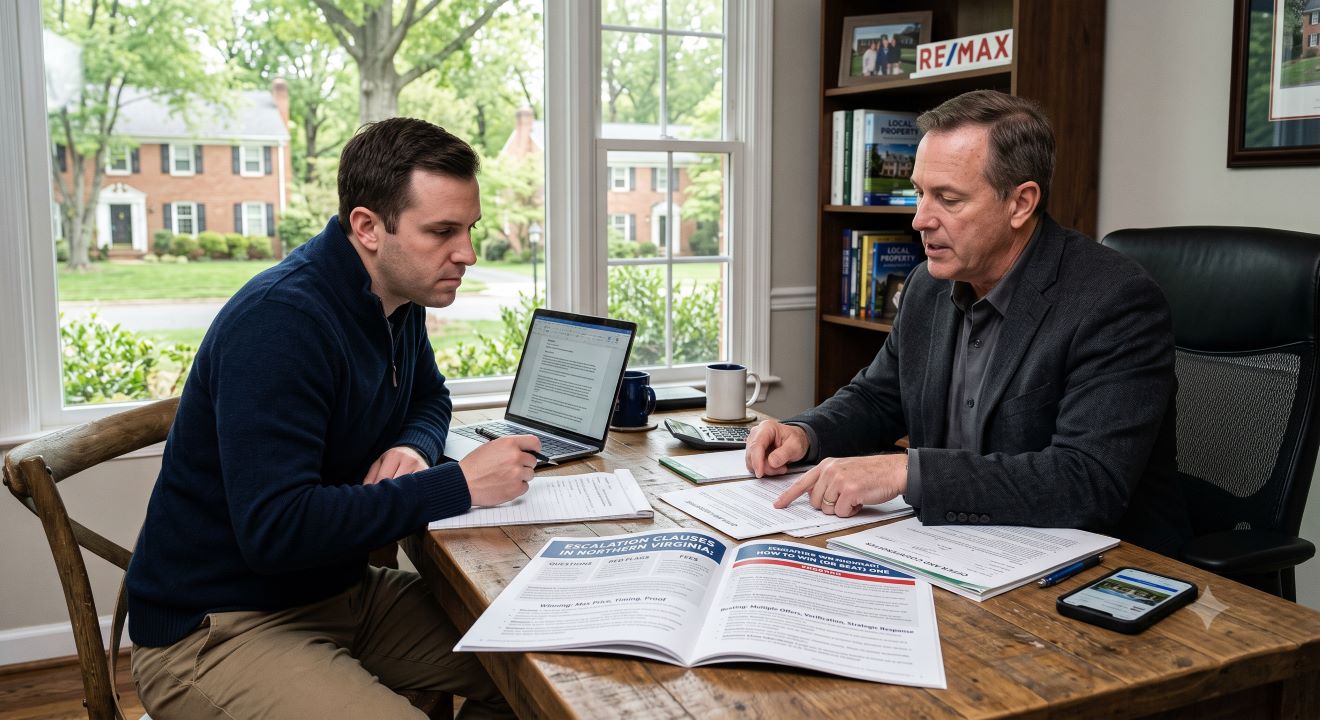
An escalation clause is not the only way to compete, and sometimes it is not the best one. Depending on the situation, a buyer might do better with a different approach, and knowing the menu helps you and your agent pick the right tool.
The most common alternative is a strong fixed "highest and best" offer: you simply name your best number without revealing a ceiling that can be gamed. Others include waiving or shortening certain contingencies (carefully), offering appraisal gap coverage to reassure the seller, improving the deposit or timeline, or writing a personal, clean offer that is easy to say yes to. Each of these competes on something other than an auto-escalating price.
Which path wins depends on the specific home, the number of competitors, and what the seller values most, factors that also shape a home's contract status once you are under agreement, as we explain in our breakdown of contingent vs. pending home statuses. A good agent matches the tactic to the situation rather than defaulting to one move.
Interactive · Commission Savings
Selling in a Bidding War? Keep More With a 1.5% Listing Fee
Pick your Northern Virginia home value:
Typical 3% Listing Fee
Your Estimated Savings
$6,000
Kept in your pocket versus a traditional 3% listing fee.
Typical 3% Listing Fee
Your Estimated Savings
$7,500
Kept in your pocket versus a traditional 3% listing fee.
Typical 3% Listing Fee
Your Estimated Savings
$9,000
Kept in your pocket versus a traditional 3% listing fee.
Typical 3% Listing Fee
Your Estimated Savings
$11,250
Kept in your pocket versus a traditional 3% listing fee.
Typical 3% Listing Fee
Your Estimated Savings
$15,000
Kept in your pocket versus a traditional 3% listing fee.
Estimates compare a 3% listing-side fee to our 1.5% listing fee. Full-service representation either way. Buyer's-agent compensation is separate and negotiable.
Common Mistakes to Avoid
Escalation clauses go wrong less because of the tool and more because of avoidable errors in how it is written and used. Sidestep these on either side of the deal.
- Setting a cap you cannot afford: escalating to a number you cannot actually close, especially after an appraisal, is a fast way to lose your deposit or the home.
- Ignoring the net: stacking on concessions that quietly shrink your competitive number under the NVAR net-based form.
- Skipping proof: letting your price rise without requiring the bona fide competing offer that supposedly triggered it.
- Forgetting the appraisal: escalating aggressively with no plan for a value that comes in below your winning price.
- Assuming price wins: as a buyer or seller, overlooking that clean terms and certainty often beat a bigger, messier number.
The common thread is preparation. Set your terms with real comps, protect your net, require proof, and plan for the appraisal, and an escalation clause becomes a precise tool rather than a blindfolded overbid.
Explore Northern Virginia Communities
Competing for a Home in Northern Virginia?
Frequently Asked Questions
What is an escalation clause?
An escalation clause is an addendum to a purchase offer in which a buyer agrees to automatically raise their price to beat competing offers by a set increment, up to a maximum cap. In Northern Virginia it is done with the NVAR Escalation Addendum. It lets a buyer stay competitive in a multiple-offer situation without naming their absolute highest number up front, paying only enough to edge out the real competition.
How does an escalation clause work?
You set three numbers: a starting price, an increment by which you will beat a competing offer, and a maximum cap. If a qualifying higher offer arrives, your price rises by your increment above it, but never past your cap. For example, a $600,000 base with a $3,000 increment and a $630,000 cap becomes $623,000 if a competing offer nets $620,000 to the seller.
What are the increment and the cap?
The increment is how much you will beat a competing offer by, often a few thousand dollars, and the cap is the highest price your offer can reach. A larger increment makes you more likely to stay ahead but can cost more; the cap protects you from runaway bidding. Both should be set from real comparable sales and your true budget, not round-number guesses.
Does the seller have to prove the competing offer?
Yes, a well-written escalation clause requires it. For your price to escalate, the seller generally must have a genuine, written, bona fide competing offer, and you can require documentation of it to justify the increase. This protects you from a phantom or invented offer. If the seller cannot produce proof, the escalation should not stand and you pay your base price.
In NVAR contracts, does escalation apply to price or net?
To net. The NVAR Escalation Addendum measures competing offers by the seller's net, generally the sales price minus any seller concessions or subsidies, not the headline price. So a concession you ask for reduces your net and weakens your escalation, and two offers with the same price can net the seller different amounts. Sellers should compare all offers on net, not sticker price.
Should I use an escalation clause as a buyer?
It depends on the situation. An escalation clause shines when you expect real competition and want to pay only enough to win without overbidding. It is less useful when there is little competition, or when a clean fixed offer would be stronger. The right call comes from reading the specific listing and market with your agent, and structuring the cap, increment, and terms accordingly.
What are the risks of an escalation clause?
The main risks are revealing your maximum price to the seller, losing to a cleaner fixed offer, and escalating above the appraised value, which creates a gap you must cover. Asking for concessions also shrinks your net under the NVAR form. Each risk has a countermove, from requiring proof of the competing offer to pairing the clause with appraisal protection.
Can an escalation clause cause an appraisal gap?
Yes. When your price escalates above the list price and recent comparable sales, the lender's appraisal can come in below your winning number, producing an appraisal gap you must cover in cash, renegotiate, or resolve. Buyers who escalate aggressively should plan for this in advance with appraisal gap coverage, a cash cushion, or a limited appraisal contingency.
Can a seller reject an escalation clause?
Yes. A seller is generally not obligated to accept an escalation clause. They can accept a different offer, counter the escalating buyer to their cap or to a clean fixed price, or decline the clause entirely. If a seller does honor the clause, they should be prepared to document the bona fide competing offer that triggered the increase, since the buyer can require proof.
How do I beat an escalation clause?
Often the cleanest offer wins. A strong, fixed offer above the clause's likely cap, backed by a solid deposit, fewer contingencies, and a flexible timeline, can beat a conditional escalating bid. Protecting the seller's net by dropping concession requests, and adding appraisal certainty such as gap coverage, further strengthens your position. Sellers beat the uncertainty of a clause simply by valuing clean, reliable terms over the biggest headline number.
Should sellers accept escalation clauses?
Sometimes, but not automatically. An escalation clause can push your final price up in a competitive situation, which is good, but you should compare all offers on net, weigh terms and appraisal risk, and consider whether a clean fixed offer is actually stronger. You can also counter an escalating buyer. A skilled listing agent helps you use the clause to your advantage rather than being rushed by it.
What is the difference between an escalation clause and just offering more?
Offering more means naming a single higher price up front, whether or not the competition required it, so you may overpay or reveal your hand needlessly. An escalation clause only raises your price in reaction to a real competing offer, up to your cap, so you pay just enough to win. The tradeoff is that the clause reveals your ceiling and can complicate the offer.
Are escalation clauses common in Northern Virginia?
Yes, in competitive segments. Northern Virginia's strong demand and limited inventory regularly produce multiple-offer situations, and the NVAR Escalation Addendum is a standard, familiar tool here. How useful it is in any given deal depends on the specific home and level of competition, so buyers and sellers should treat it as one option among several rather than an automatic move.
Glossary
Escalation Clause (Addendum): An add-on to an offer that automatically raises the buyer's price to beat competing offers, up to a cap.
Escalation Increment: The set amount by which your offer beats a competing offer each time the clause triggers.
Cap (Maximum Price): The highest price your escalation clause will reach, protecting you from unlimited bidding.
Net to Seller: The sales price minus seller concessions and subsidies; the figure the NVAR form escalates against.
Bona Fide Offer: A genuine, written competing offer that must exist to trigger an escalation clause.
Seller Concession (Subsidy): Money the seller credits the buyer, such as closing-cost help, which reduces the seller's net.
Appraisal Gap: The shortfall when an escalated price exceeds the lender's appraised value.
Highest and Best: A request for buyers to submit their single strongest offer, an alternative to escalating.
Multiple-Offer Situation: When a listing receives competing offers, the scenario where escalation clauses come into play.
NVAR: The Northern Virginia Association of Realtors, whose standard forms include the regional Escalation Addendum.
The Bottom Line on Escalation Clauses in Northern Virginia
An escalation clause is a precision tool, not a magic bullet. Used well, it lets a buyer win a competitive Northern Virginia home for the least money necessary, while a cap keeps the bidding disciplined. Used carelessly, it reveals your ceiling, ignores the net, and collides with the appraisal. The winning approach comes down to setting your terms from real comps, protecting your net, requiring proof of the competing offer, and planning for the appraisal before you ever sign.
For sellers, the same clarity applies in reverse: compare offers on net, weigh terms and certainty against headline price, and know that a clean bid can beat an escalating one. Whether you are trying to win a bidding war or extract the most from one, we will help you structure the strategy and negotiate the terms, and if you are selling with us, keep more of your proceeds through a 1.5% full-service listing.
Whether you're structuring an escalation clause to win or weighing offers to sell for the most, we'll help you get the terms right and the appraisal handled. Start with a free consult, and if you're selling, a valuation that keeps you ahead of the competition.
Disclaimer: This article is an independent educational guide for informational purposes only and is not legal, financial, or contractual advice. Contract forms, addenda, market conditions, and negotiation practices vary and change; figures are illustrative examples only. NVAR forms and their terms are governed by their own language; always review the actual addendum. Confirm your specific strategy and contract terms with your agent and, where appropriate, a qualified attorney. The Jamil Brothers Realty Group is a licensed real estate team with Samson Properties serving Northern Virginia and the greater DMV. Equal Housing Opportunity.
Explore More
Browse Every Corner of the DMV Market
Whether you're searching by budget, neighborhood, or buying situation — find exactly what you need below.
Virginia Homes by Budget
Washington DC Homes by Budget
Maryland Homes
Explore Fairfax County & Surrounding Northern Virginia
Ready to Make a Move?
Full-Service · No Tradeoffs
List for 1.5% & Keep More Equity
Professional photography, drone video, 3D tours, and expert negotiation — all included. On an $800K home, that's $12,000 more in your pocket vs. a 3% agent.
See the 1.5% Program →Need Speed or Certainty?
Get a No-Obligation Cash Offer
Skip the showings, skip the contingencies. If timing or condition matters more than top dollar, a cash offer may be the right fit. We'll walk you through every option.
Explore Cash Offers →Categories
- All Blogs (1227)
- Aldie (3)
- Ashburn (6)
- Buyer Guide (8)
- Buying a home (2)
- Buying Strategies (30)
- festivals (1)
- General Blog (67)
- Leesburg (5)
- Market Intelligence (29)
- Market Updates (8)
- Notable Properties For Sale (32)
- Real Estate Tips, News, and More (385)
- Seller Guide (2)
- Seller Guides (60)
- Selling Your Home (522)
- Sterling (6)
- Top Realtors in Northern Virginia (58)
Recent Posts






Message Sent!
Thank you for reaching out. Arslan & Saad have received your details and will be in touch shortly.
Need immediate assistance? Call or text 703-782-4830.