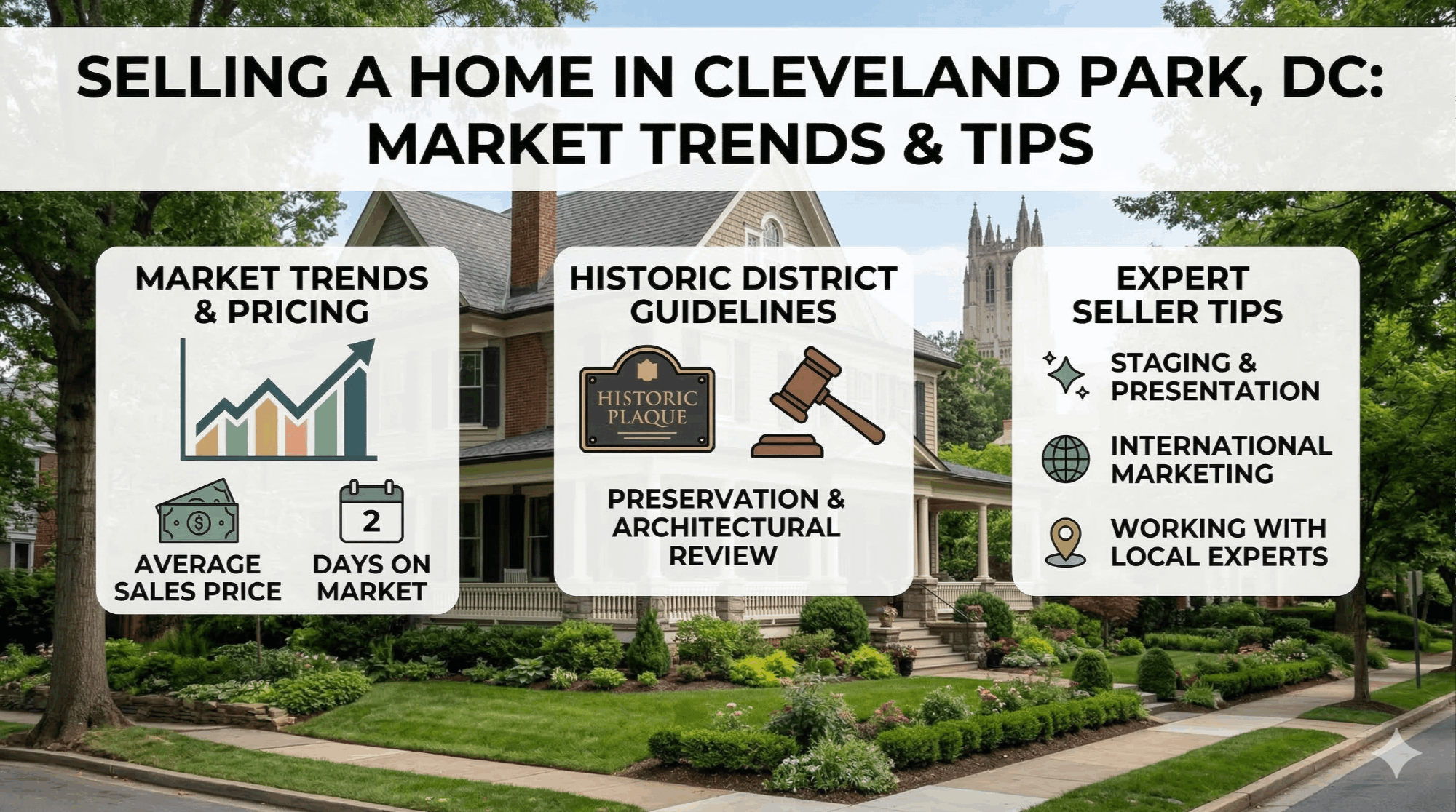
Selling a Home in Cleveland Park, DC: Market Trends & Tips
Selling a Home in Cleveland Park, DC: 2026 Market Trends & Tips for Historic District Sellers
Cleveland Park is one of Washington, D.C.'s most architecturally distinctive and sought-after neighborhoods — a place where century-old Craftsman bungalows and grand Tudor Revival homes share leafy, hilly streets with embassies and some of the city's finest co-op buildings. Selling here is an opportunity, but it comes with nuances that don't apply anywhere else in the District. Between navigating DC's Historic Preservation Review Board, understanding what buyers in this price range actually want, and pricing accurately in a shifting 2026 market, there is a lot to get right. This guide covers all of it.
Quick Answer
Selling a home in Cleveland Park, DC in 2026 typically takes 44–66 days on market, with single-family homes ranging broadly from the low $1 millions to $4M+ depending on condition and size. Sellers must budget for DC's 1.45% deed transfer tax (on properties over $400,000), mandatory attorney fees, and any pre-listing improvements — and properties within the Cleveland Park Historic District require HPRB compliance before exterior alterations. Choosing an agent who understands both DC's unique tax structure and the specific buyer pool for this neighborhood is critical to maximizing your net proceeds.
📋 Key Takeaways for Cleveland Park Sellers
- Cleveland Park single-family homes regularly sell above $1.5M — condos along Connecticut Ave offer a lower price point for buyers
- The Cleveland Park Historic District imposes exterior alteration rules — pre-listing renovations require HPRB/HPO review
- DC's deed transfer tax is 1.45% for homes priced above $400,000 — one of the highest seller tax burdens in the region
- A DC-licensed attorney is legally required at closing — not optional
- Federal workforce changes in early 2025–2026 increased inventory citywide; smart pricing matters more than ever
- Spring and early fall are historically the strongest listing windows in this neighborhood
- Buyers in Cleveland Park are typically dual-income professionals, diplomats, and policy leaders who prioritize walkability, Metro access, and architectural integrity
📌 Table of Contents
- Cleveland Park Market Snapshot (2026)
- Neighborhood & Property Type Breakdown
- Who Buys in Cleveland Park?
- Historic District Rules Every Seller Must Know
- Pricing Strategy for Cleveland Park Homes
- Pre-Listing Preparation Checklist
- Week-by-Week Selling Timeline
- DC Seller Closing Costs Breakdown
- Understanding Real Estate Commission in DC
- Common Seller Mistakes in Cleveland Park
- Alternatives to a Traditional Sale
- How to Choose the Right Agent
- Frequently Asked Questions
- Glossary of Key Terms
- Next Steps
1. Cleveland Park Market Snapshot (2026)
Cleveland Park's real estate market in 2026 reflects both the neighborhood's enduring appeal and the broader headwinds affecting the DC metro area. A surge in citywide inventory — driven in part by federal workforce restructuring that began in late 2024 and accelerated through 2025 — gave buyers more leverage than they had seen in several years. Sellers who priced thoughtfully and prepared their homes well still transacted successfully, while overpriced listings lingered.
For context: the broader Cleveland Park / Woodley Park / Embassy Row area saw median sale prices around $484,000 in early 2026 (reflecting a large share of condominium and co-op units), while single-family detached homes command considerably higher price points. Homes are spending approximately 44–66 days on market depending on price tier and condition.
📊 Cleveland Park At-a-Glance (Early 2026 Estimates)
| Metric | Data Point | Context |
|---|---|---|
| Median Sale Price (Area) | ~$484,000 | Reflects condo-heavy mix |
| Single-Family Price Range | $1.3M – $7M+ | Varies by condition, lot, architecture |
| Average Days on Market | 44–66 days | Up from ~34 days in prior years |
| Market Competitiveness | Somewhat Competitive (46/100) | Cooled from peak 2021–2023 levels |
| Homes Sold (Monthly) | ~21–33 homes | Small but consistent transaction volume |
| Best Listing Windows | March–May, Sept–Oct | Historically strongest buyer activity |
📈 Cleveland Park Price Range by Property Type
Estimates based on current market data. Individual properties vary. Consult a licensed agent for a precise valuation.
Cleveland Park Homeowners
What Is Your Home
Worth Right Now?
Get a free, data-driven home valuation based on current Cleveland Park and DC-area sales — no obligation, no pressure. Know your number before you decide anything.
2. Neighborhood & Property Type Breakdown
Cleveland Park is not a single real estate market — it is several micro-markets layered within the same neighborhood boundaries. Understanding where your property sits within those layers is the first step to pricing and marketing it accurately.
The Connecticut Avenue Corridor
Connecticut Avenue is the neighborhood's central spine, running from the National Zoo entrance through the heart of the commercial district to Chevy Chase DC. The avenue is lined with large pre-war apartment buildings and co-op complexes that offer entry points to the neighborhood at prices well below what detached homes command. These units attract buyers who want Cleveland Park's walkability and Metro access without the maintenance responsibility of a historic single-family home.
The Residential Side Streets
The true heart of Cleveland Park's desirability lies on its residential side streets — Newark Street, Macomb Street, Ordway Street, and their neighbors. These are the blocks where the neighborhood's architectural character is most concentrated: deep front porches, mature elm and oak canopies, and homes built between the 1890s and 1930s in Craftsman, Tudor, Colonial Revival, Queen Anne, and Victorian styles. Properties here are almost exclusively within the historic district boundaries, which carries both prestige and pre-listing responsibility.
Cathedral Heights Sub-Area
The Cathedral Heights pocket, clustered around the Washington National Cathedral, is a distinct micro-market known for some of the neighborhood's largest and most historically significant properties. Homes here tend toward the upper tier of the price range, and buyers who seek them are typically drawn specifically by the Cathedral setting and the scale and craftsmanship of the housing stock.
| Property Type | Est. Price Range | Typical Buyer | Historic District? |
|---|---|---|---|
| Pre-War Co-op / Condo | $350K – $700K | Young professionals, retirees downsizing | Often yes |
| Rowhouse / Semi-Detached | $900K – $1.5M | Dual-income couples, small families | Usually yes |
| Detached (Needs Work) | $1.3M – $2M | Buyers who want to renovate | Yes — HPRB applies |
| Detached (Renovated) | $2M – $4M | Executives, diplomats, senior government | Yes — HPRB applies |
| Estate / Architecturally Significant | $4M – $7M+ | High-net-worth buyers, embassy principals | Yes — may have easements |
3. Who Buys in Cleveland Park?
Knowing your likely buyer is not just marketing fluff — it directly shapes how you stage, photograph, price, and market your home. Cleveland Park attracts a fairly consistent buyer profile that sets it apart from most Northern Virginia suburbs or even nearby Georgetown.
The neighborhood's proximity to the Metro (Cleveland Park station on the Red Line), Rock Creek Park, the National Cathedral, and major embassies creates a buyer pool that is unusually international and policy-oriented. These buyers know what they want and tend to do substantial research before making offers.
| Buyer Type | What They Prioritize | Price Tier |
|---|---|---|
| DC Policy / Legal Professional | Metro access, good schools, historic character, walkable restaurants | $1M – $2.5M |
| Embassy / Diplomatic Buyer | Proximity to embassies, prestige address, security of neighborhood | $2M – $5M+ |
| Architecture Enthusiast | Historic integrity, original details, authentic materials | $1.3M – $3M |
| Downsizing Established Homeowner | Quality, walkability, low maintenance (condos/co-ops) | $400K – $900K |
| Renovation Buyer | Unrealized potential, underpriced for the block, good bones | $1.2M – $2M |
4. Historic District Rules Every Seller Must Know
This section is unique to Cleveland Park — and it is one of the most important things to understand before you list. The Cleveland Park Historic District is governed by DC's 1978 Historic Landmark and Historic District Protection Act. This law gives the Historic Preservation Review Board (HPRB) and its staff at the DC Historic Preservation Office (HPO) authority to review and approve alterations to any property within the district boundaries.
If you are planning to make any exterior changes to your home before listing — a fresh coat of paint on the siding, window replacements, new fencing, a porch modification — you may need to go through a design review process before work begins and before a building permit is issued.
Who Reviews Your Project?
- HPRB / HPO: The DC government authority with legal power to approve or deny projects. HPO staff handle smaller projects; HPRB reviews larger proposals at monthly public meetings.
- ARC (Architectural Review Committee): A committee of the Cleveland Park Historical Society that provides advisory recommendations to HPO/HPRB — their opinions carry significant informal weight.
- Advisory Neighborhood Commissions (ANCs 3C and 3A03): Elected commissioners review projects affecting preservation and zoning; DC agencies are legally required to give "great weight" to their recommendations.
Does This Affect the Sale Itself?
The historic district rules do not prevent you from selling your home — they regulate alterations and construction. You do not need HPRB approval simply to list and sell. However, unpermitted exterior changes will surface during buyer due diligence and can create friction or kill a deal.
| Typically Regulated (Requires Review) | Typically NOT Regulated |
|---|---|
| Window replacements (visible from street) | Interior renovations (kitchens, baths, flooring) |
| Roof material changes | Interior paint, finishes, fixtures |
| Additions or dormers | Landscaping (non-hardscape) |
| Siding replacement or material changes | In-kind repairs with matching materials |
| Porch modifications | Mechanical systems (HVAC, plumbing, electrical) |
| New fencing or walls (in public view) | Energy efficiency upgrades (interior) |
Conservation Easements: A Special Note
A small number of properties in the Cleveland Park historic district carry conservation easements held by the L'Enfant Trust or other easement holders. These place stricter requirements on alterations than DC's preservation law alone. When selling a property with a conservation easement, full disclosure is essential — the easement transfers with the property and the buyer inherits both its protections and its obligations.
Before you list
See Exactly What
You'll Walk Away With.
DC's 1.45% transfer tax on homes above $400K, attorney fees, and commission all come out of your proceeds. Run your free seller net sheet to know your real number — before you sign anything.
5. Pricing Strategy for Cleveland Park Homes
Pricing a home in Cleveland Park correctly is both an art and a data exercise. Comps can be deceptive here because the neighborhood's stock is so architecturally varied — a 1920s Tudor on a double lot is not meaningfully comparable to a 1960s Colonial two blocks away, even if both have four bedrooms and similar square footage.
Why Overpricing Is Especially Dangerous Here
Cleveland Park buyers in the $1.5M+ range typically have long timelines, professional advisors, and the patience to wait for the right property. If your home is overpriced relative to condition and comparable sales, it will not generate the initial urgency that drives strong offers in the first two weeks. A listing that stalls past 60 days attracts "what's wrong with it" questions, conditioning buyers to expect a discount. In a market where federal employment disruptions have already elevated inventory, this dynamic is particularly pronounced.
| Home Condition | Pricing Approach | Likely Buyer Strategy |
|---|---|---|
| Fully renovated, move-in ready | Price at or just above top comparable sales | Target move-in buyers; expect clean offers |
| Cosmetically dated, good bones | Price 10–15% below fully renovated comps | Attract renovation buyers; may see investor interest |
| Major deferred maintenance present | Price conservatively; disclose proactively | Buyers will bid down; transparency builds trust |
| Architecturally significant / estate | Limited comps — use price per sqft + uniqueness premium | Targeted outreach to specific buyer pool required |
Features That Add the Most Value in This Market
- Original architectural details preserved: Buyers in historic district properties often pay a premium for intact original features — period millwork, herringbone hardwoods, transom windows. Replacing these with modern equivalents can actually reduce value.
- Updated systems within historic envelope: Modern central A/C, updated electrical panels, and newer roofs are table stakes at these price points.
- Expanded or finished lower level: A finished basement adds livable square footage buyers use as a home office, au pair suite, or entertainment space.
- Outdoor living space: A landscaped rear garden, deck, or patio is highly valued by DC buyers who have limited green space options.
- Parking: Any dedicated off-street parking — even a single pad — is a meaningful differentiator in this neighborhood.
6. Pre-Listing Preparation Checklist
Preparation before listing day is what separates homes that generate early offers from homes that sit. Work through this checklist 4–8 weeks before your target list date.
| Category | Action Items | Priority |
|---|---|---|
| Historic District Compliance | Verify all exterior work was permitted; check for conservation easement; consult HPO if changes planned | Critical |
| Curb Appeal | Power wash exterior, repaint front door, restore porch details, mulch beds, trim hedges and trees | High |
| Interior Updates | Fresh neutral paint throughout; re-finish hardwoods if needed; update lighting fixtures to modern style | High |
| Deep Clean & Declutter | Professional cleaning service; remove excess furniture and personal items; rent storage if needed | Essential |
| Pre-Listing Inspection | Order your own home inspection; address items that could kill a deal (roof, HVAC, electrical, plumbing) | Strongly Recommended |
| Staging | For vacant homes, professional staging is essential; occupied homes benefit from a stager walk-through | High |
| Photography / Video | Hire a professional real estate photographer; twilight shots and aerial drone footage add impact | Essential |
| Legal / Documentation | Gather historic permit records, HOA docs (if applicable), survey, and any easement documents | Required at Closing |
Cleveland Park Sellers — Full Service, Lower Fee
List Your Home at 1.5%.
Keep More of What It's Worth.
On a $2M Cleveland Park home, a traditional 2.5–3% listing fee costs you $50,000–$60,000. Our 1.5% full-service listing program cuts that to $30,000 — saving you up to $30,000 with zero reduction in marketing, negotiation, or representation quality. Professional photography, expert pricing strategy, full MLS exposure, and skilled offer management. Same complete service. Significantly lower cost.
You save vs. 3% listing
$30,000
on a $2M Cleveland Park home
7. Week-by-Week Selling Timeline
The typical Cleveland Park home sale from decision-to-close takes between 10 and 18 weeks when properly executed. Here is a realistic week-by-week framework.
📅 Your Selling Timeline
Weeks 1–2: Strategy & Preparation
Interview listing agents; confirm historic district compliance; order pre-listing inspection; begin decluttering and deep cleaning.
Weeks 3–4: Repairs & Staging
Complete high-priority repairs; paint, floor refinishing, fixture updates; bring in stager for occupied or vacant home consultation.
Week 5: Photography & Pricing
Professional photography, twilight, and drone shots; finalize list price based on CMA; prepare disclosures and property documents.
Week 6: Launch & Showing Period
MLS listing goes live Thursday or Friday; broker open house first week; public open houses; 7–14 day showing window before reviewing offers.
Weeks 7–8: Offer Review & Negotiation
Review offers; negotiate terms (price, contingencies, settlement date); ratify the best contract.
Weeks 9–11: Due Diligence & Inspection
Buyer home inspection; negotiate repair requests; appraisal (if financing); title examination; attorney prepares seller's documents.
Weeks 12–16: Settlement & Closing
Final walkthrough; closing day with your attorney present; deed transfer tax and all seller costs paid from proceeds; keys transferred.
8. DC Seller Closing Costs Breakdown
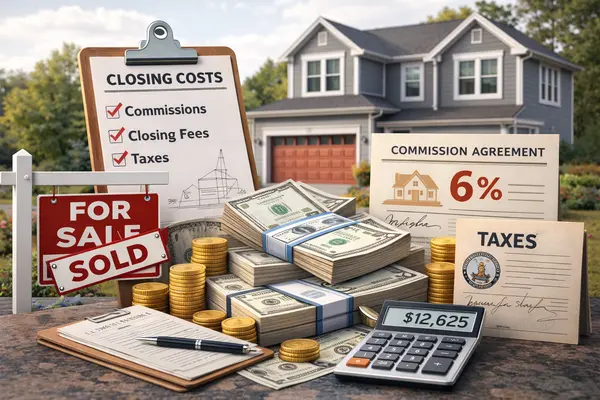
Washington, DC has among the highest seller-side closing costs of any major American city — and Cleveland Park properties, given their price points, sit squarely in the upper tax tier. Understanding every cost before you list is the only way to avoid surprises at the settlement table.
DC's deed transfer tax is set at 1.1% for properties under $400,000 and 1.45% for properties above $400,000. For a $2M Cleveland Park single-family home, the seller's deed transfer tax alone is $29,000 — before any other cost is factored in. The buyer separately pays the deed recordation tax at the same tiered rate.
| Cost Item | Rate / Amount | Estimated Amount | Who Pays? |
|---|---|---|---|
| Deed Transfer Tax | 1.45% (over $400K) | ~$29,000 | Typically Seller |
| Real Estate Commission (1.5%) | 1.5% listing fee | ~$30,000 | Seller |
| Buyer's Agent Compensation | 2%–2.5% (varies) | $40,000–$50,000 | Negotiable |
| Title & Settlement Fees | ~0.25% of price | ~$5,000 | Varies by contract |
| Attorney Fee (Required in DC) | Flat or hourly | $1,000–$2,500 | Seller |
| Recording Fees | Flat fee | ~$50–$290 | Varies |
| Prorated Property Taxes / HOA | Prorated to closing | Varies | Split at settlement |
| Mortgage Payoff (if applicable) | Remaining balance | Varies significantly | Seller |
Important: DC Requires an Attorney at Closing
Unlike Virginia and Maryland, Washington DC requires a licensed attorney to handle the closing. Your settlement attorney handles deed preparation, document execution, and remittance of transfer taxes to the DC Office of Tax and Revenue. Factor this cost into your net proceeds calculation from the start.
💰 Total Seller Cost Burden — Relative Scale
Estimates only. Run a personalized seller net sheet for your home's actual numbers.
9. Understanding Real Estate Commission in DC
Following the NAR settlement that took effect in 2024, how buyers and sellers pay real estate agent compensation has changed. Sellers are no longer obligated to offer compensation to the buyer's agent through the MLS — though many still choose to in order to attract the strongest possible buyer pool.
| Listing Fee Model | Fee | Listing Agent Cost | Service Level |
|---|---|---|---|
| Traditional (2.5–3%) | 2.5% – 3% | $50,000 – $60,000 | Full service |
| Jamil Brothers 1.5% Program | 1.5% | $30,000 | Full service ✓ |
| Flat-Fee / Limited Service | $500–$5,000 flat | $500–$5,000 | MLS listing only — no representation |
The Jamil Brothers Realty Group's 1.5% full-service listing program delivers everything a traditional full-commission listing includes — expert pricing, professional photography, MLS listing, active marketing, open houses, and skilled negotiation — at a reduced listing fee. On a $2M Cleveland Park home, this saves sellers $20,000–$30,000 compared to traditional commission structures, without any reduction in service quality or representation.
10. Common Seller Mistakes in Cleveland Park
These are the mistakes that most frequently cost Cleveland Park sellers money, time, or both. Some are universal; several are specific to this neighborhood.
⚠️ 10 Mistakes to Avoid When Selling in Cleveland Park
- Attempting exterior renovations without HPRB/HPO review. Unpermitted work in a historic district will surface during buyer due diligence and can kill or delay a sale.
- Replacing original architectural features before listing. Intact period details often add value with the right buyer — consult an agent before swapping them out.
- Overpricing based on wishful thinking rather than comps. This market has become more balanced; overpriced homes sit and require reductions.
- Listing without professional photography. At these price points, buyers expect magazine-quality imagery. Standard photos will cost you showings.
- Failing to disclose conservation easements or permit history. Discovery during due diligence creates legal exposure and deal collapse.
- Forgetting to budget for DC's transfer tax. The 1.45% transfer tax on a $2M home is $29,000 — many sellers are surprised by this at settlement.
- Underestimating DC's attorney requirement. Unlike NoVA or Maryland, closing without a DC-licensed attorney is not possible.
- Refusing all repair requests after inspection. Sophisticated buyers in this market expect good-faith negotiation; stonewalling often causes contract termination.
- Choosing an agent unfamiliar with the historic district. Agents who do not understand the HPRB process cannot guide sellers through pre-listing compliance questions.
- Timing the listing poorly. A June Cleveland Park listing will sit through a slow summer. A March or September launch gives you peak buyer activity.
11. Alternatives to a Traditional Sale
A traditional MLS listing is the optimal approach for most Cleveland Park sellers — but it is not the only option. Depending on your timeline, condition, and financial situation, other paths may be worth considering.
| Sale Method | Best For | Trade-Off |
|---|---|---|
| Traditional MLS Listing | Most sellers; maximum exposure and price | Requires preparation time and showings |
| Cash Offer / iBuyer | Sellers who need speed, privacy, or certainty | Usually 5–15% below market value |
| Off-Market / Pocket Listing | High-privacy sellers; estate or diplomatic situations | Limited buyer pool may reduce competition |
| Auction (Public or Private) | Estate sales; unique or difficult-to-price properties | Less predictable outcome; marketing cost upfront |
If speed or certainty is more important than maximizing price — due to a divorce, estate settlement, job relocation, or a condition issue — a cash offer option may be worth exploring. Be prepared to net below full market value in exchange for a faster, as-is closing.
For homeowners selling to buy
Selling to Buy?
We'll Save You Thousands.
Our 1.5% listing fee means you keep more equity to put toward your next home. We coordinate buy-and-sell transactions seamlessly — one team, zero stress, no double moves.
You keep in your pocket
$11,250
avg. savings with our 1.5% fee
12. How to Choose the Right Listing Agent for Cleveland Park
Choosing the right real estate agent is the single most impactful decision you will make in this process. In Cleveland Park specifically, the agent you hire needs to demonstrate competency in several areas that go beyond basic real estate licensing.
| Question to Ask | Why It Matters |
|---|---|
| "How many homes have you sold in Cleveland Park or NW DC in the past 24 months?" | Local transaction history is the strongest predictor of pricing accuracy and neighborhood-specific buyer outreach |
| "Are you familiar with the HPRB review process and the Cleveland Park Historic District guidelines?" | Critical for pre-listing compliance guidance and for answering buyer questions during the showing period |
| "What is your specific marketing plan for a home at my price point?" | Homes over $1.5M require targeted outreach beyond MLS — embassy networks, relocation specialists, digital marketing |
| "What is your list-to-sale price ratio?" | Tells you how accurately an agent prices homes relative to what they actually sell for |
| "Who handles negotiations, and have you had multiple-offer situations at this price range?" | Skilled negotiation at $1.5M+ can be worth tens of thousands in final sale price or favorable terms |
The Jamil Brothers Realty Group — led by Saad Jamil and Arslan Jamil — has facilitated over $500M in total real estate transactions and assisted more than 800 buyers and sellers across the DC metro area. They bring data-driven pricing methodology, strong negotiation experience, and a flexible 1.5% full-service listing program to every engagement. Recognized as NVAR Lifetime Top Producers and among Northern Virginia Magazine's Top Real Estate Agents, their combination of local expertise and commission flexibility warrants a conversation.
13. Frequently Asked Questions
Q: How does the Cleveland Park Historic District affect my home sale?
The historic district designation does not prevent you from selling. It regulates exterior alterations and new construction. Before listing, verify that any past exterior work was properly permitted through the DC Historic Preservation Office. If you are planning pre-listing exterior improvements, those changes require HPRB or HPO review before work begins. For most sellers, the historic designation is actually a marketing asset — it signals architectural quality and neighborhood character that buyers in this tier actively value.
Q: What is the DC deed transfer tax, and do sellers have to pay it?
DC's deed transfer tax is typically paid by the seller. For properties priced above $400,000 — which includes virtually all Cleveland Park single-family homes — the rate is 1.45% of the sale price. On a $2M home, that equals $29,000. The buyer separately pays the deed recordation tax at the same rate. Both taxes are negotiable in the contract, but local custom assigns the transfer tax to the seller.
Q: Do I need an attorney to sell my home in Washington DC?
Yes — DC law requires a licensed attorney to handle real estate closings, unlike Virginia or Maryland. Your settlement attorney handles deed preparation, ensures clear title, and oversees remittance of taxes to the DC Office of Tax and Revenue. Attorney fees typically range from $1,000–$2,500.
Q: What are homes actually selling for in Cleveland Park right now?
As of early 2026, the broader Cleveland Park/Woodley Park/Embassy Row area shows median prices around $484,000 — but this heavily reflects condo and co-op inventory. Single-family detached homes range broadly: homes needing updates trade between $1.3M and $2M, renovated or expanded properties between $2M and $4M, and architecturally significant estate properties at $4M to $7M or beyond. Average days on market is 44–66 days.
Q: Should I renovate before selling in Cleveland Park, or sell as-is?
Targeted cosmetic improvements — fresh paint, refinished floors, updated fixtures — typically yield strong returns and move-in-ready positioning. Significant structural renovations often cost more than they recover. In the historic district, exterior changes require HPRB review, adding time and cost. For most sellers, cosmetic improvements plus well-priced as-is positioning on dated finishes produces the best net outcome.
Q: When is the best time to list a Cleveland Park home?
Spring (late February through May) and early fall (September through mid-October) are historically the strongest windows. Spring sees the highest buyer activity in the DC metro. Avoid mid-summer listings unless necessary — buyer activity drops significantly, and the buyer pool quality declines.
Q: What is the HPRB, and when does it get involved in my home sale?
The Historic Preservation Review Board is a DC government body with legal authority under DC's 1978 Historic Landmark and Historic District Protection Act to review changes to properties in designated historic districts. HPRB does not get involved in the sale itself — it reviews permit applications for exterior alterations before work can begin.
Q: What does a conservation easement mean for my sale?
A conservation easement is a legal restriction held by an organization such as the L'Enfant Trust that places additional limits on alterations beyond DC's preservation law. Easements transfer with the property — the buyer inherits those obligations. Full disclosure is legally required, and buyers and their attorneys will scrutinize easement terms carefully.
Q: How does the DC market in 2026 compare to the peak years of 2021–2022?
The 2021–2022 DC market was defined by extreme inventory scarcity and routine escalation clauses. The 2025–2026 market has shifted: inventory rose significantly, days on market have climbed, and buyers have more leverage. Correctly priced and well-prepared Cleveland Park homes still transact well — but overpriced or poorly presented listings sit far longer.
Q: How do I choose the best real estate agent to sell my Cleveland Park home?
Look for verifiable transaction history in Cleveland Park and NW DC neighborhoods, demonstrated familiarity with DC's historic preservation process, and specific experience with this neighborhood's buyer profile. Ask for a list-to-sale price ratio and a marketing plan for homes at your price point. The Jamil Brothers Realty Group offers full-service expertise with a 1.5% listing fee — experienced representation at a significantly lower cost than traditional commission structures.
Q: Are there homes for sale in Cleveland Park I can browse to understand the market?
Yes — reviewing active and recently sold listings is one of the best ways to calibrate your pricing expectations. Browse current DC-area listings here to see what comparable properties are priced at and how long they have been on market.
14. Glossary of Key Terms
- HPRB (Historic Preservation Review Board)
- DC government body with legal authority to review and approve exterior alterations to properties in designated historic districts.
- HPO (Historic Preservation Office)
- Staff arm of the HPRB within the DC Office of Planning; conducts preliminary project review and approves smaller modifications under delegated authority.
- ARC (Architectural Review Committee)
- A committee of the Cleveland Park Historical Society providing advisory recommendations to HPO and HPRB on preservation projects in the neighborhood.
- Conservation Easement
- A legally binding restriction placed by an organization such as the L'Enfant Trust that limits future alterations beyond standard preservation law. Transfers with the property at sale.
- Deed Transfer Tax
- A DC government tax imposed when property ownership changes hands. Paid by the seller by custom. Rate: 1.1% for properties under $400,000; 1.45% for properties above $400,000.
- Deed Recordation Tax
- A DC tax charged when a deed is recorded. Typically paid by the buyer at the same tiered rates as the transfer tax.
- CMA (Comparative Market Analysis)
- An analysis comparing recently sold, active, and expired listings to estimate the most probable sale price for a specific property.
- Seller's Net Sheet
- A financial estimate showing projected proceeds after all costs — transfer taxes, commission, attorney fees, mortgage payoff — are deducted from the sale price.
- Days on Market (DOM)
- The number of days between a property's first listing date and the date it goes under contract. Currently averaging 44–66 days in Cleveland Park.
- Settlement Attorney
- A DC-licensed attorney required at every residential closing in Washington, DC. Handles deed preparation, title clearance, and tax remittance.
- ANC (Advisory Neighborhood Commission)
- Elected local body that makes advisory recommendations to DC agencies on preservation, zoning, and public space matters. Cleveland Park sits within ANCs 3C and 3A03.
15. Next Steps for Cleveland Park Sellers
You have done the research. Now it is time to put it into action. Here is how to move from this guide to a signed contract and a successful closing.
Your Action Plan — 5 Steps to Launch
Get a Free Home Valuation
Start with an objective estimate of your home's current market value. Request your free home valuation here.
Run a Seller Net Sheet
Use our free seller net sheet calculator to see what you'll net after DC's transfer tax, commission, and other costs.
Verify Historic District Compliance
Review your permit history for any exterior work; check for conservation easements; consult with your agent or HPO before planning pre-listing improvements.
Interview Listing Agents
Use the question framework from Section 12 to interview two or three agents. Ask for a formal listing presentation, a written CMA, and their commission structure.
Set Your Timeline and List Date
Work backward from your target list date — ideally a spring or fall window — confirming that all preparation, photography, and documentation will be complete before launch.
Ready to sell your Cleveland Park home?
Full-Service Listing.
Just 1.5%.
Get professional photography, expert pricing strategy, full MLS marketing, open house management, and skilled negotiation — all at 1.5% listing fee. Start with a free home valuation or see your full net proceeds today.
You save vs. 3% listing
$30,000
on a $2M Cleveland Park home
This article is for informational purposes only and does not constitute legal, tax, or financial advice. Real estate market data reflects estimates based on publicly available information as of early 2026. Tax rates, regulations, and market conditions are subject to change. Consult a licensed DC real estate attorney and a qualified agent for advice specific to your property.
Categories
- All Blogs (1243)
- Buyer Guide (8)
- Buying a home (2)
- Buying Strategies (31)
- festivals (1)
- General Blog (67)
- Market Intelligence (29)
- Market Updates (8)
- Notable Properties For Sale (32)
- Real Estate Tips, News, and More (395)
- Seller Guide (2)
- Seller Guides (60)
- Selling Your Home (527)
- Top Realtors in Northern Virginia (58)
Recent Posts






Let's Connect