
Lake Accotink Park: What the Dredging Debate Means for Springfield Home Values
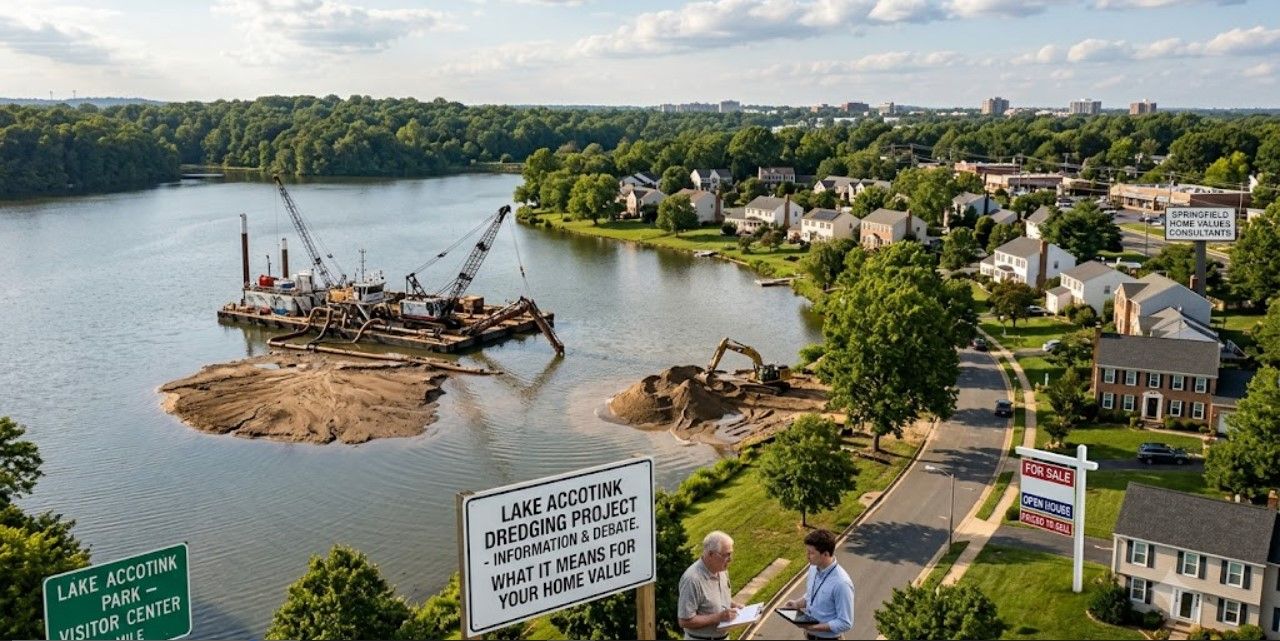
If you own a home near Lake Accotink, you have probably been told at some point that the county is going to drain the lake. That is not what was decided, but the truth is complicated enough that the rumour keeps outrunning it.
Here is the short version: the Board voted to try to save it, at a smaller size, and the studies to figure out how run into 2027 and beyond. In December 2025 the state pulled back $60.5 million in loans because the project had slipped too far. This guide walks through what actually happened, what is still undecided, and what it honestly does and does not mean for your home, from us as Fairfax County real estate agents who list homes here for a 1.5% full-service listing fee.
Quick Answer: Lake Accotink is not being drained. On 23 January 2024 the Fairfax County Board of Supervisors approved a path forward to preserve it as a smaller lake, rejecting the earlier staff recommendation to let it convert to wetland.
The problem is cost. Dredging alone was estimated at roughly $95.3 million, and with the repeat maintenance dredging the lake needs, up to about $300 million by the 20-year mark. That number is what nearly killed it in 2023.
The problem underneath the cost is sediment. A 30-square-mile watershed drains into the lake, and it has been filling at roughly 23,000 cubic yards a year. It has already been dredged twice, in 1985 and 2008.
Where it stands now: studies run into 2027, USGS analysis into 2028, and construction is projected no earlier than 2027. Because of that slippage, Virginia DEQ withdrew $60.5 million in loans in December 2025. The county can reapply. Nothing is final, and that uncertainty, not the lake vanishing, is the real story for homeowners.
Key Takeaways
- The lake is not being drained. The Board voted in January 2024 to preserve it as a smaller lake.
- The 2023 scare was real — staff formally recommended against dredging and floated a wetland conversion.
- $95.3 million to dredge, and up to roughly $300 million across 20 years with maintenance dredging.
- The state withdrew $60.5 million in December 2025 because construction slipped past the drawdown window.
- Nothing is decided. Studies run to 2027, USGS work into 2028, dredge design starts only after an alternative is picked.
- The park is not going anywhere. 476 acres, a 4-mile loop trail, 250,000-plus visitors a year.
- For home values, the enemy is uncertainty, not the outcome. Buyers price ambiguity worse than bad news.
On This Page
- What Lake Accotink actually is
- Why the lake keeps filling in
- The capacity problem, visualised
- The numbers that nearly killed it
- How the fight unfolded
- What the Board actually decided
- The $60.5 million the state took back
- Where it really stands in 2026
- What this means for home values
- Which neighbourhoods this touches
- Three outcomes, three consequences
- If you are buying near the lake
- If you are selling near the lake
- What you have to disclose
- Frequently asked questions
- Glossary
What Lake Accotink Actually Is
Start with a fact that reframes the whole argument: Lake Accotink is not a natural lake. The United States Army built it in 1940 as a freshwater supply for Camp Humphreys, which you now know as Fort Belvoir.
It is a dammed reservoir with a job. That matters, because every argument about whether to spend hundreds of millions preserving it eventually collides with the fact that nobody would build it there today, and that it has been quietly doing a second job ever since: catching the sediment and runoff of a heavily developed watershed before it reaches Accotink Creek, the Potomac, and the Bay.
What sits around it today is Lake Accotink Park: roughly 476 acres, with a 55-acre lake running from the dam at the southern end up to marshes and the Accotink stream valley. There is a 4-mile loop trail that ties into the Fairfax Cross County Trail, a marina with kayak rentals and a boat launch, an antique carousel, mini golf, a playground, volleyball and basketball courts, and picnic shelters.
It draws more than 250,000 visitors a year. In a county where most parks are a field and a car park, that is a genuine regional amenity, and it is the reason this debate produced packed public meetings rather than a quiet line item.
Why the Lake Keeps Filling In
The lake is filling with dirt, and the dirt is coming from where we live.
A 30-square-mile watershed drains into Lake Accotink. Most of it was built out after the Second World War, and crucially, most of it was built before Virginia issued meaningful stormwater management regulations in late 1980. Rain that once soaked into ground now runs off roofs, roads and driveways, hits the creek harder than it used to, erodes the banks, and carries that material downstream into the lake.
A second wave of development in the 1960s and 1970s added more. The result is not a mystery or anyone's individual fault. It is arithmetic.
The uncomfortable part: the sediment filling Lake Accotink is, in a real sense, the physical residue of the same suburban development that created the neighbourhoods and the home values around it. The houses and the lake's problem have the same cause.
The Capacity Problem, Visualised
Numbers on a page understate this. Here is the lake's storage capacity over time, and what happened each time somebody intervened.
Lake Accotink Storage Capacity
Why this keeps coming back: dredging resets the clock, it does not stop it
Bars are illustrative of the trend described in Fairfax County DPWES project documentation, not precise survey measurements. Capacity between dated studies is interpolated.
Look at the shape of it. Two dredges, two resets, and a refill rate that went up rather than down, from over 17,000 cubic yards a year to roughly 23,000. That is the entire case for the sceptics: you are not fixing a problem, you are buying time at increasing cost.
And it is also the case for the supporters: the lake has been caught and restored twice already, which is proof it can be done rather than proof it cannot.
The Numbers That Nearly Killed It
In April 2023, county staff took the numbers to the Board's environmental committee, and they were brutal.
| Item | Estimate |
|---|---|
| Dredging alone | Around $95.3 million |
| With maintenance dredging, to the 20-year mark | Up to $300 million total |
| Share of park sediment needing removal | About 43% |
| Offline lake alternative | Evaluated, still too expensive to recommend |
Christopher Herrington, the director of Public Works and Environmental Services, delivered the recommendation not to proceed and did not pretend to enjoy it. "It brings me no joy to come here with a recommendation to not proceed with dredging," he said, adding that he understood the depth of residents' connection to the lake. He was clear that the recurring maintenance cost, not the first dredge, was the nail in the coffin.
Board Chairman Jeff McKay, who grew up using the park, said he had "a hard time stomaching the recommendations." Then-Braddock District Supervisor James Walkinshaw, whose district contains the lake, pushed back hardest: "The new cost estimates are eye popping, but I'm not ready to give up."
A county survey that spring found residents split almost exactly down the middle, with "no" edging ahead by about a single percentage point. This was never a case of officials against residents. The community itself was divided.
How the Fight Unfolded
The sequence matters, because most of the rumours come from people who stopped following after 2023.
Lake Accotink, 1940 to now
From Army reservoir to the longest-running argument in Springfield
Dates and figures from Fairfax County DPWES and Park Authority documentation and contemporaneous local reporting. Verify current status before relying on any detail.
What the Board Actually Decided
This is the part that gets lost, so it is worth stating plainly.
On 23 January 2024, the Board of Supervisors approved the Task Force's findings and adopted a path forward described in the county's own words as having "the potential to preserve Lake Accotink for generations to come." The lake was not written off. The wetland-conversion recommendation was not adopted.
What the Board approved is preservation of a smaller lake, with the specifics to be worked out through further study. The alternatives now being evaluated include dredging and maintaining a smaller lake, using the dredged material on site rather than trucking it away, and creating wetland and grassland areas alongside a reduced lake.
Read that carefully: "smaller lake" and "wetland and grassland area" are not opposites here. The likely outcome is some combination — a reduced lake with wetland alongside it. The 2023 framing of lake versus wetland was always a bit of a false binary, and the current work is about finding the mix.
The scale of the reduction has not been decided. That is precisely what the feasibility study exists to answer, and it is why anyone telling you today exactly how big Lake Accotink will be in 2032 is guessing.
The $60.5 Million the State Took Back
On 5 December 2025 the county announced that Virginia's Department of Environmental Quality had withdrawn $60.5 million in construction loans earmarked for the dredging.
The money came from the Virginia Clean Water Revolving Loan Fund in two allocations, $30.5 million in 2020 and $30 million in 2021, sized against the dredging cost estimates of the time. Those programmes require the money to be drawn down within 24 months of award. With construction now projected no earlier than 2027, the project no longer met that requirement. DPWES submitted an updated schedule and asked for an extension in October 2025. DEQ said no and pulled the funds.
Do not over-read this. Turgay Dabak, the project manager, stated that "DEQ confirmed that this action does not affect Fairfax County's ability to reapply in the future," and that DPWES plans to reapply once the project nears construction. This was a bookkeeping consequence of delay, not a verdict on the lake. But it is a real signal about how long this is taking.
The honest reading is that the withdrawal is both less dramatic and more revealing than it looks. Less dramatic, because the money can come back. More revealing, because it is documentary proof that the timeline slipped so far that a funding programme timed out on it. The county also says it is pursuing grants, low-interest loans and partnership programmes in the meantime.
Where It Really Stands in 2026
As of the county's April 2026 project update, here is the actual state of play.
| Workstream | Runs through |
|---|---|
| Preservation feasibility study | Began April 2025; initial phase to autumn 2026, updated through end of 2027 |
| Sedimentation study | Summer 2024 to end of 2027 |
| Dam assessment | Autumn 2024 to early 2026 |
| Community engagement | Summer 2024 to end of 2027 |
| USGS data analysis and publication | Into 2028 |
| Dredge design and permitting | Starts only after the study concludes and an alternative is selected |
The team is currently modelling ways to make sediment settle out of Accotink Creek before it reaches the lake, and evaluating methods to trap the heavier bedload material that flowing water does not carry in suspension. In plain terms: rather than only scooping dirt out of the lake, they are trying to stop as much of it arriving. If that works, the maintenance-dredging cost that killed the original proposal comes down.
One loose end is worth knowing. The Park Authority's dam assessment finished the earthen embankment work, but the inspection of the concrete spillway was started and, in the county's phrasing, "due to unforeseen circumstances, it could not be completed." The Park Authority is working with the consultant to finalise it.
Two political notes for anyone tracking this. James Walkinshaw, the Braddock District Supervisor who fought the hardest for the lake, was elected to Congress in 2025. Rachna Sizemore Heizer won the special election and was sworn in as Braddock District Supervisor in December 2025, serving through 2027. The lake sits in the Braddock District, so her position matters to how this lands.
What This Means for Home Values
Now the part you came for, and we are going to be straight with you rather than sell you a number.
There is no published study isolating what Lake Accotink is worth to a Springfield home. Anyone quoting you a precise figure — "lake proximity adds 8%" — is inventing it or borrowing it from research about somewhere else. We would rather tell you that than make something up.
What we can tell you is what is actually knowable, and what we watch for.
What is genuinely true
- The park is not at risk. Whatever happens to the water, 476 acres of parkland, the 4-mile loop and the Cross County Trail connection remain. Most of what buyers actually use survives every scenario on the table.
- Very few homes are truly waterfront. The lake is ringed by parkland. For the overwhelming majority of Springfield homes, this is a nearby-amenity question, not a view-from-the-deck question, and amenity effects fade fast with distance.
- The strongest value drivers here are unaffected. Springfield trades on commute, schools, and price-per-square-foot relative to inner Fairfax. Nothing about the dredging debate touches any of those.
- Uncertainty is the actual cost. A buyer who reads a 2023 headline and stops there prices in a drained lake. That is worse than the truth, and it is entirely fixable with information.
What we would not claim
We would not claim the lake is irrelevant. A 250,000-visitor amenity is part of why people choose this pocket of Springfield, and if it visibly degrades over a decade, that shows up somewhere eventually. We also would not claim the current market is pricing this in with any precision, because there is no evidence it is.
The practical read: if you are within a short walk of the lake, this is worth understanding and being able to explain. If you are two miles away in the same ZIP, it is a talking point and little more. Both groups keep getting the same alarmist rumour, and only one of them has any reason to care much.
There is one place a local controversy can bite mechanically rather than emotionally, and that is the appraisal. If an appraiser leans on the wrong comparable set, or a lender's reviewer has read the same stale headline, the number can come in short of contract. Our guide to the appraisal gap and how Fairfax buyers and sellers handle low appraisals covers what to do when that happens.
For context on how the whole county's numbers get blurred at ZIP level, our Fairfax County ZIP code guide covers why 22150, 22151, 22152 and 22153 are all "Springfield" and behave nothing alike.
Which Neighbourhoods This Touches
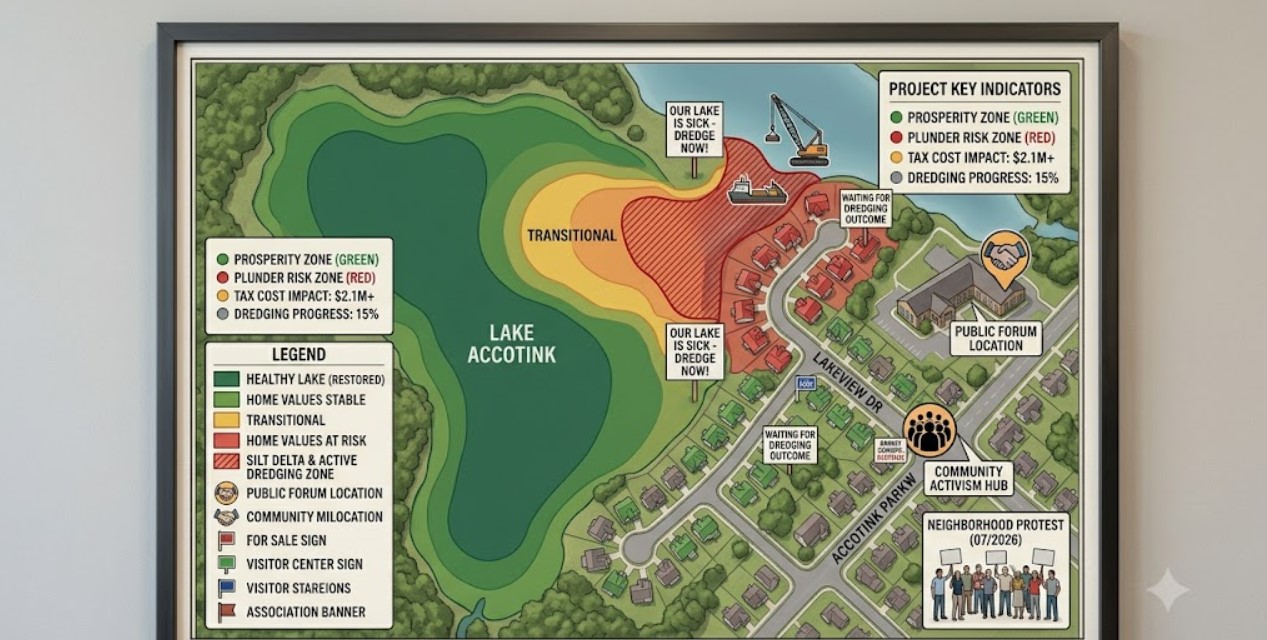
Lake Accotink sits in the Braddock Magisterial District, and the neighbourhoods that use it most are the ones threaded around the north and east of the park.
- Kings Park and Kings Glen — among the most engaged communities in the whole debate. Kings Glen Elementary has hosted county open houses on the study.
- North Springfield — established post-war stock, much of it from exactly the development wave that filled the lake.
- Ravensworth and Canterbury Woods — close-in Braddock District neighbourhoods with heavy trail use.
- Wakefield and the 22151 corridor — the 22151 ZIP has shown a median sale price in the neighbourhood of $750,000, the strongest of the Springfield ZIPs.
- West Springfield and 22152 — slightly further out, with a median more like $650,000, and correspondingly less lake exposure.
What none of those neighbourhoods are is cheap-because-of-the-lake. They are priced on the same things that price everywhere else in the county: commute, schools, and what a square foot costs relative to inner Fairfax.
Springfield overall has been showing a median around $700,000 with homes going under contract in roughly a fortnight. Those are aggregator snapshots and directional only, but the shape is clear: this is a functioning, quick-moving market that is not behaving like somewhere under a cloud.
If you want to see how the surrounding communities compare on their own terms, our guides to communities across Northern Virginia lay them out side by side.
The Jamil Brothers
LISTING FEE ESTIMATE
Illustrative sale price$700,000
At a 3% listing fee$21,000
Our listing fee @ 1.5%$10,500
Photography, drone, 3D tourIncluded
MLS syndication, negotiationIncluded
You keep$10,500
Same marketing, same negotiation, same MLS reach. One line on the settlement statement changes.
Illustrative only, not a valuation or quote. All commissions are negotiable and not set by law. Buyer's-agent compensation is separate, optional and negotiable.
Three Outcomes, Three Consequences
Nobody knows which of these lands. Here is what each would plausibly mean, clearly labelled as the speculation it is.
Notice what every column has in common: the park survives in all three. The trail survives in all three. The disagreement is about water, and about money, not about whether there is somewhere to walk the dog in 2035.
That is the single most useful thing a Springfield homeowner can understand about this issue, and it is why we spend the time to explain it rather than let a buyer's agent's half-memory of a 2023 headline set the tone of a negotiation. That is also part of what you are paying a listing agent for, and why paying 3% for someone who cannot explain it is a poor trade when our full-service listing fee is 1.5%.
If You Are Buying Near the Lake
Do not let a rumour talk you out of a good house, and do not let a listing agent wave the issue away either. Do the small amount of homework that settles it.
- Establish actual distance. Walk it. "Near the lake" covers everything from a four-minute walk to a ten-minute drive, and the difference is the entire question.
- Check the study status yourself on the county's Smaller Lake Accotink Preservation Feasibility Study page before you write an offer. It is updated, and it beats hearsay.
- Ask about construction impact, not just the outcome. If a dredge eventually proceeds, the nearby years of trucking and works are a livability question in their own right, whatever the lake ends up looking like.
- Separate the park from the water. If your reason for buying is the trail and the woods, your reason survives every scenario. If it is specifically open water, you are taking a genuine, if modest, risk.
- Do not expect a discount for it. There is no evidence sellers are pricing this in, and going in with a lowball justified by a 2023 headline will just cost you the house.
That last point deserves emphasis. Springfield homes have been going under contract in roughly two weeks, and our guide to the fastest way to sell a home in Springfield exists because this market moves, which is not the behaviour of an area buyers are fleeing.
Homes around the lake are mostly post-war and 1960s to 70s stock, which carries its own diligence entirely unrelated to sediment. You can check most of it yourself before you ever write an offer: our walkthrough of how to look up Fairfax County property records covers permits, assessments and sale history in about ten minutes, and permit gaps on a house of that age tell you more than any lake study will.
If You Are Selling Near the Lake
Your job is to make sure the first thing a buyer learns about Lake Accotink comes from you, accurately, rather than from a search two days before the deadline.
The failure mode is predictable. A buyer likes the house, goes home, searches the neighbourhood, hits a 2023 headline about the county wanting to let the lake become a wetland, and quietly downgrades the property in their head. You never hear about it. You just get no second showing.
- Get ahead of it. A short, factual paragraph in your marketing beats silence. The Board voted in 2024 to preserve a smaller lake; studies are ongoing; the park and trails are unaffected.
- Lead with the park, not the lake. 476 acres, a 4-mile loop, the Cross County Trail connection, marina, carousel. Concrete, current, and true regardless of outcome.
- Do not oversell certainty. If you claim the dredging is a done deal, you are wrong, and a sharp buyer's agent will use it to reopen price.
- Know your distance. If you are a mile out, say so plainly. Half the anxiety is people assuming proximity they do not have.
If your Springfield home has been sitting, the lake is almost certainly not the reason. Price, photos and condition explain nearly every stalled listing in this county, and the lake makes a convenient scapegoat for all three.
Before pricing, look at what you keep rather than what you list for. Our seller net sheet itemises every cost between sale price and final proceeds.
Then go line by line. Our breakdown of Burke and Springfield home sale fees and commissions walks through each cost, which are fixed, which are negotiable, and which you can remove.
The biggest line you control is the commission. On a $700,000 Springfield home a 3% listing fee runs about $21,000; our 1.5% full-service listing is about $10,500, for identical photography, syndication and negotiation. That gap is real money, and unlike the lake, it is entirely your decision.
What You Have to Disclose
Sellers ask this constantly, so here is the shape of it, with the obvious caveat that we are agents and not lawyers and you should confirm anything specific with a Virginia real estate attorney.
Virginia is fundamentally a caveat emptor state. Sellers of residential property generally provide a Residential Property Disclosure Statement under the Virginia Residential Property Disclosure Act, which largely tells buyers that the property is sold as-is and that they are responsible for their own due diligence on the property and the surrounding area, including adjacent parcels and public projects.
The general principle: Virginia's disclosure framework puts the burden on the buyer to investigate off-site conditions like a county park study. That is not licence to lie. Actively misrepresenting a known material fact is a different matter entirely from not volunteering one, and the distinction is where sellers get into trouble.
Our strong practical advice is to be forthcoming anyway, and not for moral reasons. A buyer who discovers a public controversy late feels deceived, and a buyer who feels deceived renegotiates or walks. Getting there first costs you nothing and removes the weapon.
Frequently Asked Questions
Is Lake Accotink being drained?
No. On 23 January 2024 the Fairfax County Board of Supervisors approved a path forward to preserve Lake Accotink as a smaller lake, rejecting the earlier staff recommendation to allow it to convert to wetland. The confusion comes from February 2023, when county staff did formally recommend against dredging. That recommendation was not adopted. What happens next, and how much smaller the lake becomes, is still being studied.
Why does Lake Accotink need dredging at all?
Because it is filling with sediment. A 30-square-mile watershed drains into the lake, and most of it was developed after the Second World War, largely before Virginia adopted stormwater management regulations in late 1980. Runoff erodes stream banks and carries material downstream. The lake had lost roughly 75% of its capacity by 1982, was dredged in 1985 and again in 2008, and by recent estimates is filling at about 23,000 cubic yards a year.
How much does dredging Lake Accotink cost?
County staff estimated the dredging itself at roughly $95.3 million, with total costs reaching up to about $300 million by the 20-year mark once the repeat maintenance dredging is included. It was that recurring maintenance figure, rather than the first dredge, that led staff to recommend against proceeding in 2023. Estimates predate the current feasibility study and may change.
Why did Virginia DEQ withdraw $60.5 million for Lake Accotink?
The money came from the Virginia Clean Water Revolving Loan Fund in two allocations, $30.5 million in 2020 and $30 million in 2021. Those funds must be drawn down within 24 months of award. With construction now projected no earlier than 2027, the project no longer met that requirement. Fairfax County submitted an updated schedule and requested an extension in October 2025; DEQ declined and withdrew the loans in December 2025. The county can reapply when the project nears construction.
Will Lake Accotink dredging lower my home value?
There is no published study isolating Lake Accotink's effect on Springfield home values, so anyone quoting a precise percentage is guessing. What is knowable: the 476-acre park, the 4-mile loop trail and the Cross County Trail connection survive in every scenario currently on the table, very few homes are genuinely waterfront, and Springfield's core value drivers are commute, schools and relative price. The greater practical risk is a buyer acting on a stale 2023 headline rather than the actual 2024 decision.
When will a decision on Lake Accotink be made?
Not soon. The preservation feasibility study began in April 2025 with an initial phase to autumn 2026 and updates through the end of 2027. The sedimentation study runs to the end of 2027 and USGS analysis and publication continues into 2028. Dredge design and permitting only start after the study concludes and a preferred alternative is selected, and construction is projected no earlier than 2027.
Is Lake Accotink Park closing?
No. The park is not closing and is not part of the debate. Lake Accotink Park covers roughly 476 acres with a 4-mile loop trail connecting to the Fairfax Cross County Trail, a marina, an antique carousel, mini golf, playground, sports courts and picnic areas, and it draws more than 250,000 visitors a year. The argument concerns the 55-acre lake within the park, not the parkland itself.
Is Lake Accotink a natural lake?
No. The United States Army built it in 1940 as a freshwater supply for Camp Humphreys, now Fort Belvoir. It is a dammed reservoir. That fact sits underneath the whole debate: it is an artificial structure with a large ongoing maintenance obligation, which is why some argue for returning the area to a natural stream valley and others argue it now serves an essential role catching sediment before it reaches Accotink Creek and the Potomac.
Which neighbourhoods are closest to Lake Accotink?
The lake sits in the Braddock Magisterial District, and the communities most connected to it include Kings Park, Kings Glen, North Springfield, Ravensworth, Canterbury Woods and the Wakefield area, with West Springfield somewhat further out. County open houses on the study have been held at Kings Glen Elementary School. Distance varies enormously within the same Springfield ZIP codes, so proximity is worth checking address by address.
Do I have to disclose the Lake Accotink dredging issue when selling?
Virginia is largely a caveat emptor state, and sellers provide a Residential Property Disclosure Statement that generally places responsibility on buyers to investigate the property and surrounding area, including public projects. That said, actively misrepresenting a known material fact is a different matter from not volunteering one. Practically, we advise addressing it openly, because a buyer who discovers a public controversy late tends to renegotiate or walk. Confirm your specific obligations with a Virginia real estate attorney.
What is the median home price in Springfield, VA?
Recent aggregator data has shown Springfield around $700,000 overall, with meaningful variation by ZIP: roughly $750,000 in 22151 and closer to $650,000 in 22152, with homes going under contract in about two weeks. Treat those as directional snapshots rather than valuations, since Springfield spans several ZIP codes and a wide range of housing types, and get a specific figure for a specific address.
Who is the supervisor for the Lake Accotink area?
Lake Accotink is in the Braddock Magisterial District. James Walkinshaw, who represented Braddock through the dredging fight and publicly resisted abandoning the lake, was elected to Congress in 2025. Rachna Sizemore Heizer won the ensuing special election and was sworn in as Braddock District Supervisor in December 2025, serving the remainder of the term through 2027.
Could the lake still be turned into a wetland?
Partly, and that is likelier than most people realise. The alternatives the county is evaluating explicitly include creating wetland and grassland areas alongside a smaller lake, and using dredged material on site. The 2023 framing of lake versus wetland was something of a false binary; the current work is largely about finding the mix. A full conversion to stream valley with no lake would require the Board to reverse its January 2024 direction, which is not current county policy.
What is being done to stop the sediment in the first place?
As of the county's April 2026 update, the team is modelling sediment management measures upstream of the lake, intended to encourage suspended silt to settle out of Accotink Creek before it arrives, and separately evaluating methods to trap heavier bedload sediment that flowing water does not carry in suspension. This matters financially: the recurring maintenance dredging is what made the original proposal unaffordable, so reducing sediment arrival is the most direct route to a viable long-term plan.
Glossary
Dredging: Mechanically removing accumulated sediment from a lake bed to restore depth and storage capacity.
Sedimentation: The accumulation of soil and silt carried by runoff. Lake Accotink takes in roughly 23,000 cubic yards a year.
Watershed: The land area draining to a point. Lake Accotink's is about 30 square miles of developed suburb.
Bedload: Heavier sediment that rolls along a stream bed rather than staying suspended. Harder to trap upstream.
Offline lake: A proposed alternative separating the lake from Accotink Creek. Evaluated and found too costly to recommend.
DPWES: Fairfax County's Department of Public Works and Environmental Services, which leads the stormwater side of this.
FCPA: The Fairfax County Park Authority, which owns and runs the park and is handling the dam assessment.
Clean Water Revolving Loan Fund: The Virginia DEQ programme that allocated, then withdrew, the $60.5 million.
Caveat emptor: "Let the buyer beware." The general default in Virginia residential sales.
Cross County Trail: The Fairfax trail running much of the county's length. Lake Accotink's loop connects to it.
The Bottom Line on Lake Accotink
The rumour is that Fairfax County is draining Lake Accotink. The reality is that in January 2024 the Board voted to try to save it at a smaller size, and has been studying how ever since, with the studies running to 2027 and the USGS work into 2028. Along the way the state pulled back $60.5 million because the whole thing had taken so long that a funding programme timed out on it.
For a Springfield homeowner, the useful conclusions are narrow but solid. The park is not at risk in any scenario. Very few homes here are truly waterfront. Nobody can honestly tell you the lake's dollar effect on your address, because nobody has measured it. And the largest practical risk to your sale is not sediment; it is a buyer who read one headline from 2023 and never read the correction.
That is precisely the kind of thing a listing agent is supposed to handle for you, and it should not cost you 3% of your house to get it. Ours is 1.5%, full service. If you want the real read on a specific Springfield address, that is what we do as a real estate agency working across the DMV.
When you are ready, our Sell My Home page lays out exactly how a 1.5% full-service listing works.
Explore Nearby Communities
Comparing Springfield With the Rest of Southern Fairfax?
Ready to Make a Move?
List for 1.5%. Keep the Difference.
Selling near Lake Accotink means handling a question most agents cannot answer accurately. We can, and we do it for a 1.5% listing fee.
Free, no-obligation consult. Buying instead? We will tell you what a specific Springfield address really carries, lake included.
Disclaimer: This article is an independent educational guide for informational purposes only and is not legal, tax, financial, engineering, or environmental advice. The Jamil Brothers Realty Group is not affiliated with, endorsed by, or sponsored by Fairfax County, the Fairfax County Board of Supervisors, the Fairfax County Department of Public Works and Environmental Services, the Fairfax County Park Authority, the Virginia Department of Environmental Quality, the U.S. Geological Survey, or the U.S. Army. Project details, cost estimates, study timelines, and funding status are drawn from publicly available county documentation and contemporaneous local reporting as of July 2026, are summarised in general terms, and are subject to change; cost estimates cited predate the current feasibility study. The capacity chart is illustrative of documented trends and is not a survey measurement. Statements about scenarios and outcomes are clearly identified speculation, not predictions. Market figures are directional snapshots of third-party aggregator data, not appraisals, valuations, or price quotes. Nothing here should be relied upon as a representation about any specific property or about future decisions of Fairfax County or any agency. Disclosure obligations vary by transaction; consult a licensed Virginia real estate attorney regarding your specific situation. Always confirm current project status with Fairfax County directly. The Jamil Brothers Realty Group is a licensed real estate team with Samson Properties serving Fairfax County and the greater DMV. Equal Housing Opportunity.
Explore More
Browse Every Corner of the DMV Market
Whether you're searching by budget, neighborhood, or buying situation — find exactly what you need below.
Virginia Homes by Budget
Washington DC Homes by Budget
Maryland Homes
Explore Fairfax County & Surrounding Northern Virginia
Ready to Make a Move?
Full-Service · No Tradeoffs
List for 1.5% & Keep More Equity
Professional photography, drone video, 3D tours, and expert negotiation — all included. On an $800K home, that's $12,000 more in your pocket vs. a 3% agent.
See the 1.5% Program →Need Speed or Certainty?
Get a No-Obligation Cash Offer
Skip the showings, skip the contingencies. If timing or condition matters more than top dollar, a cash offer may be the right fit. We'll walk you through every option.
Explore Cash Offers →
Categories
- All Blogs (1197)
- Aldie (3)
- Ashburn (6)
- Buyer Guide (8)
- Buying a home (2)
- Buying Strategies (30)
- festivals (1)
- General Blog (66)
- Leesburg (5)
- Market Intelligence (29)
- Market Updates (8)
- Notable Properties For Sale (29)
- Real Estate Tips, News, and More (378)
- Seller Guide (2)
- Seller Guides (60)
- Selling Your Home (504)
- Sterling (6)
- Top Realtors in Northern Virginia (58)
Recent Posts
Message Sent!
Thank you for reaching out. Arslan & Saad have received your details and will be in touch shortly.
Need immediate assistance? Call or text 703-782-4830.