
When Is the Best Time to Sell a House in Maryland?
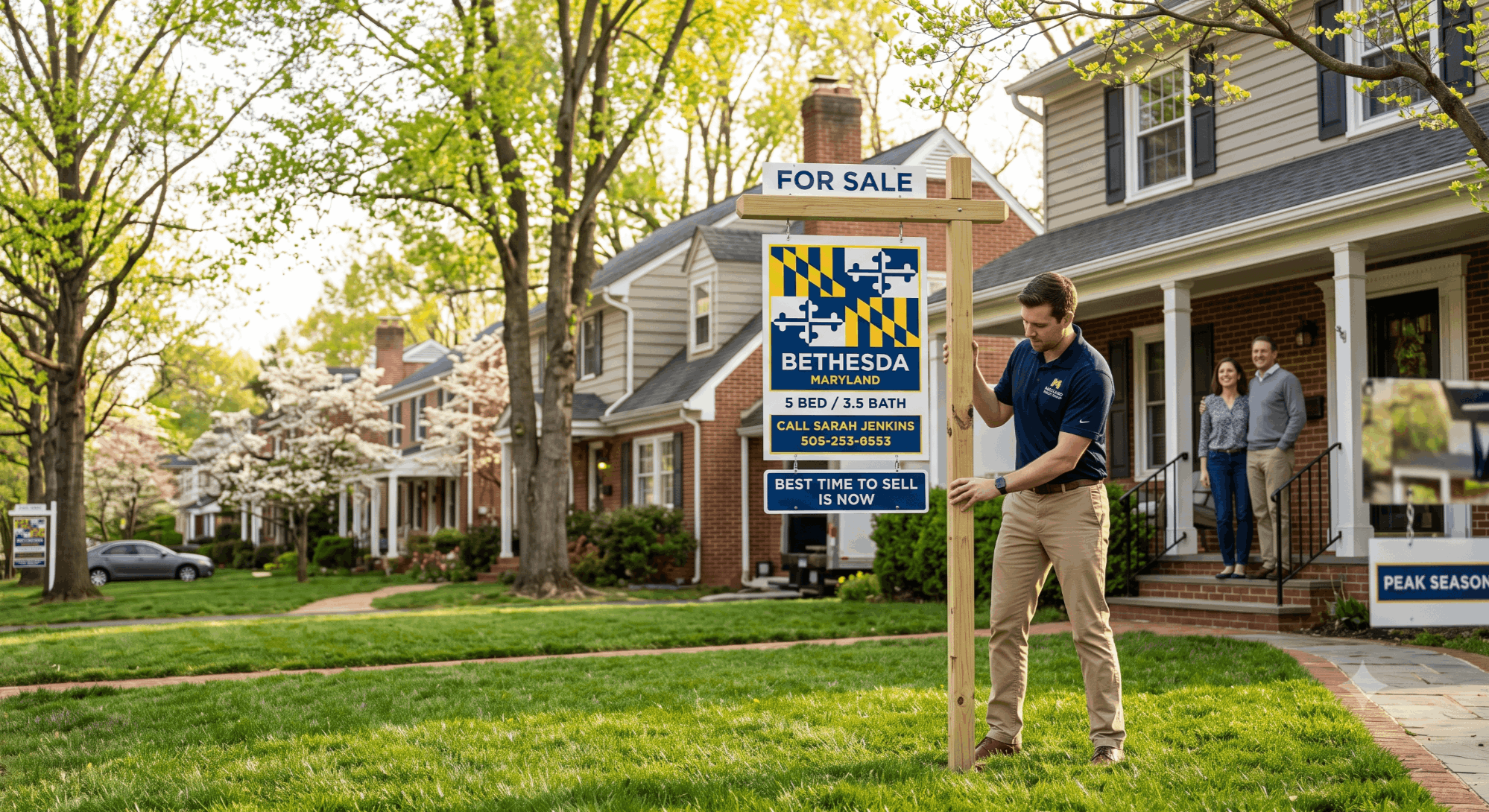
Quick Answer: The best time to sell a house in Maryland is late April through early July. Homes listed in May and June tend to fetch the highest sale prices, often a few percent above the yearly average, while April listings usually sell the fastest. Because Maryland keeps steady, year round buyer demand, a well priced and well prepared home can still sell in any season.
Key Takeaways
- Highest prices: May and June consistently deliver median sale prices roughly 3 to 5 percent above the annual average.
- Fastest sales: April listings move quickest, averaging about 43 days from listing to closing, roughly 13 days faster than the yearly norm.
- Current conditions: Maryland's median sale price sits near $448,500 with about 2.2 to 3 months of supply, which still favors sellers.
- Regional gap: Montgomery and Howard counties stay busy all year, while rural and waterfront areas swing hard with the seasons.
- Timing the list day: Homes posted Thursday evening tend to capture the most weekend showing traffic.
In This Guide
- Maryland Market Snapshot for Sellers
- Best Months to Sell a House in Maryland
- Best Season to Sell a Home in Maryland
- How Timing Differs Across Maryland
- Maryland Housing Market Forecast for Sellers
- What Pushes Maryland Home Prices Up or Down
- Costs to Plan For When You Sell
- Seller Savings Calculator
- Common Timing Mistakes to Avoid
- Options If You Cannot Wait for Peak Season
- What Timing Means for Sellers and Buyers
- Frequently Asked Questions
- Glossary of Terms
Timing your home sale is one of the few decisions that can shape both your final price and how quickly you close. In Maryland, sellers ask about timing more than almost anything else, and our Maryland real estate agents give the same honest answer every time: the right month depends on whether you care most about top dollar, a fast closing, or facing the least competition. The encouraging part is that the state's historical data tells a consistent story you can plan around.
Maryland holds steadier demand than many states thanks to its location beside Washington, D.C., a deep base of government and healthcare jobs, and well regarded school districts. Even so, real seasonal patterns exist. Spring and early summer reward sellers with stronger prices and quicker sales, while winter trades buyer volume for less competition and a more motivated pool of shoppers.
Below you will find the Maryland housing market broken down month by month, a look at how timing shifts from Montgomery County to the Eastern Shore, a clear picture of the costs you will pay, and practical strategies that help you list at the right moment no matter what your timeline looks like.
Maryland Market Snapshot for Sellers
Before you choose a month, it helps to understand where the Maryland real estate market stands today. The figures below reflect late 2025 through early 2026 data and point to a market that still leans toward sellers, though with more balance than the rush of the pandemic years.
Maryland Real Estate at a Glance
$448,500
Median Sale Price
28 to 46
Days on Market
2.2 to 3
Months of Supply
100.7%
Sale to List Ratio
+4.2%
Year over Year Price Change
30%
Sold Above List Price
Sources: Redfin, Realtor.com, Houzeo, Bright MLS (late 2025 to early 2026)
These numbers tell a clear story. With supply under five months (anything below that line signals a seller's market) and homes still closing at or above asking, sellers hold real leverage. At the same time, inventory has climbed roughly 18 to 25 percent year over year, so buyers now have more to choose from and the negotiating table is more even than it was in 2022 and 2023. Before you set a date, it is worth getting a current read on your own equity, which you can do with a free home valuation built on recent neighborhood sales rather than an automated guess.
Get a personalized valuation from The Jamil Brothers built on street level comps, not an algorithm. You will have a clear number in hand before you pick a listing date.
Best Months to Sell a House in Maryland
Maryland follows the same rhythm as much of the Mid-Atlantic, with spring and early summer carrying the most buyer activity. What sets the state apart is its steadier baseline. A large government workforce and proximity to several major metros keep demand from disappearing in the slower months the way it might elsewhere. Timing still shapes how long it takes to sell a house in Maryland, with peak months moving listings noticeably faster than the winter lull.
If Your Goal Is the Highest Sale Price
Year after year, May and June produce the strongest median prices in Maryland. Buyer competition peaks as families try to close before the next school year, and that urgency works in a seller's favor. The table below shows how each month tends to perform against the annual average.
| Month | Price Performance | vs. Annual Average | Seller Advantage |
|---|---|---|---|
| January | Below Average | -2% to -4% | Low |
| February | Below Average | -1% to -3% | Low to Moderate |
| March | Rising | +1% to +2% | Moderate |
| April | Above Average | +2% to +4% | High |
| May | Peak | +3% to +5% | Highest |
| June | Peak | +3% to +5% | Highest |
| July | Above Average | +2% to +3% | High |
| August | Average to Above | +1% to +2% | Moderate to High |
| September | Average | 0% to +1% | Moderate |
| October | Average | 0% to +1% | Moderate |
| November | Below Average | -1% to -2% | Low to Moderate |
| December | Below Average | -2% to -4% | Low |
Based on historical Maryland sales data. Actual results vary by location and property type.
If Your Goal Is the Fastest Sale
When speed is the priority, April has the edge in Maryland. April homes average about 43 days from listing to closing, roughly 13 days quicker than the 56 day annual average. May and June are close behind, with homes typically spending just 19 to 28 days on the market before going under contract.
Average Days on Market by Season
Keep in mind that days on market only measures the stretch from listing to an accepted offer. Add the usual 35 to 40 day closing window and even a strong spring sale runs about 60 to 80 days from listing to keys in hand.
Best Season to Sell a Home in Maryland
Spring (March to May): The Peak Window
Spring owns the Maryland calendar, and for good reason. As temperatures warm and landscaping greens up, buyer activity surges statewide. The market usually stirs in late February and hits full stride by April, which makes it the season most sellers aim for.
| ✓ Why Spring Works | ✗ What to Watch For |
|---|---|
| Highest buyer demand of the year | More competing listings on the market |
| Homes show their best with blooming yards | Buyers have more options to compare |
| Families motivated to close before summer | Prep work has to happen during winter |
| Multiple offers are far more common | Higher buyer expectations for curb appeal |
For a smooth spring launch, plan to be listing ready by mid-March. That means finishing repairs, decluttering, and staging over the winter so professional photos can be shot on a bright April day. Strong online photos are often the difference between a quick contract and a listing that lingers.
Summer (June to August): Strong but Cooling
Summer carries spring's momentum, especially in June and early July. Activity tends to ease by mid-July as vacations scatter buyers and humid weekends make house hunting less appealing. The upside is that summer shoppers are usually serious: families racing to settle before school starts, federal employees relocating into the D.C. metro, and military households with orders to nearby posts such as Fort Meade or Aberdeen Proving Ground.
Summer Selling Checklist
- ✓ Confirm the air conditioning runs cold and quiet for showings
- ✓ Keep the lawn and beds maintained despite the heat
- ✓ Schedule showings for cooler morning and evening hours
- ✓ Address musty odors and run a dehumidifier where needed
- ✓ Price competitively, since buyer urgency peaks early in the season
Fall (September to November): The Second Window
Fall is Maryland's quieter second season. Roughly 40 percent of yearly listings hit the market across August, September, and October. Prices and pace do not match the spring peak, but fall opens a genuine opportunity for sellers who missed the earlier rush. Buyers active now are often people who lost spring bidding wars or who have had a change of plans through a job transfer, a growing family, or a divorce. They tend to be practical and ready to move, though they may negotiate harder on price.
Early September
List to catch families settling in after the back to school rush.
Mid-September to October
Peak fall activity, with autumn color adding to curb appeal.
Early November
The last clear window before the holiday slowdown, with serious buyers still looking.
Late November
Activity slows. If your timeline allows, holding until January often pays off.
Winter (December to February): Less Competition, Serious Buyers
Winter is the slowest stretch for Maryland real estate, but that does not mean you should rule it out. Inventory thins and traffic dips around the holidays, yet the people who shop in December through February are usually highly motivated. Think corporate transferees on relocation deadlines, renters facing lease expirations, and investors chasing year end deals. The thinner field can work in your favor if you price with intent and keep the home show ready.
Winter Selling Tips for Maryland
Keep the home warm and well lit during showings, clear walkways and driveways of snow and ice, supplement winter photos with shots from warmer months, highlight energy efficient features such as insulation and newer windows, stay flexible with showing times since daylight is short, and price strategically to stand out in a smaller pool.
Our seller net sheet breaks down every cost, from commission and transfer taxes to closing fees, so you know your true bottom line before you choose a listing date.
How Timing Differs Across Maryland
Maryland stretches from the D.C. suburbs to the Chesapeake Bay to the Appalachian foothills, and each area runs on its own calendar. Knowing how your region behaves helps you fine tune the month you list.
| Region or County | Median Price Range | Typical DOM | Timing Notes |
|---|---|---|---|
| Montgomery County | $600K to $650K | 28 to 39 days | Strong year round; the federal workforce keeps demand consistent |
| Howard County | $550K to $600K | 25 to 35 days | Top schools drive spring family demand; Columbia stays popular |
| Anne Arundel County | $480K to $520K | 30 to 40 days | Waterfront peaks spring to summer; Annapolis holds year round |
| Baltimore County | $350K to $400K | 30 to 45 days | Towson and Catonsville competitive; outer areas more seasonal |
| Baltimore City | $220K to $260K | 40 to 55 days | Varies by neighborhood; trendy pockets feel less seasonal |
| Harford County | $400K to $450K | 17 to 30 days | Aberdeen and Bel Air strong; military families anchor demand |
| Prince George's County | $400K to $450K | 35 to 50 days | D.C. proximity helps; spring peak is gentler than the suburbs |
| Frederick County | $450K to $500K | 35 to 45 days | Growing market; spring and summer best for commuter appeal |
| Eastern Shore | $300K to $450K | 45 to 70 days | Highly seasonal; waterfront peaks late spring through summer |
| Western Maryland | $250K to $350K | 50 to 80 days | Most seasonal region; avoid winter listings where possible |
The D.C. metro corridor counties, including Montgomery, Prince George's, and parts of Anne Arundel and Howard, show the least seasonality because employment driven moves happen all year. Rural and resort leaning areas such as Western Maryland and the Eastern Shore swing the hardest with the calendar.
Maryland Housing Market Forecast for Sellers
Several forces will shape Maryland's market and the best moment to list in the year ahead. Here is what current projections suggest for anyone weighing when to sell.
Where Mortgage Rates Are Headed
Rates are expected to ease somewhat while staying high by historical standards. Most forecasts put the 30 year fixed in the high 5 to low 6 percent range, with brief dips below 6 percent possible if inflation keeps cooling. Lower rates tend to pull more buyers off the sidelines, and even a one point drop can expand the pool of qualifying households by millions nationwide. For Maryland sellers, that points to a livelier spring and early summer if the projections hold.
30 Year Fixed Rate Projections
Fannie Mae
5.9%
Year end
Realtor.com
6.3%
Average
Morgan Stanley
5.75%
Mid year
Bankrate
About 6%
Range
Price and Inventory Outlook
Maryland prices are projected to keep climbing at a modest pace, roughly 2 to 4 percent, supported by limited supply and a healthy job base across healthcare, technology, government, and education. Inventory should keep rising gradually as the lock-in effect loosens. Many owners who secured sub 4 percent rates have been reluctant to trade up to a higher payment, but life events eventually force moves regardless of where rates sit.
Market Outlook Summary
- Home prices: Expected to rise about 2 to 4 percent statewide, with local variation.
- Mortgage rates: Projected to average in the high 5 to low 6 percent range, easing affordability.
- Inventory: Likely to keep increasing, nudging the market toward balance.
- Market type: Shifting from a strong seller's market toward a more even one.
- Timing takeaway: Spring could see heightened activity if rates decline as forecast.
What Pushes Maryland Home Prices Up or Down
Understanding the forces behind the market helps you read whether conditions in a given stretch favor sellers or buyers.
| Factors That Push Prices Up | Factors That Push Prices Down |
|---|---|
|
|
In Maryland specifically, federal employment trends move the D.C. adjacent counties more than anything else. Policy shifts, agency relocations, and budget changes ripple straight into local housing demand. Growth in the state's biotech and cybersecurity sectors, concentrated in Montgomery County and along the I-95 corridor, also lifts demand in particular pockets.
Costs to Plan For When You Sell
Whenever you list, knowing the full cost picture keeps your expectations realistic and your timing decision grounded. Here is what Maryland sellers typically pay on a sale near the state median. For a line by line breakdown, see our guide to Maryland seller closing costs.
| Cost Category | Typical Range | On a $450,000 Home |
|---|---|---|
| Listing Agent Commission | 1.5% to 3% | $6,750 to $13,500 |
| Buyer's Agent Compensation | 2.5% to 3% | $11,250 to $13,500 |
| Maryland State Transfer Tax | 0.5% (seller share) | $2,250 |
| County Transfer and Recordation Tax | 0.5% to 1.5% | $2,250 to $6,750 |
| Title and Settlement Fees | $800 to $1,500 | $800 to $1,500 |
| Prorated Property Taxes | Varies by date | Varies |
| Home Prep and Repairs | $1,000 to $5,000+ | $1,000 to $5,000+ |
| Estimated Total | 7% to 10% | $31,500 to $45,000 |
The biggest line you can influence is the listing commission. Choosing an agent with a leaner fee can save thousands without giving up marketing or negotiation, and it is worth taking time to estimate your net proceeds before you commit to a date. Our 1.5% full-service listing program delivers professional photography, drone video, 3D tours, full MLS syndication, and expert negotiation, and if your situation calls for something different we also offer flexible commission options tailored to how you want to sell.
Every sale is different. Compare full-service options and see which commission structure keeps the most money in your pocket while covering the marketing your home needs.
Seller Savings Calculator
See how much more you keep on a Maryland sale with a 1.5% listing fee compared with a traditional 3% agent. Pick the value closest to your home to view both sides side by side.
Seller Savings Calculator
How much more do you keep with our 1.5% listing fee?
Select your home's estimated value to see your real net proceeds, side by side.
Traditional Agent, 3%
Our Fee, Only 1.5%
Extra in your pocket
$6,000
vs. a traditional 3% listing agent, with zero reduction in service or marketing.
Traditional Agent, 3%
Our Fee, Only 1.5%
Extra in your pocket
$7,500
vs. a traditional 3% listing agent, with zero reduction in service or marketing.
Traditional Agent, 3%
Our Fee, Only 1.5%
Extra in your pocket
$9,000
vs. a traditional 3% listing agent, with zero reduction in service or marketing.
Traditional Agent, 3%
Our Fee, Only 1.5%
Extra in your pocket
$11,250
vs. a traditional 3% listing agent, with zero reduction in service or marketing.
Traditional Agent, 3%
Our Fee, Only 1.5%
Extra in your pocket
$15,000
vs. a traditional 3% listing agent, with zero reduction in service or marketing.
Estimates only. Closing costs vary. Buyer's agent compensation is negotiable.
4K photography, drone video, 3D tours, expert negotiation, and full MLS marketing, all included at 1.5%. No hidden fees and no reduction in service.
Common Timing Mistakes to Avoid
Even sellers who know the seasonal patterns can stumble on timing in ways that cost money or stretch out the process. These are the mistakes we see most often in Maryland, along with how to sidestep them.
Timing Mistakes That Cost Sellers Money
1. Waiting for the perfect market
Holding out for lower rates or higher prices often backfires. While you wait, the home you plan to buy appreciates too, and you may face more competition when you finally list. If you are ready to move, the best time is usually now.
2. Listing too late in spring
Hitting the market in mid-June means you have already missed the heaviest buyer traffic of April and May. If spring is the goal, aim to list by late March or early April.
3. Underestimating prep time
Repairs, decluttering, staging, and photography all take time. Sellers who want an April launch should start preparing in January or February, not March.
4. Ignoring local nuances
Statewide averages do not apply everywhere. A waterfront Eastern Shore property follows a very different calendar than a Bethesda townhome. Work with an agent who knows your specific market.
5. Overpricing to test the market
Listing high to see what happens usually backfires. Overpriced homes linger, collect days on market, and often sell for less than if they had been priced right from day one, no matter the season.
6. Letting curb appeal slide off-season
Fall and winter sellers sometimes neglect the exterior, but first impressions matter all year. Keep walkways clear, add seasonal touches, and make sure exterior lights work for evening showings.
Options If You Cannot Wait for Peak Season
Life does not always line up with the calendar. A job relocation, a family change, or a financial situation may require selling in a slower stretch. Here are practical paths to consider.
Price Strategically for an Off-Season Sale
If you must sell in winter or late fall, pricing matters even more. Listing just below comparable spring sales helps attract the smaller pool of active buyers. The aim is to generate quick interest rather than let the home sit and gather days on market.
Consider a Cash Offer for Speed and Certainty
When closing on time matters more than squeezing out the last dollar, you can request a cash offer and close on your own schedule, often within days or weeks and regardless of the season. You typically net less than full market value, but for sellers facing a tight deadline or wanting a guaranteed result, the trade-off can be worth it.
Use a Slow Stretch to Prepare
If you know you will sell in spring but it is currently winter, put the quiet months to work. Handle repairs, refresh fixtures, paint in neutral tones, and clear up any inspection red flags. When spring arrives you can list right away instead of scrambling to get ready.
| Option | Speed | Price | Best For |
|---|---|---|---|
| Wait for peak season | Months | Highest | Flexible timeline, maximum value |
| List off-season, price sharp | 45 to 75 days | Moderate | Need to move soon, some flexibility |
| Cash offer | 7 to 21 days | Below market | Urgent timeline, certainty first |
| Rent and delay the sale | Variable | Potential gains | No urgency, willing to be a landlord |
If timing, condition, or certainty matters more than top dollar, a cash offer may fit. We will walk you through your full range of options with no pressure.
What Timing Means for Sellers and Buyers
Market conditions and timing land differently depending on which side of the deal you are on. Here is a side by side look at what the current Maryland market means for each.
| For Sellers | For Buyers |
|---|---|
|
Spring timing advantage Listing April through June maximizes competition and price potential. Start prep work months ahead. |
Off-season opportunity Fall and winter bring less competition and more room to negotiate with motivated sellers. |
|
The market still leans your way With two to three months of supply and homes selling at or above list, sellers keep leverage. |
More inventory ahead Rising supply means more choice and less pressure to jump into bidding wars. |
|
Equity keeps growing Projected 2 to 4 percent appreciation should add to your equity. No crash is expected. |
Possible rate relief If rates ease as forecast, affordability improves, and you can refinance later if they fall further. |
|
Budget for concessions Buyer requests for closing help or repairs are rising, so plan for possible concessions. |
More negotiating room Ask for closing cost credits, repair allowances, or a home warranty as sellers grow more flexible. |
Putting the Timing to Work for Your Sale
The data points clearly to late April through early July as the sweet spot for price and speed in Maryland, but the real best time to sell is the moment your home and your life are both ready. A property that is well priced, well prepared, and well marketed performs in every season, and Maryland's steady demand gives sellers more room to choose their timing than buyers in many other states. For the full process from listing to closing, our complete guide to selling a house in Maryland walks through every step.
If you want a clear plan, our team can guide you through selling your Maryland home from pricing and prep to negotiation and closing, with data driven advice tailored to your county and your goals. Start with a current value, understand your costs, and pick the month that fits your numbers and your timeline.
Get a personalized selling strategy, a clear read on your value, and a full breakdown of your costs from a team that has closed 840+ homes across the region, all at no cost or obligation.
Frequently Asked Questions
What is the best month to sell a house in Maryland?
May and June consistently bring the highest sale prices in Maryland, often 3 to 5 percent above the annual average. For the quickest sale, April has a slight edge, with homes averaging about 43 days from listing to closing. If price is your priority, target late April through June. If speed matters most, April or early May is ideal.
What is the best season to sell a home in Maryland?
Spring is the strongest season overall. From March through May, buyer demand peaks, homes show well, and listings tend to draw more competition and faster offers. Early summer keeps much of that momentum. Fall is the reliable second window, while winter trades volume for less competition and more motivated buyers.
What is the worst time to sell a house in Maryland?
December through February is typically the slowest stretch, with lighter buyer traffic, longer days on market, and prices running 2 to 4 percent below the yearly average. The holidays slow things further. That said, there is no truly bad time to sell in Maryland, since well priced homes in good shape attract buyers all year, especially in the D.C. metro corridor.
How long does it take to sell a house in Maryland?
From listing to closing, the total runs about 82 days on average, roughly 47 days on market to reach an accepted offer plus about 35 days to close. In the peak spring months that can shrink to 60 to 70 days, while slower winter listings can stretch to 90 to 100 days or more. Well priced homes in desirable areas often move faster.
Do Maryland homes sell faster in spring or fall?
Spring wins by most measures. Spring listings typically earn 3 to 5 percent higher prices and sell 10 to 15 days faster than fall listings. Fall is still the second strongest season, with roughly 40 percent of yearly listings hitting the market from August through October, and the buyers who shop then tend to be motivated even though there are fewer of them.
How much does it cost to sell a house in Maryland?
Maryland sellers generally pay 7 to 10 percent of the sale price in total costs. That covers real estate commissions, the state transfer tax of 0.5 percent, county transfer and recordation taxes of 0.5 to 1.5 percent, title and settlement fees of $800 to $1,500, and prep work. On a $450,000 home, expect roughly $31,500 to $45,000. Choosing a leaner listing fee can cut that figure meaningfully.
What day of the week is best to list a Maryland home?
Thursday evening is usually the sweet spot. About 21 percent of homes nationwide list on Thursday, which keeps a listing fresh in search results heading into the weekend when buyer activity peaks. Posting Thursday after 5 p.m. captures both end of week online browsing and Saturday and Sunday showing requests.
Should I wait for mortgage rates to drop before selling in Maryland?
Not necessarily. Lower rates may bring more buyers, but they also bring more competing sellers and can push up the price of the home you buy next. Rates are hard to predict, and waiting for perfect conditions often backfires. If you are ready to move and your circumstances line up, the current market offers solid footing for sellers, and you can refinance later if rates fall after you buy.
How do I choose a real estate agent to sell my Maryland home?
Look for proven experience in your county or neighborhood, a strong recent record of closed sales, marketing that fits your property type, and clear communication about strategy and pricing. Interview a few agents, ask for references, and review their sold listings. Compare commission structures as well. The Jamil Brothers Realty Group, for example, offers a full-service 1.5 percent listing option alongside complete marketing and negotiation support.
Is the Maryland housing market going to crash?
No credible forecast predicts a Maryland crash. Prices sit well above pre-pandemic levels with steady demand, strong employment, and limited inventory all supporting stability. Appreciation may slow to 2 to 4 percent, but that is normalization rather than decline. The state's diversified economy, anchored by government, healthcare, and technology, adds resilience against sharp corrections.
Does home staging help sell a house faster in Maryland?
Yes, especially for higher priced homes or slower stretches. Staged homes generally sell faster and often for more. At a minimum, declutter, depersonalize, and invest in professional photos. Full staging delivers the most value for vacant properties or dated interiors. The typical spend of $1,500 to $5,000 often returns several times over through quicker sales and stronger offers.
What repairs should I make before selling my Maryland home?
Focus on what buyers notice right away and what inspectors flag. High priority items include working HVAC, plumbing, and electrical systems, sound roofing, and any water damage or mold, which is common in Maryland's humid climate, especially in crawl spaces and attics. Cosmetic updates with strong returns include fresh neutral paint, updated light fixtures, and refinished hardwood floors. Avoid major renovations unless your agent recommends them, since most do not return their full cost.
Glossary of Terms
Days on Market (DOM)
The number of days a home stays listed before going under contract. A lower DOM usually signals strong demand.
Months of Supply
How long it would take to sell all current inventory at the present pace. Under five months favors sellers; over six favors buyers.
Sale to List Ratio
The final sale price divided by the original list price. Above 100 percent means homes are selling over asking.
Lock-In Effect
When owners with low pandemic era rates resist selling to avoid taking on a higher rate, which holds down inventory.
Transfer Tax
A tax due when ownership changes hands. Maryland charges 0.5 percent at the state level plus varying county rates.
Seller Concession
Money a seller contributes toward buyer costs such as closing fees or a rate buydown, common in softer markets.
Bright MLS
The multiple listing service covering Maryland and the wider Mid-Atlantic, where agents list homes and access buyer activity.
Median Sale Price
The midpoint of all sale prices in an area, where half sold for more and half for less. Less skewed than an average.
Categories
- All Blogs (1236)
- Buyer Guide (7)
- Buying a home (2)
- Buying Strategies (30)
- festivals (1)
- General Blog (66)
- Market Intelligence (28)
- Market Updates (7)
- Notable Properties For Sale (32)
- Real Estate Tips, News, and More (396)
- Seller Guides (58)
- Selling Your Home (524)
- Top Realtors in Northern Virginia (58)
Recent Posts









Let's Connect