
Why February Sellers in Northern Virginia Need a Different Strategy Than Last Year
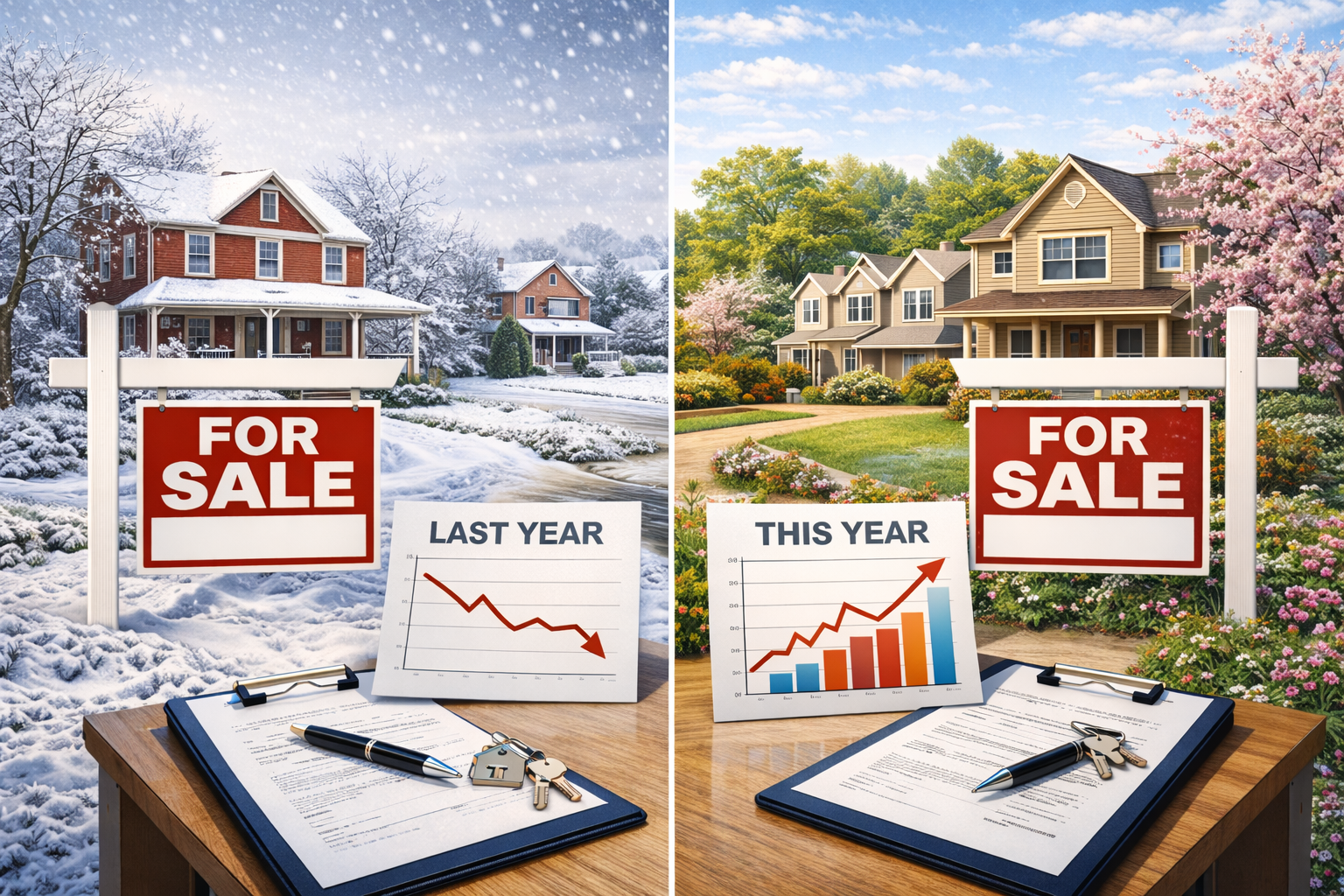
If you're thinking about listing your Northern Virginia home this February, there's something you need to understand before you do anything else: the market you're walking into is meaningfully different from the one sellers faced in February 2025. Not worse. Not crashed. But structurally different, in ways that require you to rethink pricing, preparation, and timing from the ground up.
January 2026 data from the Northern Virginia Association of Realtors (NVAR) confirmed what many agents have been seeing on the ground for months. Inventory across the region climbed 21.1% year over year. Average days on market jumped 35.5% to 42 days. Closed sales dipped 5.6%. And the median sold price slipped 1.5% to $675,000, the first meaningful downward price movement in years. These aren't catastrophic numbers. They're recalibration numbers. And recalibration rewards sellers who adapt, while punishing those who rely on the playbook from 12 months ago.
Mortgage rates have also shifted the calculus. The 30-year fixed rate averaged 6.01% as of mid-February 2026, according to Freddie Mac, nearly a full percentage point below the 6.85% average from one year ago. That means buyers have more purchasing power. But it also means they have more options, more confidence to negotiate, and less tolerance for overpriced listings. The leverage in this market is shifting, and sellers who ignore that shift are watching their listings go stale.
⚡ Quick Facts at a Glance — Northern Virginia Seller Market, February 2026
- 30-Year Fixed Mortgage Rate: 6.01% (down from 6.85% in Feb 2025) — Freddie Mac, 2/19/2026
- NoVA Median Sold Price (Jan 2026): $675,000 — down 1.5% year over year (NVAR)
- Active Listings (Jan 2026): 1,526 units — up 21.1% YoY (NVAR)
- Average Days on Market: 42 days — up 35.5% from January 2025 (NVAR)
- Months of Supply: 1.1 months — up 19.9% YoY (NVAR)
- Closed Sales (Jan 2026): 786 units — down 5.6% from January 2025 (NVAR)
- New Pending Sales: 1,001 units — up 7.3% YoY, signaling buyer activity is alive (NVAR)
- Fairfax County Inventory: Up 23% vs. same week in 2025 (Bright MLS)
- NVAR 2026 Forecast: Moderate price growth, higher inventory, rates hovering near 6%
📑 Table of Contents
- What Changed in the NoVA Seller Market Since Last February
- Why the Old Playbook No Longer Works
- Pricing Strategy: The Single Biggest Variable in 2026
- The February–April Listing Window and Why It Still Matters
- County-by-County: Where Sellers Have Leverage and Where They Don't
- Home Preparation in a Buyer-Empowered Market
- The Two-Speed Market: New Listings vs. Stale Inventory
- Negotiation Dynamics Sellers Must Prepare For
- What Smart February Sellers Are Doing Right Now
📊 What Changed in the NoVA Seller Market Since Last February
Twelve months ago, sellers in Northern Virginia were still operating with a meaningful structural advantage. Inventory was tight. Days on market were short. Most properly prepared homes attracted multiple offers within the first week. It wasn't the feeding frenzy of 2021–2022, but it was still decisively a seller's market.
That dynamic has shifted. Not collapsed — shifted. Here's what the NVAR data from January 2026 actually shows compared to the same period in 2025:
| Market Metric | January 2025 | January 2026 | Change |
|---|---|---|---|
| Closed Sales | 832 units | 786 units | ▼ 5.6% |
| Median Sold Price | $685,000 | $675,000 | ▼ 1.5% |
| Avg Days on Market | 31 days | 42 days | ▲ 35.5% |
| Active Listings | 1,260 units | 1,526 units | ▲ 21.1% |
| Months of Supply | 0.92 months | 1.1 months | ▲ 19.9% |
| New Pending Sales | 933 units | 1,001 units | ▲ 7.3% |
| 30-Yr Mortgage Rate | 6.85% | 6.01% | ▼ 84 bps |
The takeaway isn't doom. New pending sales are actually up 7.3%, which means buyers are active. But those buyers are behaving very differently than they were a year ago — they're taking longer, demanding more, and walking away from homes that don't meet their expectations on price and condition. This is the market sellers are entering in February 2026, and the strategy has to match it.
🔄 Why the Old Playbook No Longer Works
Let's be direct about what worked for sellers in February 2025 and earlier: list slightly above comps, sit back, let the scarcity of inventory drive urgency, and field offers within the first weekend. That model operated on a specific set of conditions — conditions that no longer exist in their previous form.
Here's what changed and why it matters for your February 2026 listing:
Inventory is no longer your ally by default. Active listings jumped 21.1% across Northern Virginia. In Fairfax County alone, inventory is up 23% compared to the same week in 2025. Arlington, Alexandria, Prince William, and Stafford are all seeing significant percentage increases as well. The only exception is Loudoun County, which is running roughly flat. More homes on the market means more competition among sellers — and buyers can afford to be choosy.
Buyers are no longer in a rush. The average days on market in January 2026 reached 42 days — more than a third higher than last year's 31 days. Buyers are taking their time. They're touring more homes, requesting more disclosures, and negotiating harder. The urgency-driven decision-making that favored sellers throughout 2023–2024 has largely dissipated.
Price reductions are becoming more common. As of mid-January 2026, roughly 28.4% of active listings in Virginia had undergone at least one price reduction. That's a modest uptick, but it signals that a meaningful share of sellers are mispricing their homes on day one — and paying for it on day 30 with a reduction that resets buyer perception. A price cut after weeks on market doesn't just lower your asking price — it signals weakness.
💲 Pricing Strategy: The Single Biggest Variable in 2026
Pricing has always mattered. But in a market with rising inventory and longer days on market, pricing is no longer just important — it's the single factor that most determines whether your home sells in 10 days or sits for 60.
NVAR's mid-February 2026 data reveals a striking pattern in Fairfax County that illustrates this perfectly: 73% of homes that went under contract during the three weeks ending February 18th had been on the market for less than two weeks. Meanwhile, 55% of active listings sitting unsold had accumulated 30 or more days on market, with those homes averaging over four months of exposure.
This is the definition of a two-speed market. Homes priced correctly from the start are being absorbed quickly. Homes priced aspirationally are languishing — and once a listing accumulates significant days on market, buyer interest drops sharply regardless of the eventual price reduction. If you're considering listing in the coming weeks, knowing what your home is actually worth in today's conditions is the first and most important step you can take.
How to think about pricing in February 2026:
- Start with January and February closed comp data — not September or October 2025 numbers. The market has moved since then. Use the most recent sales within a tight radius of your property.
- Account for property type dynamics. Condominiums represent the largest share of current inventory (725 of 1,526 active listings). If you're selling a condo, you face the most competition. Single-family homes (579 active) have less direct competition but must still be priced within today's range.
- Price at or slightly below fair market value. The goal in this market is to generate immediate interest and potentially create a competitive dynamic — not to "test" a price and adjust later. Testing costs you time, and time costs you perception.
- Watch your neighborhood's absorption rate. If homes similar to yours are averaging 40+ days on market, you may need to price more aggressively to stand out. If similar homes are still moving in under two weeks, you have slightly more room — but not as much as you think.
📅 The February–April Listing Window and Why It Still Matters
Despite all the shifts, one thing hasn't changed: early spring remains the best window for sellers in Northern Virginia. The reasons are structural, and they still apply in 2026.
February and March listings face less competition. NVAR projects that new listings and inventory will ramp up significantly from March through May. Sellers who list in February get to capture early-season buyer demand — the buyers who have been pre-approved, who have been watching the market through winter, and who are ready to move — before the full wave of spring inventory hits the market.
This is especially important in 2026 because inventory is already elevated compared to the prior year. When spring listings pile onto an already higher baseline, sellers who waited until April or May will face even stiffer competition than they would have at the same time last year. The math is simple: if you can be on the market by late February or early March, you're ahead of the curve.
Rate conditions favor urgency. The 30-year fixed rate at 6.01% gives buyers meaningfully more purchasing power than they had last February at 6.85%. For a buyer financing $500,000, that's roughly $130 less per month. This improved affordability is drawing more buyers into the market — new pending sales rose 7.3% year over year in January — but there's no guarantee rates stay this low. Listing early captures the buyers who are motivated by today's rate environment before the economic picture shifts.
For buyers actively shopping at these lower rates, the variety of homes for sale across Northern Virginia has expanded meaningfully compared to where things stood a year ago.
🏘️ County-by-County: Where Sellers Have Leverage and Where They Don't
Northern Virginia is not a monolith. Your strategy in February 2026 should be calibrated not just to the regional market, but to the specific dynamics of your county and property type. NVAR's 2026 Regional Housing Market Forecast provides jurisdiction-level predictions that sellers should take seriously.
| Jurisdiction | 2026 Price Forecast | Sales Volume Forecast | Inventory Trend |
|---|---|---|---|
| Fairfax County | +1.9% | +8.4% | Rising (+35.8% SF) |
| Arlington County | +3.8% | +1.1% | Spiking (+27.8%) |
| Alexandria | +4.2% | +4.5% | Rising moderately |
| Loudoun County | +3.3% | +7.6% | Sharp rise (+36.2%) |
| Prince William County | -0.2% | +3.0% | Rising |
| Stafford County | -4.6% | — | Rising |
What this means for your listing strategy:
Arlington and Alexandria sellers are in the strongest position, with NVAR forecasting 3.8% and 4.2% price growth respectively. Strong walkability scores, proximity to Metro, and sustained demand from professionals working in D.C. continue to differentiate these markets. Even here, however, inventory is rising substantially (Arlington's projected at 27.8%), so accurate pricing and sharp presentation are still critical.
Fairfax County sellers face the most nuanced market. Prices are forecast to grow just 1.9% — barely above flat — while inventory is projected to climb more than 35% for single-family homes. This is the county where pricing discipline matters most. The good news: sales volume is forecast to rise 8.4%, meaning buyers are expected to be active. But they'll have abundant choices. Sellers who want to understand how their specific Fairfax property stacks up should consider getting a data-driven market evaluation before committing to a list price.
Prince William and Stafford sellers need to be most cautious. Price forecasts in both counties are essentially flat to negative. Sellers in these areas should price conservatively, prepare their homes aggressively, and consider listing earlier rather than later to capture available demand before spring inventory arrives.
Loudoun County occupies an interesting middle ground. Prices are projected to grow 3.3%, and sales volume is expected to climb 7.6%, which is healthy. But a projected 36.2% jump in inventory means competition among sellers will intensify rapidly. The Silver Line corridor areas around Ashburn and Reston remain among the region's strongest sub-markets, particularly for homes near Metro stations.
🏠 Home Preparation in a Buyer-Empowered Market
In a tight-inventory market, sellers could get away with a moderate approach to preparation. Buyers had fewer options and were willing to overlook deferred maintenance, dated finishes, or imperfect staging because the alternative was losing out entirely. That calculation has changed.
With 21% more active listings and buyers spending more time evaluating options, the homes that stand out are the ones that look and feel move-in ready. This doesn't necessarily mean a full renovation. It means being intentional about the details that drive buyer perception.
Pre-listing preparation priorities for February 2026:
- Pre-listing inspection. In 2026, more buyers are including inspection and appraisal contingencies — a luxury that didn't exist during the bidding-war era. Getting ahead of inspection issues before listing removes negotiation ammunition from buyers and signals confidence in your home's condition.
- Professional photography and video. This was always important, but it's now non-negotiable. With buyers scrolling through 20+ listings before scheduling a tour, your online presentation determines whether you even get a showing. Poor photos are the fastest way to add days on market.
- Staging — even if it's partial. Vacant homes are harder to sell in this market. Even light staging (key rooms like living room, primary bedroom, kitchen) makes a measurable difference in online engagement and showing frequency.
- Curb appeal updates. February and March weather in Northern Virginia means bare landscaping and grey exteriors. Power washing, fresh mulch, a painted front door, and updated exterior lighting create a first impression that sets your home apart from the competing listing down the street.
- Address dated finishes selectively. You don't need to gut a kitchen. But replacing outdated light fixtures, adding modern hardware, and refreshing paint in neutral tones can meaningfully shift buyer perception of value. Focus on the changes with the highest return per dollar spent.
Sellers who are planning to list and want to reduce their total cost of sale should also understand how commission structure affects net proceeds. In a market where every percentage point of cost matters, listing at a competitive commission rate can make a significant difference in your bottom line without sacrificing service quality or market exposure.
⚡ The Two-Speed Market: New Listings vs. Stale Inventory
One of the most important dynamics defining the February 2026 market — and one that most sellers are unaware of — is the sharp divide between fresh listings and stale inventory. This isn't theoretical. The data is striking.
According to mid-February 2026 tracking data from Bright MLS for Fairfax County, 73% of homes that went under contract during the three weeks ending February 18th had been on the market for fewer than 14 days. Only 20% of homes going under contract during that period had accumulated more than the average days on market — and those homes had been sitting for an average of nearly four months.
Meanwhile, 55% of the active homes sitting unsold on February 18th had 30 or more days on market. These are the "stale" listings — many of which originally listed in fall 2025 with aspirational pricing, failed to sell, and are now carrying the stigma of extended market time.
Why this matters for February sellers:
Buyers in 2026 are discriminating between new and old inventory at a ratio of roughly 2-to-1. They are gravitating toward freshly listed homes and largely ignoring listings that have been sitting. This means your listing's first two weeks on market are absolutely critical. If you don't generate meaningful interest within that window, your home risks falling into the "stale" category — and recovering from that perception is extremely difficult, even with a price reduction.
This is why preparation before listing matters so much more than it did a year ago. The margin for error is smaller. A home that launches with professional photos, accurate pricing, strategic marketing, and a polished showing experience will capitalize on that initial burst of buyer attention. A home that launches underprepared — even at the right price — may miss the window entirely.
Ready to position your home ahead of the spring rush? Let's build a strategy tailored to your neighborhood, your property type, and today's market.
🤝 Negotiation Dynamics Sellers Must Prepare For
For the first time in roughly five years, buyers in Northern Virginia are successfully including inspection and appraisal contingencies in their offers. Waived contingencies — which became standard practice during the 2021–2023 frenzy — are no longer the norm. This is a significant shift, and sellers need to be prepared for what it means at the negotiation table.
What to expect when offers come in:
- Inspection contingencies are back. Buyers are negotiating credits for deferred maintenance found during inspection. Pre-listing inspections can help you address major issues upfront and reduce buyer leverage.
- Appraisal contingencies are standard again. Lenders are holding tight on appraisal values, and buyers with contingencies can renegotiate if the appraisal comes in below the contract price. This is another reason accurate pricing matters — overpriced homes that go under contract often face appraisal gaps that collapse deals.
- Closing cost assistance is being requested more frequently. With mortgage rates at 6.01%, buyers are asking sellers to contribute toward rate buydowns or closing costs. This is becoming a standard negotiation tactic, and sellers should budget for it rather than being caught off guard.
- Multiple offers are rarer. While well-priced homes in desirable locations can still attract competing bids, the expectation of receiving five or ten offers on the first weekend is largely gone. Plan for a one-at-a-time negotiation process and evaluate each offer on its complete terms — not just price.
Understanding today's financing landscape and what buyers are working with can help sellers anticipate the types of offers they'll receive and structure counteroffers that keep deals on track.
The federal workforce factor. One variable that remains partially unresolved is the impact of federal government workforce reductions. Mass layoffs across several agencies throughout 2025 introduced uncertainty into the DMV housing market. NVAR CEO Ryan McLaughlin has noted that the full effect has not yet been realized. While Northern Virginia's economy has diversified significantly — Amazon HQ2, NVIDIA's Manassas facility, and the Loudoun County data center corridor all anchor substantial private-sector employment — federal workforce disruptions can still affect buyer confidence and demand in specific sub-markets, particularly those with higher concentrations of government employees.
✅ What Smart February Sellers Are Doing Right Now
The sellers who will get the best outcomes in this market aren't the ones sitting on the sideline waiting for conditions to improve. They're the ones acting now with a clear, data-driven strategy. Here's what that looks like in practice:
1. Getting a current, comp-based market evaluation — not a Zestimate. Online automated valuations use algorithms that haven't fully adjusted to the 2026 market shift. A professional evaluation based on January and February 2026 closed comparables, active inventory, and neighborhood-specific absorption rates gives you a pricing foundation you can actually rely on.
2. Choosing a listing date strategically. Mid-to-late February through mid-March is the window. List too early (first week of January) and you sit through the slowest buyer-activity weeks of the year. List too late (April or May) and you're competing against the largest wave of new inventory. The goal is to be visible when buyer demand is ramping but before the full spring supply surge.
3. Investing in preparation before listing. Pre-listing inspection, professional staging, high-quality photography and video, and targeted updates to dated finishes. These aren't luxuries — they're the cost of competing in a market where buyers have 21% more options than they did last year.
4. Pricing at or just below fair market value. The homes moving quickly in February 2026 are priced accurately from day one. The homes sitting are priced for last year's market. Accurate pricing generates showings, showings generate offers, and offers generate leverage. Aspirational pricing generates days on market and eventual price reductions.
5. Marketing with a multi-channel strategy. MLS syndication alone isn't enough. Social media, video walkthroughs, neighborhood-targeted digital advertising, and email campaigns to active buyer databases all play a role in driving the maximum number of qualified buyers to your listing in the critical first two weeks. Many buyers who are already exploring available homes in the region can be reached proactively with the right marketing approach.
6. Working with a team that understands the 2026 market — not the 2024 market. The strategy for selling in a rebalancing market is fundamentally different from the strategy for selling in a seller's market. Your agent's ability to read current data, price accurately, negotiate effectively, and market aggressively is the difference between selling in two weeks and sitting for two months.
Sellers exploring their options should also factor in the financial side of the equation. With rates near three-year lows, understanding current financing conditions and their impact on your next purchase can help you plan a seamless transition from your current home to your next one.
And for those focused on maximizing net proceeds, reducing your listing-side commission while maintaining full-service marketing and negotiation support can put thousands of additional dollars in your pocket — especially in a market where sale prices aren't climbing the way they were. Our 1.5% listing model is built specifically for this environment.
❓ Frequently Asked Questions
Is now a good time to sell a home in Northern Virginia?
Yes, but with a different approach than prior years. The February–March window still offers the best timing for sellers who want to capture early buyer demand before spring inventory peaks. Mortgage rates near 6% are drawing more buyers into the market, and new pending sales rose 7.3% year over year in January 2026. Success depends on pricing accurately and preparing the home thoroughly.
How long are homes taking to sell in Northern Virginia in 2026?
The average days on market in January 2026 was 42 days across the NVAR region — up 35.5% from January 2025. However, homes priced correctly are still selling much faster. In Fairfax County, 73% of homes going under contract in mid-February had been listed for less than two weeks. The difference is almost entirely about pricing strategy.
Are home prices dropping in Northern Virginia?
Prices are moderating, not crashing. The NVAR region saw a 1.5% decline in median sold price in January 2026, but NVAR's 2026 forecast still projects moderate price growth across most jurisdictions — ranging from 1.9% in Fairfax to 4.2% in Alexandria. Prince William and Stafford counties may see flat to slight negative movement.
What is the biggest mistake sellers are making right now?
Overpricing based on 2024 or early 2025 comparable sales data. The market has shifted, and prices need to reflect current conditions. Homes that launch too high accumulate days on market, require price reductions, and ultimately sell for less than they would have if priced accurately from the start.
How much has inventory increased in Northern Virginia?
Active listings rose 21.1% year over year to 1,526 units in January 2026, according to NVAR. In Fairfax County specifically, inventory is up 23% compared to the same week last year. NVAR forecasts continued inventory growth throughout 2026, with single-family inventory in Fairfax rising an estimated 35.8%.
What mortgage rate do buyers have right now?
The 30-year fixed-rate mortgage averaged 6.01% as of February 19, 2026, per Freddie Mac — the lowest level since September 2022 and nearly a full point below the 6.85% rate from February 2025. Most forecasters expect rates to hover in the low 6% range through the first half of 2026, with the possibility of dipping into the upper 5s later in the year.
Should I do a pre-listing inspection before selling?
In the 2026 market, pre-listing inspections are strongly recommended. With buyers routinely including inspection contingencies again, knowing — and addressing — major issues upfront removes negotiation leverage from the buyer and signals confidence. It also prevents deal-killing surprises after you've already gone under contract.
How are federal layoffs affecting the DMV housing market?
Federal workforce reductions have introduced uncertainty, but the full impact on housing demand has not yet materialized according to NVAR. Northern Virginia's economy has diversified significantly, with major employers like Amazon, NVIDIA, and the data center industry in Loudoun County offsetting government-related softness. Markets closest to major federal employment centers may see slightly more caution from buyers.
Which Northern Virginia counties are best for sellers right now?
Arlington and Alexandria are projected to see the strongest price growth in 2026 at 3.8% and 4.2%, respectively. Fairfax County remains the largest market with healthy sales volume forecasts but requires the most pricing discipline. Loudoun is strong but facing significant inventory increases. Sellers in Prince William and Stafford counties should expect flat to slightly declining prices.
What does "two-speed market" mean for sellers?
It means homes that are priced right and well-presented are selling within two weeks, while overpriced or underprepared homes are sitting for months. In Fairfax County, 73% of recent contracts were on homes listed less than 14 days, while 55% of unsold inventory had been on the market 30+ days. Sellers who launch correctly thrive; those who don't face an uphill battle.
Ready to Sell Smart in 2026?
The Jamil Brothers Realty Group helps Northern Virginia sellers navigate today's market with data-driven pricing, full-service marketing, and a commission model designed to maximize your net proceeds. Call us at 703-782-4830 or get started below.
Categories
- All Blogs (1235)
- Buyer Guide (7)
- Buying a home (2)
- Buying Strategies (30)
- festivals (1)
- General Blog (62)
- Market Intelligence (28)
- Market Updates (7)
- Notable Properties For Sale (32)
- Real Estate Tips, News, and More (396)
- Seller Guides (58)
- Selling Your Home (523)
- Top Realtors in Northern Virginia (58)
Recent Posts








Let's Connect