
What Is the Process for Selling a House in Annapolis, MD?
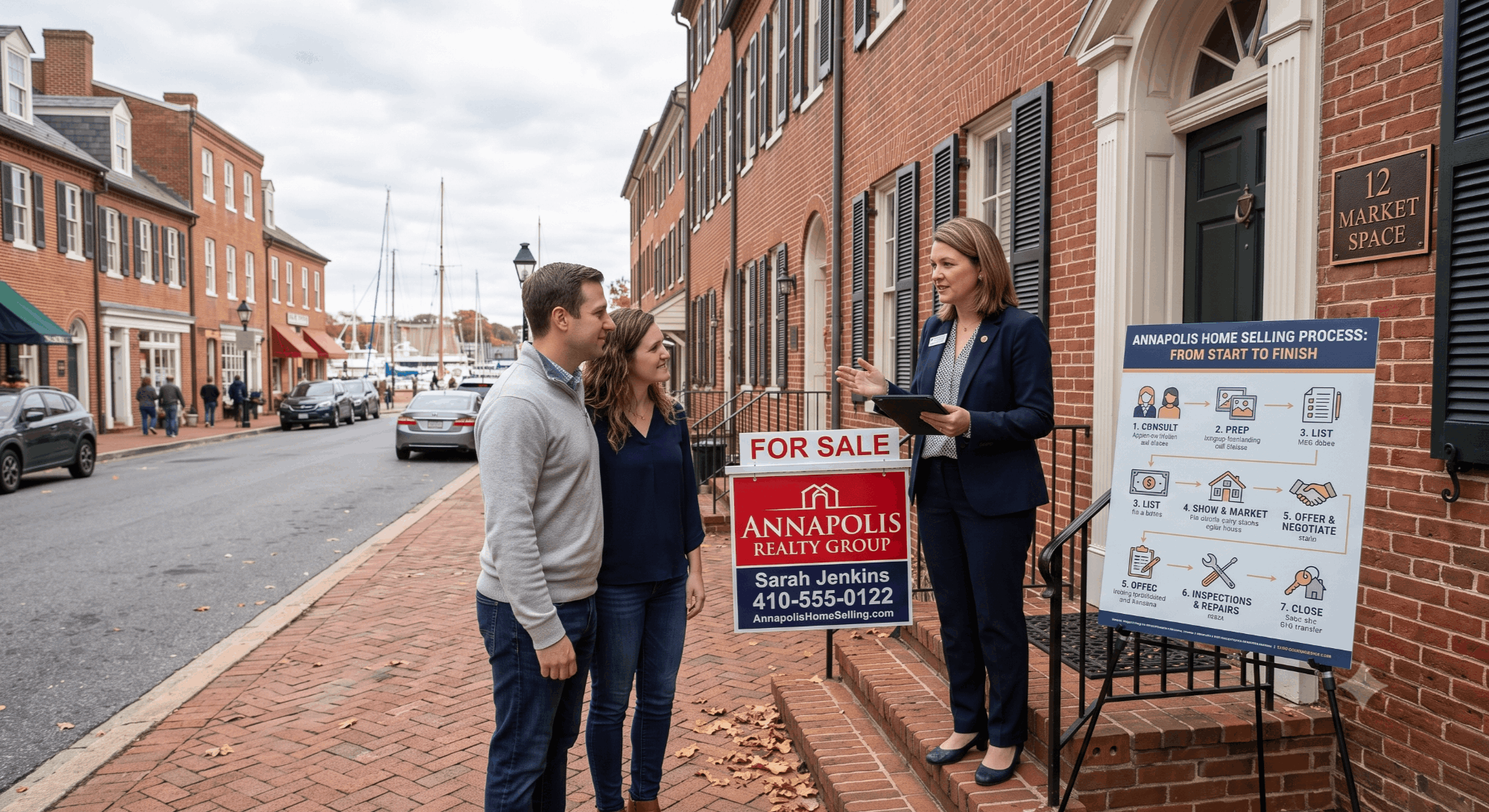
Selling a house in Annapolis, MD follows the same core path as any Maryland home sale, but the local details shape every step. The process moves through a clear sequence: set your goals and price the home, prepare and stage it, list on the Bright MLS, review offers and negotiate, clear the buyer's inspection and financing, then sign at settlement. Because Annapolis blends waterfront property, historic districts, and steady Naval Academy demand, working with Maryland home selling experts who understand these micro-markets helps you move through each stage with fewer surprises and a stronger net result.
This guide walks through the full process step by step, then covers how long a sale takes, what it costs, the extra requirements for waterfront homes, and the mistakes that slow sellers down. Whether you are selling a downtown colonial, an Eastport cottage, or a suburban home near the Academy, the roadmap below shows exactly what to expect from decision to closing day.
Quick Answer
The process for selling a house in Annapolis, MD runs through seven stages: set your goals and choose a selling path, price the home with a comparative market analysis, prepare and stage it, list on the Bright MLS with professional marketing, review and negotiate offers, clear inspection and appraisal, then close at settlement and record the deed with Anne Arundel County. Start to finish, most sales take about 10 to 14 weeks, and sellers typically budget 3.5% to 4.5% of the price for closing costs on top of commission.
Key Takeaways
- Seven-step process: goals and pricing, prep, listing, offers, contract, closing, and recording the deed.
- Typical timeline: about 10 to 14 weeks from listing to settlement, faster for sharply priced homes.
- Closing costs: roughly 3.5% to 4.5% of the sale price, plus a separate, negotiable listing commission.
- Transfer taxes: 1.0% county (under $1,000,000) or 1.5% ($1,000,000 and up), plus 0.5% state and $7.00 per $1,000 recordation.
- Waterfront homes add steps: flood disclosures, bulkhead inspection, pier permits, and Critical Area compliance.
- Commission savings: a full-service 1.5% listing fee can save thousands versus a traditional 3% rate.
In This Guide
- How the Annapolis Selling Process Works
- Step-by-Step: Selling a House in Annapolis
- How Long Does the Process Take?
- Costs Involved in Selling
- Seller Savings Calculator
- Extra Steps for Waterfront Homes
- Common Mistakes to Avoid
- Alternatives to a Traditional Sale
- Choosing the Right Agent
- Frequently Asked Questions
- Glossary of Key Terms
How the Annapolis Selling Process Works
At a high level, selling a home in Annapolis is a linear process with a few local twists. You establish a price, get the property market-ready, expose it to buyers through the Bright MLS, negotiate the strongest offer, then work through inspection, appraisal, financing, and title before signing at settlement. What makes Annapolis distinct is the mix of buyers and property types: military families relocating on tight timelines, boaters chasing waterfront, and second-home shoppers drawn to the Historic District all move through the same market.
That demand keeps Annapolis firmly in seller's-market territory, but it does not make pricing automatic. Understanding where your home sits before you list is what lets you sell quickly and for full value rather than chasing the market down with price cuts.
Annapolis Selling at a Glance
- Market type: Seller's market, driven by limited inventory and steady demand.
- Median sale price: generally in the $600,000s citywide, with Downtown and Eastport running well higher.
- Months of supply: under two months in the city, well below the six-month balanced-market mark.
- Time to contract: sharply priced homes often go pending within about a month.
Housing Supply: Annapolis vs a Balanced Market
Below roughly four months of supply is generally considered a seller's market. Estimates vary by property type and source.
Every smart sale starts with an accurate number. Get a personalized valuation from The Jamil Brothers based on real, street-level Annapolis comps, not an automated guess.
Step-by-Step: Selling a House in Annapolis
Here is the process broken into seven concrete steps. Each one builds on the last, so completing them in order keeps your sale on schedule and protects your leverage at the negotiating table.
Set Your Goals and Choose a Selling Path
Decide what matters most: top dollar, speed, or certainty. That choice points you toward a traditional full-service listing, a lower-cost listing model, or a cash sale. Clarifying your timeline and priorities up front is the foundation for every decision that follows when you sell your home in a market this varied.
Price the Home With a Comparative Market Analysis
Online estimates struggle in Annapolis because they blend waterfront, historic, and inland homes within the same zip code. A professional comparative market analysis, or a formal realtor home valuation built on recent local sales, gives you a defensible list price that matches your specific property type and neighborhood.
Prepare and Stage Your Annapolis Home
Focus on high-return work: deep clean and declutter, refresh landscaping and power wash the exterior, and apply neutral paint where needed. If the home has any water view, even a partial one, clear sightlines by trimming trees and cleaning windows. This is also the stage to prepare the paperwork buyers will expect, including the property condition forms covered by Maryland home seller disclosure rules. Skip major remodels, which rarely recoup their full cost in this market.
List on the Bright MLS and Market the Property
Your listing goes live on the Bright MLS and syndicates to consumer sites. Strong marketing includes professional photography, drone imagery for waterfront or larger lots, a floor plan, and a launch strategy timed to your first weekend of showings and an open house.
Review Offers and Negotiate Terms
Compare offers on more than price alone: financing type, contingencies, closing date, and buyer flexibility all matter. Following the National Association of Realtors settlement dated August 17, 2024, buyer-agent compensation is negotiated separately and is no longer assumed to come from your listing fee, so factor that into how you evaluate each offer.
Clear Inspection, Appraisal, and Financing
Once under contract, the buyer schedules a home inspection, the lender orders an appraisal, and financing moves toward approval. You may negotiate repair requests, the title company runs its search, and any waterfront or historic-district documentation is reviewed during this due-diligence window.
Close at Settlement and Record the Deed
After the final walkthrough, you sign the deed and closing documents at settlement. Funds are disbursed, transfer and recordation taxes are paid from proceeds, and the title company records the transfer with Anne Arundel County. Your net proceeds are usually released within one to three business days.
From pricing to closing, we manage every step so you can focus on your move. See how a full-service listing works and exactly what to expect from day one.
How Long Does the Process Take?
From the moment you decide to sell until closing day, a typical Annapolis sale takes about 10 to 14 weeks. Well-priced homes in strong neighborhoods can go under contract in three to four weeks, while the under-contract-to-closing stretch usually adds another 30 to 45 days for inspection, appraisal, financing, and title work. For a statewide comparison, our guide to the Maryland home selling timeline shows how these stages shift by market. The phases below show how that timeline breaks down in Annapolis.
| Phase | Typical Duration | What Happens |
|---|---|---|
| Pre-listing prep | Weeks 1 to 2 | Choose an agent, get a CMA, complete repairs, order photography. |
| Go live | Week 3 | Listing activates on Bright MLS, first showings and open house. |
| Showings and offers | Weeks 3 to 7 | Gather feedback, receive offers, negotiate, and accept the best one. |
| Under contract | Weeks 7 to 10 | Inspection, appraisal, financing, repair negotiation, title search. |
| Closing | Weeks 10 to 14 | Final walkthrough, settlement, deed recorded, proceeds disbursed. |
When Is the Best Time to Sell in Annapolis?
Spring through early summer is the strongest window. Buyer traffic peaks with boating season, Naval Academy graduation and Commissioning Week, and the summer wave of military relocations, which brings a reliable pipeline of buyers who often have financing ready. Listing in early spring positions your home in front of that demand, and statewide data on the best month to list in Maryland supports that timing. If you sell in fall or winter, price a touch more competitively to account for a smaller buyer pool.
Costs Involved in Selling a House in Annapolis
Maryland's closing costs are more layered than many sellers expect, mostly because of transfer and recordation taxes charged at both the state and county level. In Anne Arundel County, which includes all of Annapolis, the county transfer tax rate depends on whether your sale price is above or below $1,000,000. Knowing your full seller closing cost picture before you list keeps your net-proceeds expectations realistic.
| Cost Category | Rate or Amount | Who Typically Pays |
|---|---|---|
| State transfer tax | 0.5% of sale price | Split buyer and seller (typical) |
| County transfer tax (under $1M) | 1.0% of sale price | Split buyer and seller (typical) |
| County transfer tax ($1M and up) | 1.5% of sale price | Split buyer and seller (typical) |
| Recordation tax | $7.00 per $1,000 | Split buyer and seller (negotiable) |
| Title services and insurance | about $1,200 to $1,800 | Seller (owner's policy) |
| Recording and misc. fees | about $100 to $300 | Varies |
| Prorated property taxes | about $1.09 per $100 assessed | Seller (for period owned) |
| HOA transfer fees (if any) | $200 to $500 | Varies by HOA |
What Do the Costs Look Like in Dollars?
The example below uses a $650,000 sale, a typical Annapolis price point, and assumes the customary split of transfer and recordation taxes between buyer and seller. For a full county-by-county Maryland closing cost breakdown, our statewide guide compares every jurisdiction. It also compares a traditional 3% listing commission with a full-service 1.5% fee so you can see the difference on one line.
Estimated Seller Costs on a $650,000 Sale
| Seller share of state transfer tax (0.25%) | $1,625 |
| Seller share of county transfer tax (0.5%) | $3,250 |
| Seller share of recordation tax (about 0.35%) | $2,275 |
| Title services and insurance | $1,500 |
| Recording and misc. fees | $300 |
| Estimated closing costs (before commission) | about $8,950 |
| Listing commission at 3% | $19,500 |
| Listing commission at 1.5% (full-service) | $9,750 |
| Savings with the 1.5% full-service fee | $9,750 |
Figures are estimates. Tax splits and commission are negotiable and depend on your contract.
One Maryland quirk to plan for: if your buyer is a first-time Maryland home buyer, the state transfer tax drops to 0.25%, but the seller pays that full amount. In practice, your seller-side transfer tax obligation can be similar either way, so confirm the exact split in your contract rather than assuming.
Transfer taxes, recordation tax, title fees, and commission all come out at settlement. Our seller net sheet breaks down every line so you know your real bottom line before you list.
Seller Savings Calculator
Commission is usually the single largest cost in the selling process. Select a price point below to see how much more you keep with a full-service 1.5% listing fee compared with a traditional 3% agent.
Seller Savings Calculator
How much more do you keep with our 1.5% listing fee?
Select your home's estimated value to see your real net proceeds, side by side.
Traditional Agent, 3%
Our Fee, Only 1.5%
Extra in your pocket
$6,000
vs. a traditional 3% listing agent, with zero reduction in service or marketing.
Traditional Agent, 3%
Our Fee, Only 1.5%
Extra in your pocket
$7,500
vs. a traditional 3% listing agent, with zero reduction in service or marketing.
Traditional Agent, 3%
Our Fee, Only 1.5%
Extra in your pocket
$9,000
vs. a traditional 3% listing agent, with zero reduction in service or marketing.
Traditional Agent, 3%
Our Fee, Only 1.5%
Extra in your pocket
$11,250
vs. a traditional 3% listing agent, with zero reduction in service or marketing.
Traditional Agent, 3%
Our Fee, Only 1.5%
Extra in your pocket
$15,000
vs. a traditional 3% listing agent, with zero reduction in service or marketing.
Estimates only. Closing costs vary. Buyer's agent commission is negotiable.
Extra Steps for Selling a Waterfront Home
Waterfront homes are the crown jewels of the Annapolis market, but they add steps to the selling process that inland sellers never encounter. Getting this documentation in order before you list prevents deal-killing surprises during inspection and due diligence.
| Waterfront Advantages | Waterfront Challenges |
|---|---|
| National, even international, buyer pool | Flood zone disclosure required |
| Much higher value per square foot | Higher insurance can narrow the buyer pool |
| Strong lifestyle premium over comps | Bulkhead or seawall condition can be a dealbreaker |
| Limited supply supports steady appreciation | Longer days on market at premium prices |
Waterfront Seller Checklist
- ✓ Obtain a current bulkhead or seawall inspection report
- ✓ Confirm flood zone designation and current flood insurance costs
- ✓ Document pier permits, riparian rights, and depth at mean low water
- ✓ Gather records of any Maryland Critical Area compliance work
- ✓ Commission water-side photography during golden hour
- ✓ Pre-inspect for moisture, mold, or foundation concerns
Common Mistakes Annapolis Sellers Make
A strong market can create a false sense of security. These are the errors that most often cost Annapolis sellers time and money during the selling process.
Mistakes to Avoid
- Pricing from an automated estimate alone. Online valuations struggle with waterfront and historic premiums and can miss by tens of thousands.
- Ignoring seasonality. Listing in the slowest months means a smaller buyer pool. Spring into early summer draws the most demand.
- Skipping a pre-listing inspection. Older downtown and waterfront homes often hide moisture, settling, or system issues a buyer's inspector will find.
- Underestimating transfer taxes. Combined transfer and recordation taxes can add several thousand dollars to a seller's closing costs.
- Neglecting waterfront documentation. Missing bulkhead reports, flood details, or dock permits can delay or kill a deal.
- Overimproving before listing. A large remodel rarely returns its full cost. Prioritize paint, cleaning, and curb appeal.
- Choosing an agent on promised price alone. An inflated list price to win the listing often leads to reductions after weeks on market.
Alternatives to a Traditional Sale
A traditional on-market listing is the right fit for most sellers, but not every situation. Some owners prioritize speed or skip repairs and choose to sell a Maryland house as-is, while others hold out for maximum price. Here is how the main paths compare so you can match the process to your goals.
| Option | Speed | Net Proceeds | Best For |
|---|---|---|---|
| Traditional listing | 10 to 14 weeks | Highest | Maximizing sale price |
| Cash sale | 1 to 3 weeks | Lower | Speed, certainty, as-is condition |
| FSBO (for sale by owner) | Varies widely | Mixed | Experienced sellers with time |
| 1.5% full-service listing | 10 to 14 weeks | Highest (lower cost) | Full exposure plus commission savings |
If timing or condition matters more than squeezing out top dollar, requesting a cash offer for my house can compress the whole process into a few weeks with no showings or repairs. It suits tight timelines, inherited property, or homes that need significant work.
For most sellers, though, a full-service listing at a competitive rate delivers the best balance of exposure, price, and take-home. Working with a low commission realtor that still provides full marketing, MLS syndication, professional photography, and negotiation means you keep more equity without cutting corners on the sale itself.
If timing, condition, or certainty matters more than maximum price, a cash sale can close in weeks with no showings or repairs. We will walk you through the tradeoffs, no pressure.
Choosing the Right Agent to Manage Your Sale
The agent you choose has more influence on your final price and experience than almost any other decision in the process. Weigh these objective criteria before you sign a listing agreement, and compare your real estate commission options alongside the services each plan includes.
Agent Selection Criteria
- Local transaction volume: recent closings in your specific Annapolis neighborhood, not just the county.
- Pricing accuracy: a track record of selling near original list price.
- Marketing plan: professional and drone photography, MLS syndication, and a clear launch strategy.
- Commission transparency: written terms comparing a traditional 3% listing to a full-service 1.5% option.
- Communication: regular updates and written feedback after showings.
- Waterfront expertise: for water homes, fluency in flood zones, bulkheads, pier permits, and Critical Area rules.
The Jamil Brothers Realty Group brings this experience across the greater DC and Maryland region. Their full-service 1.5% listing model includes professional photography, MLS marketing, negotiation, and closing coordination at a rate that saves sellers thousands versus a traditional structure. With more than $500M in closed volume and recognition as NVAR Lifetime Top Producers, they pair local expertise with cost efficiency for sellers weighing their options.
Not every seller needs the same plan. Compare full-service listing options and pick the structure that matches your goals, timeline, and budget.
Your Roadmap From Listing to Closing Day
The process for selling a house in Annapolis, MD is straightforward once you see it laid out: set your goals and price, prepare the home, list and market it, negotiate the strongest offer, clear due diligence, and close. What separates a smooth sale from a stalled one is preparation, accurate pricing, and representation that knows the difference between a downtown colonial, an Eastport waterfront, and a suburban home near the Academy.
Start where every successful sale begins: understand what your home is truly worth today based on real comparable sales, not an algorithm. From there, a clear pricing strategy, focused preparation, and the right agent will decide whether you go pending in weeks or wait months and settle for less.
Frequently Asked Questions
What is the process for selling a house in Annapolis, MD?
Selling a house in Annapolis follows seven main steps: set your goals and choose a selling path, price the home with a comparative market analysis, prepare and stage it, list on the Bright MLS with professional marketing, review and negotiate offers, clear the buyer's inspection, appraisal, and financing, then sign at settlement and record the deed with Anne Arundel County. Most sales take about 10 to 14 weeks from listing to closing.
How long does it take to sell a house in Annapolis?
From listing to closing, a typical Annapolis sale takes roughly 10 to 14 weeks. Well-priced homes in strong neighborhoods can go under contract in about three to four weeks, and the under-contract-to-closing period usually adds another 30 to 45 days for inspection, appraisal, financing, and title work.
What are the first steps to selling a home in Annapolis?
Start by clarifying your timeline and goals, then get an accurate value through a professional comparative market analysis rather than an automated estimate. From there, choose an agent or selling path, complete high-return preparation like deep cleaning and minor repairs, and gather key documents such as your deed, tax records, and any HOA or waterfront paperwork before you list.
How much does it cost to sell a house in Annapolis, MD?
Excluding the listing commission, most Annapolis sellers pay about 3.5% to 4.5% of the sale price in closing costs. That includes the seller's share of state and county transfer taxes, recordation tax, title fees, and prorated property taxes. On a $650,000 sale, that is roughly $9,000 to $12,000 before commission, which is separate and negotiable.
What is the transfer tax rate in Anne Arundel County?
Anne Arundel County charges a 1.0% county transfer tax on sales under $1,000,000 and 1.5% on sales of $1,000,000 or more, plus a 0.5% Maryland state transfer tax and a recordation tax of $7.00 per $1,000. These charges are commonly split between buyer and seller, though the split is negotiable in the contract.
When is the best time to sell a house in Annapolis?
Spring through early summer is the strongest selling window in Annapolis. Buyer activity peaks during boating season, Naval Academy graduation and Commissioning Week, and the summer wave of military relocations. Well-priced homes in sought-after areas like Eastport and Historic Downtown still sell year-round.
Do I need a real estate agent to sell my house in Annapolis?
No law requires an agent, and some owners sell FSBO. However, Annapolis transactions often involve waterfront disclosures, historic-district rules, Maryland Critical Area regulations, and layered transfer taxes, so most sellers use a full-service agent to price accurately, market on the MLS, and manage negotiation and closing. A full-service listing at a competitive rate can capture strong exposure while keeping costs lower.
What disclosures are required when selling a home in Maryland?
Maryland sellers must provide a residential property disclosure or disclaimer statement and disclose known material defects. Homes built before 1978 also require federal lead-based paint disclosure. In Annapolis, sellers should additionally disclose flood history and flood zone status, and, for older or waterfront homes, any known moisture, bulkhead, or structural issues.
What extra steps are involved in selling a waterfront home in Annapolis?
Waterfront sales require additional documentation, including flood zone designation and flood insurance costs, a current bulkhead or seawall inspection, pier permits with depth at mean low water, and proof of Maryland Critical Area compliance. Professional photography from the water side and a wider, often national buyer pool are also part of the process, which can mean longer marketing time at higher price points.
How do I choose the right agent to handle the selling process?
Look for agents with recent closings in your specific Annapolis neighborhood, a strong record of selling near list price, a detailed marketing plan with professional and drone photography, and transparent, written commission terms. If your home is on the water, confirm the agent understands flood zones, bulkheads, pier permits, and Critical Area rules.
Can I sell my Annapolis house as-is or for cash?
Yes. You can list any home as-is, though as-is sales usually draw lower offers because buyers price in repair risk. For a faster, more certain path, a cash sale can close in a few weeks with no showings or repairs, trading top dollar for speed and simplicity. It suits sellers facing tight timelines, inherited property, or homes needing significant work.
What happens on closing day in Annapolis?
At settlement, you sign the deed and closing documents, the buyer's funds and loan are disbursed, and the title company records the transfer with Anne Arundel County. Transfer and recordation taxes, prorated property taxes, and commission are paid from the proceeds, and your net funds are typically released within one to three business days.
Glossary of Key Terms
Comparative Market Analysis (CMA)
An agent-prepared report comparing your home to recently sold, similar properties to set an accurate list price.
Bright MLS
The multiple listing service for Maryland, Virginia, and DC, where your listing is published and syndicated to consumer sites.
Days on Market (DOM)
The number of days from when a listing goes active until it goes under contract, a key demand indicator.
Contingency
A condition in the contract, such as inspection, appraisal, or financing, that must be met for the sale to proceed.
Transfer Tax
A state and county tax on the transfer of property ownership. In Anne Arundel County the combined rate is 1.5% under $1M, typically split between the parties.
Recordation Tax
A tax to record the deed in county land records, charged at $7.00 per $1,000 of consideration in Anne Arundel County.
Settlement (Closing)
The final step where documents are signed, funds are disbursed, and ownership legally transfers to the buyer.
Critical Area (Maryland)
A state-regulated zone within 1,000 feet of tidal water. Development and modifications there require special permits and compliance.
Disclaimer: This article is for informational purposes only and does not constitute legal, financial, or tax advice. Market figures are estimates based on publicly available sources and may vary. Consult a licensed real estate professional, attorney, or tax advisor for guidance specific to your situation.
Explore More
Browse Every Corner of the DMV Market
Whether you're searching by budget, neighborhood, or buying situation — find exactly what you need below.
Virginia Homes by Budget
Washington DC Homes by Budget
Maryland Homes
Explore Northern Virginia Communities
Loudoun County
Fairfax County & Surrounding
Ready to Make a Move?
Full-Service · No Tradeoffs
List for 1.5% & Keep More Equity
Professional photography, drone video, 3D tours, and expert negotiation — all included. On an $800K home, that's $12,000 more in your pocket vs. a 3% agent.
See the 1.5% Program →Need Speed or Certainty?
Get a No-Obligation Cash Offer
Skip the showings, skip the contingencies. If timing or condition matters more than top dollar, a cash offer may be the right fit. We'll walk you through every option.
Explore Cash Offers →Categories
- All Blogs (1228)
- Aldie (3)
- Ashburn (6)
- Buyer Guide (8)
- Buying a home (2)
- Buying Strategies (30)
- festivals (1)
- General Blog (67)
- Leesburg (5)
- Market Intelligence (29)
- Market Updates (8)
- Notable Properties For Sale (32)
- Real Estate Tips, News, and More (385)
- Seller Guide (2)
- Seller Guides (60)
- Selling Your Home (523)
- Sterling (6)
- Top Realtors in Northern Virginia (58)
Recent Posts
Message Sent!
Thank you for reaching out. Arslan & Saad have received your details and will be in touch shortly.
Need immediate assistance? Call or text 703-782-4830.