Selling a Luxury Estate in Middleburg, VA: What Every Seller Needs to Know
Selling a Luxury Estate in Middleburg, VA: What Every Seller Needs to Know
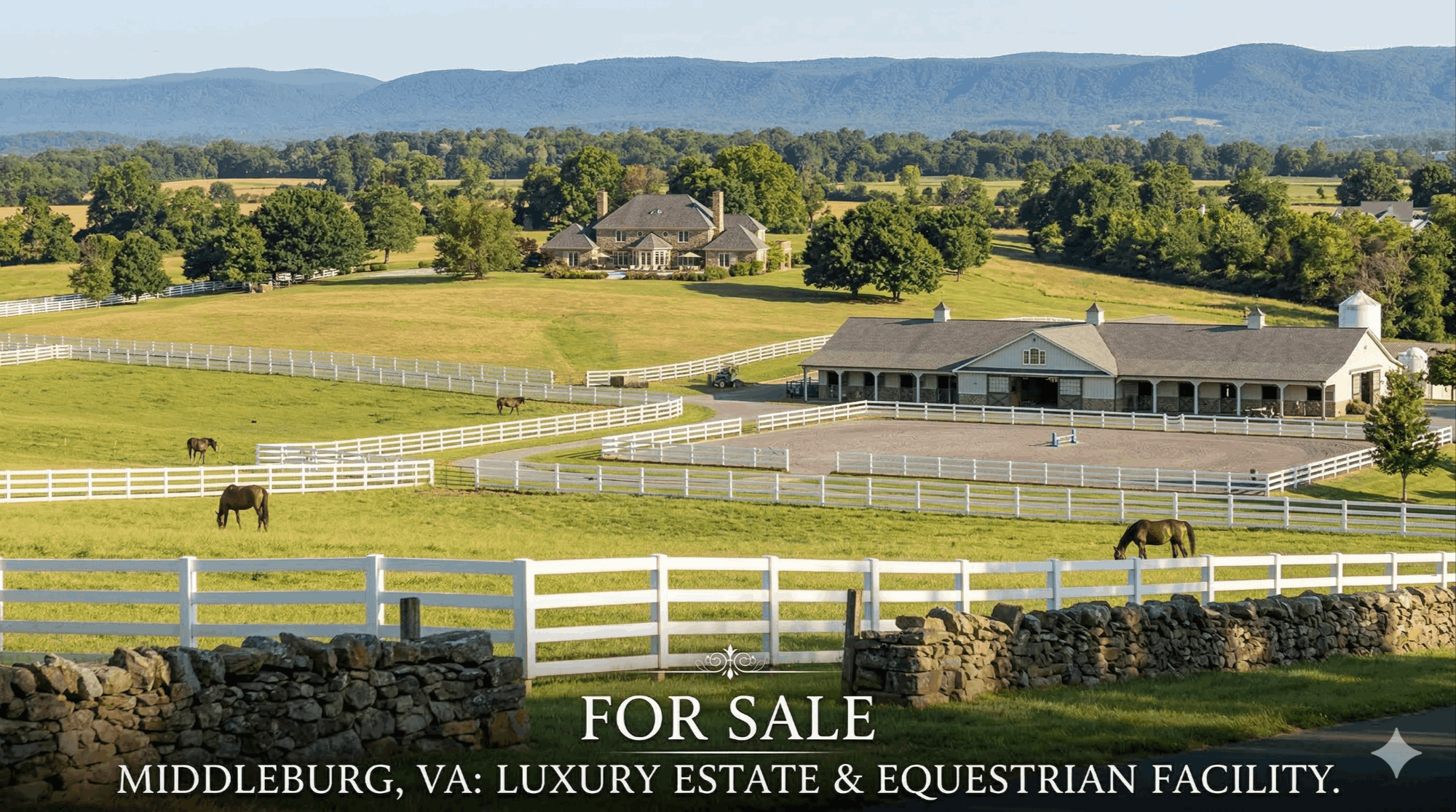
Middleburg, Virginia is not just a zip code — it is an identity. Nestled in the rolling hills of Loudoun County, this historic town has served as Virginia's equestrian capital for more than two centuries. Selling a luxury estate here — particularly one with acreage, a barn, paddocks, or a full equestrian facility — requires a fundamentally different strategy than selling a suburban home in Ashburn or Vienna. The buyer pool is smaller and more specific, the marketing must be cinematic, and the pricing methodology must account for features that automated valuation tools consistently get wrong.
Whether you own a 10-acre gentleman's farm, a 50-acre working horse operation, or a historic stone manor on St. Louis Road, this guide walks you through every step of the Middleburg estate sale — from pricing acreage correctly to reaching the right buyers nationally and globally.
⚡ Quick Answer
Selling a luxury estate in Middleburg, VA typically takes 90 to 180 days for acreage properties priced above $1.5M, with sellers netting between $1.2M and $5M+ depending on acreage, equestrian improvements, and condition. The key to maximizing value is strategic pricing that captures the land, improvements, and lifestyle premium — combined with marketing that reaches buyers far beyond the local MLS.
📋 Key Takeaways
- Middleburg's median sold price reached $1,543,750 in early 2026 — up nearly 100% year-over-year, signaling strong high-net-worth demand.
- Equestrian features (stalls, paddocks, arenas, run-in sheds) add value but must be marketed to the right audience — not just priced per square foot.
- The typical luxury estate sale in Middleburg takes 3 to 6 months; proper pre-listing preparation compresses this timeline significantly.
- Virginia sellers pay a Grantor's Tax (~0.1%) plus a Northern Virginia surcharge — on a $2M sale, plan for roughly $4,000 in state transfer costs alone.
- Commission structure matters significantly at these price points — a 1.5% listing fee vs. a traditional 3% fee saves $30,000 on a $2M sale.
- The most serious Middleburg buyers come from the DC-metro corridor, the Mid-Atlantic equestrian circuit, and increasingly from out-of-state relocation buyers seeking rural retreats within an hour of Dulles.
📖 Table of Contents
- Middleburg's Luxury Estate Market in 2026
- Who Actually Buys Luxury Estates in Middleburg
- What Makes a Property Truly "Equestrian" — and How It Affects Value
- How to Price Your Middleburg Estate
- Pre-Listing Prep for Acreage & Horse Properties
- Marketing a Middleburg Estate: What's Different
- Photography, Video & Staging for Country Estates
- The Selling Timeline: Week-by-Week
- Closing Costs for Luxury Sellers in Virginia
- Commission Options & What You'll Actually Pay
- Common Mistakes Middleburg Sellers Make
- Alternatives to the Traditional Sale
- How to Choose the Right Agent for a Middleburg Estate
- Frequently Asked Questions
- Glossary
- Next Steps
1. Middleburg's Luxury Estate Market in 2026
Middleburg has long operated outside the typical suburban real estate cycle. Its market is driven by wealth migration, lifestyle preferences, and equestrian demand — not interest rates or inventory ratios in the same way Ashburn or Leesburg are. That said, 2025 and early 2026 have brought remarkable price movement to this market.
According to BrightMLS-sourced data for the DC Metro region, Middleburg's median sold price in early 2026 reached approximately $1,543,750 — representing one of the most dramatic year-over-year swings across all Northern Virginia communities. Neighboring estate markets told a similar story: Waterford climbed to $2,434,000, Upperville posted a median around $1,225,000, and Paeonian Springs surged past $926,000. Capital is visibly concentrating in the estate-tier segment of Loudoun County.
For sellers, this is both an opportunity and a complexity. The buyer pool is genuinely motivated — but it is also highly selective. An estate that is priced correctly, presented beautifully, and marketed to the right audience can command a premium. One that is mispriced or poorly marketed will sit for months, accumulate days-on-market stigma, and ultimately sell below its real value.
📊 Middleburg Estate Market — Key Numbers At-a-Glance (Early 2026)
| Metric | Value / Range | Context |
|---|---|---|
| Median Sold Price | ~$1,543,750 | Significant YoY appreciation |
| Price Range (estates) | $550,000 – $7M+ | Broad based on acreage & features |
| Typical Lot Size | 5 – 200+ acres | Larger parcels command premium |
| Avg. Days on Market (luxury) | 60 – 180 days | Well-priced properties move faster |
| Distance from Dulles Airport | ~30 minutes | Drives executive buyer interest |
Inventory in the Middleburg estate segment remains tightly controlled. Few properties come to market in any given quarter, which means a well-presented listing attracts significant attention from buyers who have been waiting. Timing your listing for spring — typically March through June — aligns with peak buyer activity in the equestrian community and the broader luxury market.
2. Who Actually Buys Luxury Estates in Middleburg
Understanding your buyer is one of the most powerful tools in a successful estate sale. Middleburg attracts a specific and identifiable buyer profile — and your marketing must speak directly to each segment.
| Buyer Type | What They're Looking For | Where They Come From |
|---|---|---|
| Equestrian Enthusiasts | Stalls, arenas, paddocks, direct trail access, proximity to hunt territory | DC Metro, Mid-Atlantic show circuit, national |
| Executive Retreat Buyers | Privacy, acreage, high-end finishes, easy airport access, guest quarters | Northern Virginia, DC, NYC, international |
| Historic Property Collectors | Pre-Civil War stone buildings, original hardwoods, documented provenance | DC-area wealth, preservation buyers |
| Agricultural / Winery Buyers | Fertile acreage, existing farm structures, zoning for ag use, vineyard potential | Regional & national investors, lifestyle buyers |
| Multigenerational Family Buyers | Guest houses, multiple dwellings, privacy, compound potential | Wealthy DC-area families, out-of-state wealth |
One of the most common mistakes estate sellers make is listing on the MLS and hoping the right buyer finds them. Luxury estate buyers — particularly equestrian buyers — rely heavily on word of mouth, specialty publications like The Chronicle of the Horse, targeted digital campaigns, and agent networks. A passive listing approach virtually guarantees a longer sale timeline and lower sale price.
What Is Your Middleburg Estate Actually Worth?
Get a professional valuation that accounts for your acreage, equestrian improvements, and the current luxury market — not just a Zestimate.
Get My Free Home Valuation →3. What Makes a Property Truly "Equestrian" — and How It Affects Value
Not all horse properties are created equal in the eyes of a serious equestrian buyer. The presence of a barn alone does not make a property "equestrian." Buyers with sophisticated horse operations have very specific requirements — and they will walk away from a property that doesn't meet them, regardless of how beautiful the manor house is.
Understanding how your property's equestrian infrastructure is perceived — and valued — is essential before you set a list price or begin any improvements.
🐴 Equestrian Feature Value Guide — What Buyers Look For
| Feature | Value Impact | Notes |
|---|---|---|
| Center-aisle barn (4–12+ stalls) | High | Must be in working condition; electric, water, rubber mats expected |
| Outdoor arena / ring | High | Footing quality matters significantly; drainage is critical |
| Indoor arena | Very High | Rare; attracts professional trainers and serious competitors |
| Fenced, subdivided paddocks | Medium-High | Board, post-and-rail, or high-tensile — condition is critical |
| Run-in sheds / field shelters | Medium | Expected on any legitimate horse property |
| Wash stall & tack room | Medium | Heated wash stall adds premium |
| Hay/feed storage barn | Medium | Practical need for working farms |
| Trails / hunt territory access | High (location-dependent) | Proximity to Blue Ridge Hunt territory is a significant premium |
| Caretaker / groom quarters | Medium-High | Essential for large operations; adds utility value |
A critical point: equestrian improvements do not always appraise at full market value. A buyer paying $500,000 for a 12-stall center-aisle barn with a 100-foot lighted arena may be willing to do so based on its lifestyle value — but a lender's appraiser will value it based on comparable sales, which are rare by definition. Cash buyers and private financing are therefore more common in the Middleburg market than in typical suburban transactions.
Before listing, work with your agent to document every equestrian feature thoroughly — square footage of structures, stall count, arena dimensions, fencing materials and linear footage, well capacity, and any agricultural tax exemptions currently in place.
4. How to Price Your Middleburg Estate
Pricing a Middleburg luxury estate is part science, part art. The comparable sales approach — which works well for suburban neighborhoods — breaks down quickly when every property on the market is fundamentally different. A 50-acre equestrian operation and a 10-acre historic farmhouse are both "Middleburg estates," but they have essentially nothing in common from a valuation standpoint.
A sophisticated pricing strategy for a Middleburg estate will typically layer three valuation methods:
The Three-Layer Valuation Approach
Land Value (Acreage Baseline)
Assess raw land value per acre based on zoning, soil quality, slope, road frontage, and water features. In Loudoun County's agricultural district (AR-1 and AR-2 zoning), undeveloped acreage in the Middleburg corridor has recently traded between $12,000 and $35,000 per acre depending on location and development rights.
Residential Improvement Value
Value the primary residence independently using cost and income approaches. High-end finishes, architectural provenance (particularly pre-Civil War stone or federal-period structures), and recent renovations are weighted heavily. Comparable luxury home sales in Upperville, Purcellville, and the Atoka Chase community provide the most useful data points.
Equestrian & Agricultural Premium
Layer in the value of operational horse infrastructure. This premium is buyer-pool-driven — it is only realized if your marketing reaches the right buyers. An indoor arena alone can justify a $300,000–$800,000 premium, but only to a buyer who will use it. Pricing this premium too high for the wrong audience results in a long, expensive listing period.
📊 Middleburg Estate Price Range by Property Type (Estimates)
*Estimates based on market activity in the Middleburg/Loudoun County corridor. Individual property values vary significantly.
5. Pre-Listing Prep for Acreage & Horse Properties
Luxury estate buyers conduct thorough due diligence before making an offer — and they rarely give a second chance to a first impression. Pre-listing preparation for a Middleburg estate is substantially more involved than for a suburban home. Budget both time and money accordingly.
Exterior & Grounds (Highest Priority)
- Fencing: Walk all fencing lines before listing. Replace broken boards, rusted wire, and sagging gate posts. First-impression fencing along the road frontage is non-negotiable.
- Pastures: If pastures are overgrown or muddy, harrow and reseed at minimum 60 days before listing. Healthy green pastures photograph dramatically better and signal stewardship.
- Driveway & entry: Re-grade gravel driveways, power-wash stone pillars, and trim any tree overhang. The entrance sets tone for the entire property experience.
- Landscape around the house: Clean, manicured gardens and hardscape immediately adjacent to the main residence create the "magazine cover" look that luxury buyers expect.
- Exterior of barn & outbuildings: Power-wash exteriors, paint or stain if faded, replace broken windows or damaged siding. A well-maintained barn is a strong trust signal.
Interior Preparation
- Deep-clean all spaces, including utility areas — buyers at this price point inspect every corner.
- Neutralize and depersonalize without stripping the character that makes the home distinctive.
- Address any deferred maintenance visibly — cracked plaster, dated HVAC systems, worn carpeting in key rooms.
- Have all mechanicals (HVAC, well pump, septic) serviced and provide documentation.
✅ Middleburg Estate Pre-Listing Checklist
Pre-Listing Documentation (Often Overlooked)
Buyers of equestrian estates want to understand the full operational picture before they make an offer. Having the following documentation ready accelerates due diligence and builds buyer confidence:
- Current survey and plat map
- Agricultural/land use tax records and any conservation easements
- Well yield test results and water quality reports
- Septic system permits, inspections, and capacity
- List of improvements with approximate dates and contractor documentation
- Electric service capacity (particularly for barns with 3-phase or high-amperage needs)
- Any existing leases (grazing, tenant farming, boarding agreements)
See What You'll Walk Away With After Costs
Use our free Seller Net Sheet to estimate your proceeds after commissions, taxes, and closing costs — before you list.
Calculate My Net Proceeds →6. Marketing a Middleburg Estate: What's Different
Standard MLS-driven marketing is insufficient for a luxury estate in Middleburg. The pool of qualified buyers is genuinely small — perhaps a few dozen active buyers nationally at any given time for a property in the $2M–$5M equestrian segment. Reaching them requires a multi-channel, national and global marketing approach.
Channels That Move Luxury Estate Listings
- MLS (BrightMLS): Table stakes — every serious buyer's agent checks the MLS. Ensure your listing has maximum photos (40+), complete equestrian infrastructure data, and a professionally written property description.
- Luxury real estate portals: Listings.com, LuxuryPortfolio, Christie's International Real Estate, and similar platforms expose the property to high-net-worth buyers who do not search Zillow.
- Equestrian-specific platforms: HorseProperties.net, EquineNow, and related networks reach active horse community members who are specifically searching for horse farms.
- Social media and targeted digital advertising: Facebook and Instagram campaigns targeting equestrian interests, country living, and luxury lifestyle buyers in DC, NYC, and major East Coast markets.
- Print and specialty publications: The Chronicle of the Horse, Middleburg Life, Northern Virginia Magazine, and regional lifestyle publications reach a concentrated audience of Middleburg buyers.
- Agent network outreach: Proactive outreach to agents who represent equestrian and luxury buyers in the DC metro, New York, Palm Beach, and other feeder markets is one of the highest-return activities for an estate listing.
- Property-specific website or landing page: A dedicated URL for a significant estate creates a professional destination for international and national buyers who want a deeper experience before scheduling a showing.
| Marketing Channel | Reach | Equestrian Buyer Relevance | Cost (Approx.) |
|---|---|---|---|
| BrightMLS | Regional | High | Included in commission |
| HorseProperties.net | National | Very High | $99–$299/listing |
| Luxury Portals | Global | Medium | Included / agent fee |
| Targeted Digital Ads | National | High | $500–$3,000+/mo |
| Print / Specialty Pubs | Regional/National | High | $500–$5,000+/placement |
7. Photography, Video & Staging for Country Estates
At the $1.5M+ price point, photography is not a nice-to-have — it is a core marketing deliverable. Buyers shortlist properties based almost entirely on online visuals before they ever contact an agent. Inferior photography on a superior property is one of the most expensive mistakes a seller can make.
What Luxury Estate Photography Must Capture
- Aerial/drone footage: Essential for any acreage property. Drone video and stills capture the relationship between house, land, and equestrian infrastructure in a way no ground-level photo can.
- Golden-hour exterior photography: Shoot the house in early morning or late afternoon light. The warm light on a stone manor or painted wood farmhouse is dramatically different from midday flat light.
- Barn and arena interior shots: Clean, well-lit barn interiors signal quality and care. Messy barns photograph terribly and create negative first impressions with equestrian buyers.
- Pasture and fencing shots: Show the property in use or in its most ideal state — horses in the pasture (if any remain), well-maintained fencing, and lush green fields.
- Lifestyle and context imagery: The Salamander Resort, local steeplechase events, vineyard proximity, and the Blue Ridge Mountain backdrop are selling points worth showing.
- Video walkthrough (3D Matterport or Cinematic Video): Out-of-state and international buyers will make competitive offers based on video tours. This is not optional at the luxury tier.
💡 Pro Tip: Seasonal Photography
If you're listing in winter or early spring when pastures may be brown, consider supplementing with any existing summer/fall aerial imagery. Conversely, spring green and fall foliage against the Blue Ridge backdrop are arguably the most compelling visuals Middleburg offers — schedule your primary photo shoot accordingly.
8. The Selling Timeline: What to Expect
Selling a luxury estate in Middleburg takes longer than selling a suburban home — and that's not a negative signal. It reflects the smaller buyer pool, the complexity of due diligence, and the thoughtfulness of high-net-worth buyers who are making a major lifestyle decision, not just a financial one. Understanding the realistic timeline prevents sellers from making panicked pricing decisions early in the process.
Weeks 1–6: Pre-Listing Preparation
Completing the property checklist, ordering survey, servicing mechanicals, making repairs, staging, and completing photography. Budget 4–8 weeks minimum for a well-prepared estate.
Weeks 6–8: Active Marketing Launch
Property goes live on MLS and all luxury/equestrian platforms. Agent begins outreach to buyer network. Open houses or private showings begin. Initial buyer pool activity typically within the first 30 days.
Weeks 8–20: Showing Period & Offer Negotiation
Qualified buyers conduct property visits — often requiring multiple showings and inspection walkthroughs. Expect 30–90 days from listing to accepted offer for a well-priced property. Some luxury estates take longer; don't reduce price prematurely.
Weeks 20–30: Under Contract & Due Diligence
Once under contract, expect an extended due diligence period (30–60 days is common for complex estates). Buyers will conduct home inspection, well and septic inspection, survey review, environmental assessments, and specialized equestrian appraisals.
Weeks 28–36+: Closing
Settlement is typically 45–60 days after contract ratification, though cash transactions can close faster. Final walk-through, title transfer, and disbursement of proceeds.
9. Closing Costs for Luxury Sellers in Virginia
At Middleburg price points, even "small percentage" costs add up to significant dollar amounts. Understanding every line item before you list helps you accurately calculate your net proceeds and negotiate from a position of knowledge.
Virginia Seller Closing Cost Breakdown
| Cost Item | Rate / Amount | On a $2M Sale | Notes |
|---|---|---|---|
| Listing Agent Commission | 1.5% – 3% | $30,000 – $60,000 | Negotiable; see Section 10 |
| Buyer's Agent Commission | 2.5% – 3% | $50,000 – $60,000 | Offered but negotiable post-Aug 2024 |
| Virginia Grantor's Tax | $0.50 / $500 (~0.1%) | ~$2,000 | State seller's transfer tax |
| N. Virginia Grantor Surcharge | $0.10 / $100 (~0.1%) | ~$2,000 | Applies to Loudoun County |
| Title / Settlement Fee | Flat / tiered | $1,500 – $4,000 | Attorney or title company |
| Deed Preparation | Flat fee | $300 – $700 | Attorney requirement in VA |
| Property Tax Proration | Per-diem to closing | Varies | Based on Loudoun County assessed value |
| Survey (if needed) | Per-acre / flat | $1,500 – $5,000+ | May be required for acreage; budget separately |
| Pre-Sale Repairs / Prep | Varies | $5,000 – $50,000+ | Dependent on property condition |
| Total Estimated (excl. prep) | 5.5% – 8% | $110,000 – $160,000 | At full traditional commission |
💰 Commission Savings at This Price Point Are Significant
On a $2,000,000 sale, the difference between a 3% listing fee and a 1.5% listing fee is $30,000 in your pocket. That's not a rounding error — it's a meaningful portion of your total transaction cost. The Jamil Brothers Realty Group's 1.5% full-service listing program delivers the same professional marketing, negotiation, and representation — at a fraction of the traditional cost.
Sell Your Middleburg Estate for a 1.5% Listing Fee
Full-service representation, luxury marketing, and expert negotiation — without paying 3% to list. Save $30,000+ on a $2M sale.
Learn About the 1.5% Listing Program →10. Commission Options & What You'll Actually Pay
Real estate commission structures changed significantly following the NAR settlement that took effect in August 2024. Buyers and sellers now have more flexibility in how representation is structured and compensated. For luxury estate sellers, this is an important conversation to have before signing any listing agreement.
| Commission Structure | Listing Side | Total Commission | On $2M Sale |
|---|---|---|---|
| Traditional Full Commission | 2.5 – 3% | 5 – 6% | $100,000 – $120,000 |
| 1.5% Listing + 2.5% Buyer Agent | 1.5% | 4% | $80,000 |
| 1.5% Listing + 2% Buyer Agent | 1.5% | 3.5% | $70,000 |
| Flat Fee / FSBO (limited service) | $500 – $3,000 | Varies | Not recommended at luxury tier |
It's worth being direct: a flat-fee or FSBO approach to selling a Middleburg luxury estate is a false economy. The marketing reach, negotiation expertise, buyer qualification, and professional documentation management required at this price tier are not services you want to compromise on. A poorly negotiated contract on a $2M estate can cost far more than any commission savings.
The practical sweet spot for most Middleburg sellers is a 1.5% full-service listing agreement combined with a competitive buyer's agent commission. This approach preserves full marketing quality and representation while producing meaningful savings at the closing table.
11. Common Mistakes Middleburg Estate Sellers Make
Even sophisticated sellers make avoidable mistakes when listing a property as unique as a Middleburg estate. Here are the most common — and most costly — errors to avoid.
⚠️ Common Seller Mistakes — and How to Avoid Them
- Overpricing based on emotional attachment: Sellers who have invested years and significant capital into equestrian improvements often price based on what they've spent — not market value. The market doesn't reimburse renovation costs; it rewards move-in readiness and condition.
- Underpricing land value: The inverse problem — using a standard per-square-foot analysis that ignores the strategic value of the acreage, conservation potential, or agricultural tax benefits.
- Using a suburban specialist instead of an estate-fluent agent: An agent who primarily sells Ashburn townhomes lacks the equestrian market knowledge, luxury buyer network, and specialized marketing experience needed to optimize a Middleburg estate sale.
- Listing before the property is ready: A half-prepared estate with muddy paddocks, a messy barn, and deferred maintenance will accumulate days-on-market stigma and eventually require a price cut that exceeds what the preparation would have cost.
- Neglecting agricultural tax documentation: Buyers often plan to maintain agricultural tax exemptions. If you cannot provide clear documentation of current land-use designations and agreements, buyers get nervous — and sometimes walk away.
- Ignoring out-of-state buyers: An estimated 20–30% of luxury estate buyers in Middleburg come from outside Virginia. A marketing strategy that doesn't include national digital reach, cinematic video tours, and out-of-state agent outreach leaves real money on the table.
- Accepting the first offer without understanding market conditions: A strong opening offer in a low-inventory market is sometimes an indicator of underpricing, not a good deal. Work with an experienced agent to understand whether the first offer reflects full market value.
12. Alternatives to the Traditional Sale
The traditional MLS listing is the right path for most Middleburg estate sellers — but not all. If speed, certainty, or tax strategy considerations outweigh maximum price, alternative routes deserve serious evaluation.
| Alternative | Best For | Tradeoffs |
|---|---|---|
| Cash Offer / Direct Sale | Sellers who need speed, certainty, or want to avoid showing prep | Typically 5–15% below market value; no showings, no contingencies |
| 1031 Exchange | Investment property owners wanting to defer capital gains | Complex rules; 45-day ID period; must identify replacement property |
| Conservation Easement | Owners of large parcels wanting to preserve land and receive tax benefits | Permanently restricts development; complex legal/tax implications |
| Auction (Traditional or Online) | Estate settlements, motivated sellers wanting a set closing date | Unpredictable sale price; buyer pool may be limited; costs apply |
| Private Off-Market Sale | High-privacy sellers with agent access to qualified buyers | Limits competition; may leave money on table without market exposure |
For sellers who are weighing whether the extended timeline of a full market listing is worth it versus a faster cash offer option, an honest side-by-side net proceeds analysis is the most useful tool. At Middleburg price points, even a 10% premium from the traditional market route often translates to $150,000–$300,000 or more.
Buying After You Sell? Don't Lose Out Twice.
If you're purchasing a new home after selling your Middleburg estate, a clear buying strategy can save you from contingency complications and missed opportunities.
Get a Buyer Strategy →13. How to Choose the Right Agent for a Middleburg Estate
Choosing the right listing agent for a Middleburg estate is one of the most consequential decisions in the sale process. The agent you select will shape how the property is priced, how it's presented to the world, and how offers are negotiated. The right agent earns you significantly more than they cost.
What to Look For
| Criteria | What to Ask / Verify |
|---|---|
| Luxury/estate sales experience | How many properties above $1.5M have they closed in Loudoun County in the last 24 months? |
| Equestrian market knowledge | Can they speak to barn valuation, equestrian buyer psychology, and specialty marketing channels? |
| Marketing quality | Ask to see a current listing — judge photography quality, video production, and digital reach. |
| National buyer network | What is their plan for reaching out-of-state buyers? Which platforms and networks do they use? |
| Negotiation track record | What was their average sale-to-list price ratio on their last 10 luxury transactions? |
| Commission structure | Is there a full-service, reduced-rate option? What does "full service" specifically include? |
| Client references | Ask for references from past acreage or luxury sellers — and actually call them. |
The Jamil Brothers Realty Group has served luxury and estate sellers across Northern Virginia for years, with over $500M in total transactions and recognition as NVAR Lifetime Top Producers and Northern Virginia Magazine Top Agents. Their team brings deep knowledge of Loudoun County's estate market, data-driven pricing strategy, and a 1.5% full-service listing program that delivers premium marketing without the traditional listing fee. For sellers evaluating their options, they offer a free estate valuation with no obligation.
14. Frequently Asked Questions
15. Glossary: Key Terms for Middleburg Estate Sellers
Agricultural Tax Exemption (Land Use): Loudoun County's program that assesses certain land at its agricultural use value rather than market value, resulting in significantly lower property tax bills. Must be maintained by qualifying agricultural activity.
AR-1 / AR-2 Zoning: Loudoun County's Agricultural Rural zoning designations that govern most Middleburg-area parcels. AR-1 allows one dwelling per 40 acres; AR-2 allows one per 20 acres. Zoning determines subdivision potential and permitted uses.
Blue Ridge Hunt Territory: The geographic area covered by the Blue Ridge Hunt Club, one of Virginia's oldest and most prestigious fox hunting organizations headquartered in Bluemont. Proximity to hunt territory is a significant premium for equestrian buyers.
Center-Aisle Barn: The most functional and desirable barn configuration for horse operations — a central corridor with stalls on both sides, typically including tack room, wash stall, feed room, and hay storage.
Conservation Easement: A legal agreement that permanently restricts development on a parcel in exchange for significant tax benefits. Common in Loudoun County; may affect subdivision and development rights that buyers need to understand.
Grantor's Tax: Virginia's state-level transfer tax paid by the seller at closing. The base rate is $0.50 per $500 of sale price (~0.1%), with an additional $0.10 per $100 in Northern Virginia localities including Loudoun County.
1031 Exchange: An IRS-approved method for deferring capital gains taxes on the sale of an investment or income-producing property by reinvesting proceeds into a "like-kind" replacement property within a defined timeline.
Rollback Tax: A penalty assessed when land that has been receiving agricultural use tax benefits is converted to non-qualifying use. In Virginia, rollback taxes can cover up to 5–7 prior tax years and can be substantial on high-value parcels.
Steeplechase: A horse racing format run over a course with obstacles (fences, hedges, water). Middleburg is home to the Middleburg Spring Races and is close to the Virginia Gold Cup at Great Meadow — both are central cultural events for the horse community and attract estate buyers.
Salamander Resort & Spa: A luxury resort in Middleburg that anchors the town's high-end hospitality identity and serves as a lifestyle landmark for buyers evaluating the community.
Ready to See What Your Estate Is Worth?
Run a free net sheet before you make any decisions. Know exactly what you'll walk away with after commissions, Virginia taxes, and closing costs.
Calculate My Net Proceeds → Browse Loudoun County Listings →16. Next Steps for Middleburg Estate Sellers
Selling a luxury estate in Middleburg is a meaningful undertaking — but it is also one of the most financially significant opportunities you will navigate. The sellers who achieve the strongest outcomes are those who start with accurate information, allow adequate time for preparation, and partner with professionals who genuinely understand this market.
Here is a clear sequence to follow as you move forward:
- Get a professional estate valuation — not an automated estimate. A valuation that accounts for acreage, equestrian improvements, and current market conditions is the essential starting point. → Free valuation at thejamilbrothers.com
- Run your net sheet — before you commit to a list price or a commission structure, calculate your actual projected proceeds. → Free net sheet calculator
- Walk your property with fresh eyes — use the pre-listing checklist in this guide. Identify deferred maintenance, fencing gaps, and curb-appeal issues before your first agent consultation.
- Interview agents with luxury estate experience — ask for specific Loudoun County luxury comps and a written marketing proposal.
- Compile your documentation — survey, land use agreements, well tests, septic records, and improvement documentation before listing day.
- Choose your listing window strategically — spring is typically the strongest window for equestrian and lifestyle buyers in this market.
When you're ready to take that first step, the Jamil Brothers Realty Group is available for a private consultation — no pressure, no obligation — just accurate information about what your estate is worth and what the sale process will look like for your specific property.
Categories
- All Blogs (1228)
- Aldie (3)
- Ashburn (6)
- Buyer Guide (8)
- Buying a home (2)
- Buying Strategies (30)
- festivals (1)
- General Blog (67)
- Leesburg (5)
- Market Intelligence (29)
- Market Updates (8)
- Notable Properties For Sale (32)
- Real Estate Tips, News, and More (385)
- Seller Guide (2)
- Seller Guides (60)
- Selling Your Home (523)
- Sterling (6)
- Top Realtors in Northern Virginia (58)
Recent Posts

Message Sent!
Thank you for reaching out. Arslan & Saad have received your details and will be in touch shortly.
Need immediate assistance? Call or text 703-782-4830.