
Richmond Becomes the Fastest-Growing Data Center Market in the U.S.
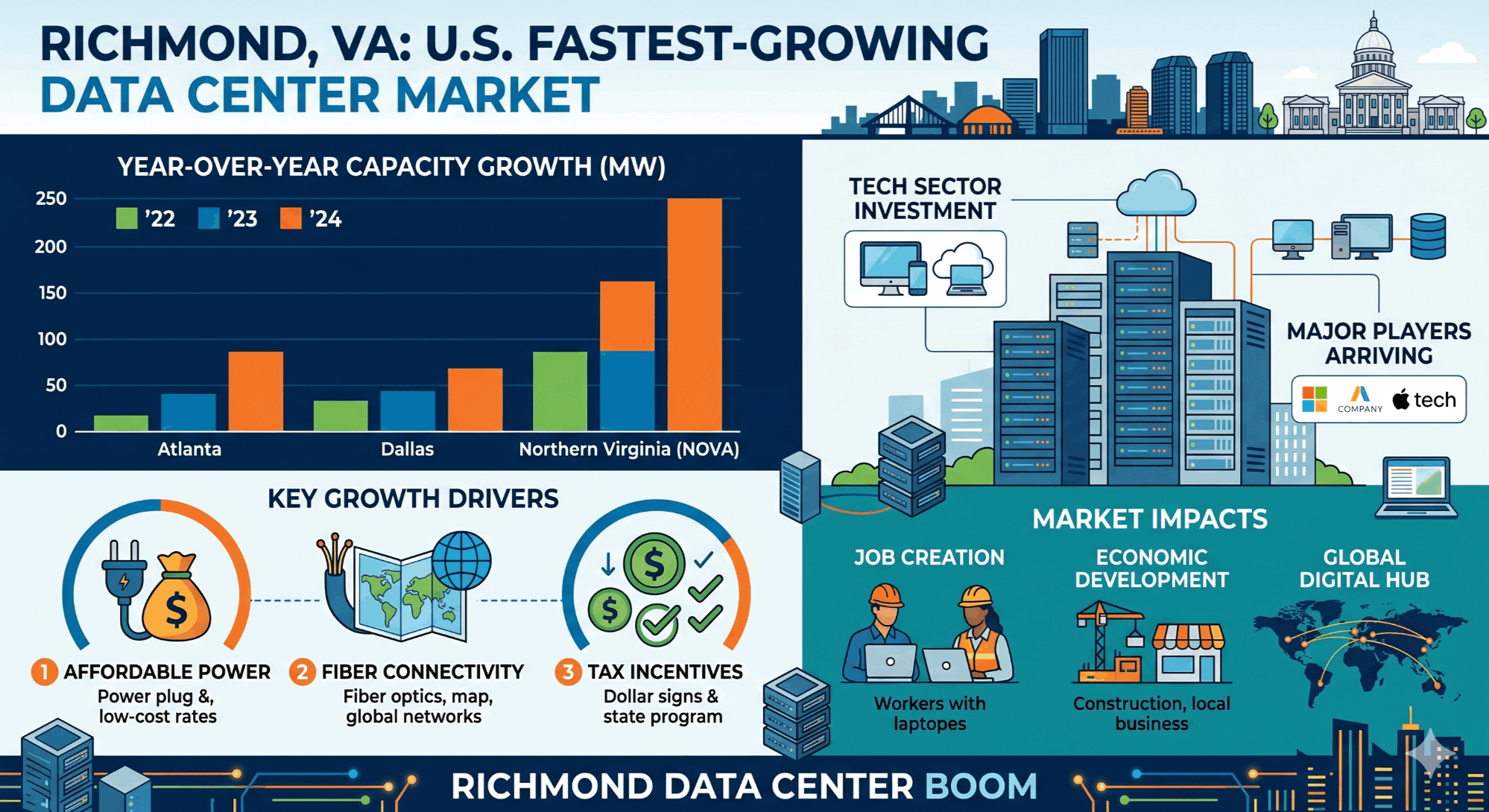
Quick Answer: Richmond, Virginia is now the fastest-growing data center market in the United States, with colocation and hyperscale capacity expanding roughly sevenfold in just six months. Driven by available land, abundant power, and overflow demand from Northern Virginia's "Data Center Alley," the Richmond data center market is reshaping the regional economy, creating jobs, and adding fresh pressure to an already competitive Virginia housing market.
For two decades, Northern Virginia held the title of the world's data center capital. That story is now expanding south. Richmond data centers are being built at a pace that has outrun Dallas and Chicago combined, and the region's sudden rise is the single biggest commercial real estate story in the state. As Virginia real estate experts who track how infrastructure shifts ripple into neighborhoods, we see Richmond's data center boom as more than a tech headline — it is a force that touches land values, job creation in Richmond, and housing demand across Central Virginia.
This guide breaks down why Richmond is attracting hyperscale data centers, what the expansion means for Virginia's economy, and — most importantly for homeowners — how data center growth in Virginia is connected to property values, relocation patterns, and the decision to buy or sell. We'll keep the technology plain-English and focus on the real-world impact on residents, businesses, and the Virginia housing market.
Whether you own a home near a planned campus, you're relocating to Virginia for a tech-sector job, or you simply want to understand how digital infrastructure is reshaping your local market, the sections below give you a clear, data-forward picture of what's happening and what comes next.
In This Guide
- Why Richmond Is Becoming a Major Data Center Hub
- Key Factors Driving Data Center Growth in Richmond
- Economic Benefits of Richmond's Data Center Expansion
- How Data Centers Are Affecting Virginia Real Estate
- Richmond-Area Housing Market Snapshot
- What This Means for Virginia Home Sellers
- Challenges of Rapid Data Center Development
- What the Growth Means for Businesses and Residents
- The Future of Virginia's Data Center Industry
- Positioning Yourself for Virginia's Data-Driven Decade
- Frequently Asked Questions
- Glossary
Key Takeaways
- Richmond is the fastest-growing data center market in the U.S., with capacity climbing roughly sevenfold in six months and vacancy below 2%.
- Roughly 4 gigawatts of colocation and nearly 5 gigawatts of hyperscale capacity are planned or under construction across the Richmond region.
- Available land, natural gas and grid access, fiber optic networks, and tax incentives are the core factors driving data center development in Virginia.
- The expansion fuels Richmond economic growth — construction jobs, enterprise data center operations, and demand for supporting industrial real estate.
- Data center growth adds to housing demand and property values in nearby counties like Henrico, Chesterfield, and Hanover, where the Richmond-area median sits near $414,000.
- Virginia hosts about 35% of the world's hyperscale data centers, anchoring its lead in cloud computing infrastructure and AI infrastructure.
Why Richmond Is Becoming a Major Data Center Hub
For years, the global digital economy ran through a single Virginia corridor: Loudoun County's "Data Center Alley," where a large share of the world's internet traffic is routed. But that corridor is running into hard limits — scarce land, strained power grid capacity, and local pushback. Developers needed a new frontier with room to build, and Richmond data centers became the answer.
The shift has been dramatic. Industry trackers report that Richmond's data center capacity grew roughly sevenfold in just six months, outpacing the growth of Dallas and Chicago combined. With colocation vacancy now below 2%, demand is effectively absorbing space as fast as it can be delivered. That combination — explosive supply growth and near-zero vacancy — is what earned Richmond the title of fastest-growing data center market in the country.
Major players have already planted flags. Amazon has proposed more than 1,600 acres of new campuses across multiple counties, while Meta, QTS, DC Blox, Iron Mountain, and institutional investors like Blue Owl Capital are staking claims throughout the region. Henrico County's White Oak Technology Park alone has become a magnet for hyperscale and enterprise data centers, drawing billions in committed investment.
Richmond as Virginia's Next Technology Hub
Richmond's emergence reflects a broader trend toward secondary markets with better access to land and energy. As Northern Virginia's vacancy fell below 1%, the overflow had to go somewhere — and Central Virginia's mix of affordability, infrastructure, and willing localities made it the natural landing spot. The result is a fast-maturing Richmond technology sector built on cloud computing infrastructure, digital infrastructure, and the server farms that power everyday internet use.
ℹ️ The bigger picture
Virginia already hosts roughly 35% — about 150 — of the world's known hyperscale data centers, making it the largest data center market on the planet. Richmond's rise extends that dominance rather than replacing it, spreading the digital economy across more of the Commonwealth.
Key Factors Driving Data Center Growth in Richmond
Richmond's data center surge isn't accidental. Several structural advantages converged to make the region ideal for hyperscale data centers and large-scale technology investment. Understanding these drivers explains why the growth is likely to continue — and why it matters for Virginia business growth and regional growth more broadly.
| Growth Driver | Why It Matters |
|---|---|
| Land availability | Large, contiguous parcels in Henrico, Chesterfield, and surrounding counties support campuses Northern Virginia can no longer accommodate. |
| Power grid capacity | Access to natural gas and expanding utility infrastructure meets the enormous energy demand of AI and cloud workloads. |
| Fiber optic networks | Dense fiber backbones inherited from decades of federal investment provide the internet infrastructure hyperscalers require. |
| Tax incentives | Virginia's sales-and-use tax exemption on data center equipment lowers the cost of infrastructure investment. |
| AI & cloud demand | Artificial intelligence infrastructure and cloud services are scaling faster than existing markets can absorb, pushing demand outward. |
Power and Energy Demand Lead the List
If there's one factor above all others driving data center construction in Richmond, it's energy. A single hyperscale campus can consume as much electricity as a small city, so proximity to natural gas supply and available power grid capacity is decisive. Richmond's utility infrastructure — paired with growing renewable energy and sustainability initiatives — gives developers a credible path to powering campuses that Northern Virginia simply can't energize fast enough.
Richmond Data Center Pipeline (Planned / Under Construction)
Source: Avison Young / regional market reporting. Figures are approximate and evolving.
Infrastructure booms move markets street by street. Get a personalized home valuation from The Jamil Brothers — real comps, not automated estimates. Response within 24 hours.
Economic Benefits of Richmond's Data Center Expansion
The economic impact of Richmond's data center expansion reaches far beyond the campuses themselves. Data centers are capital-intensive, long-lived assets that generate substantial tax revenue, support land development, and create demand across a web of supporting industries. For Virginia, the benefits compound into measurable economic development.
Job Creation in Richmond and Workforce Development
While a finished data center employs a relatively small permanent staff, construction phases create thousands of temporary jobs, and operations sustain skilled roles in security, engineering, and maintenance. Just as important, the cluster attracts supporting manufacturers — power management firms like Eaton and Anord Mardix have expanded in Henrico County specifically to serve data center clients, adding manufacturing jobs and deepening workforce development pipelines.
Tax Revenue and Local Government Funding
Data centers are among the most valuable taxable assets a locality can host. The equipment inside — servers, switchgear, cooling systems — is taxed as business property, generating recurring revenue that can fund schools, roads, and public services without raising residential property taxes. Henrico County alone has attracted billions in data center investment, a tax base that strengthens the broader community.
How Data Center Growth Ripples Through the Local Economy
- ✓ Construction crews drive demand for hotels, restaurants, and local retail.
- ✓ Electrical contractors, HVAC specialists, and security firms see sustained new business.
- ✓ Commercial property and industrial parks near data center corridors appreciate.
- ✓ Higher-paying technology jobs raise household incomes and local buying power.
- ✓ Recurring business-equipment tax revenue funds public services and infrastructure investment.
How Data Centers Are Affecting Virginia Real Estate
This is where the data center story becomes personal for homeowners. The connection between digital infrastructure and residential real estate is indirect but powerful: data centers create high-paying jobs, those jobs attract workers relocating to Virginia, and those new residents need places to live. The result is added housing demand layered onto markets that are already tight.
How Data Centers Affect Housing Demand and Property Values
Counties hosting major campuses — Henrico, Chesterfield, Hanover, and Goochland — are seeing some of the strongest population growth in Virginia. Chesterfield County has added more than 36,000 residents since 2020, the fastest growth of any locality in the Commonwealth, surpassing even Loudoun County. That kind of in-migration supports property values and keeps residential development moving, even as it strains affordability for first-time buyers.
For homeowners, the takeaway is straightforward: sustained employment growth tends to support home prices over time. If you own near a growth corridor, that's a tailwind for your equity. If you're buying, it's a reason to move deliberately rather than wait indefinitely. Either way, understanding the local impact of data centers on communities helps you make a better-informed decision — and a knowledgeable local agent can translate macro trends into what they mean for your specific street.
| Real Estate Effect | Who It Helps | Who It Pressures |
|---|---|---|
| Rising property values | Existing homeowners / sellers | First-time buyers |
| Stronger housing demand | Sellers, landlords | Renters facing higher rents |
| More residential development | Buyers seeking new construction | Communities managing growth |
| Industrial real estate demand | Commercial owners / investors | Land near campuses (use conflicts) |
The same dynamics that started in Northern Virginia's Loudoun County are now playing out in Central Virginia — and Northern Virginia communities like Ashburn remain the original blueprint for how data center clusters reshape a local market. If you're weighing a move, our current Virginia listings are a good place to see how demand is showing up in real prices.
Richmond-Area Housing Market Snapshot
To put the real estate impact in context, here's where the Richmond housing market stands as of spring 2026. These are realistic figures drawn from regional MLS and major listing platforms — useful for understanding the backdrop against which the data center boom is unfolding.
| Metric | Richmond Area (Spring 2026) |
|---|---|
| Median sale price (Richmond City) | ~$414,000 |
| Metro median range | ~$395,000 – $420,000 |
| Median days on market | ~14 days (city); ~19–36 days (suburbs) |
| Average offers per home | ~3 |
| Market temperature | Competitive, modest price gains, seller's edge in tight pockets |
County-by-County Price Ranges
| County / Area | Approx. Median | Notes |
|---|---|---|
| Henrico County | ~$379K–$402K | Established suburban market; major data center investment. |
| Chesterfield County | ~$365K–$410K | Fastest-growing locality in Virginia; strong new construction. |
| Hanover County | ~$375K–$425K | Growth story; families seeking schools and a rural feel. |
| Richmond City (The Fan) | ~$550K–$650K | Premium in-town neighborhoods; limited supply. |
What This Means for Virginia Home Sellers
A rising market is exactly when seller strategy matters most. When data center growth supports values and demand, the difference between a good outcome and a great one often comes down to two things: pricing the home correctly and minimizing the costs that eat into your equity. The single largest controllable cost in any sale is the listing commission.
Traditionally, sellers pay a listing agent around 3% of the sale price. The Jamil Brothers Realty Group offers a 1.5% full-service listing fee in Virginia — which includes professional photography, drone video, 3D tours, partner-led negotiation, and full MLS marketing. Nothing is reduced except the fee itself. On a $414,000 Richmond-area home, that difference alone keeps roughly $6,000 more in your pocket. Use the calculator below to see your own numbers, then check your bottom line with our seller net sheet .
Seller Savings Calculator
How much more do you keep with our 1.5% listing fee?
Select your home's estimated value to see your real net proceeds — side by side.
|
Traditional Agent — 3%
|
Jamil Brothers — 1.5%
Our Fee — Only 1.5%
|
Extra in your pocket
$6,000
vs. a traditional 3% listing agent — with zero reduction in service or marketing.
|
Traditional Agent — 3%
|
Jamil Brothers — 1.5%
Our Fee — Only 1.5%
|
Extra in your pocket
$7,500
vs. a traditional 3% listing agent — with zero reduction in service or marketing.
|
Traditional Agent — 3%
|
Jamil Brothers — 1.5%
Our Fee — Only 1.5%
|
Extra in your pocket
$9,000
vs. a traditional 3% listing agent — with zero reduction in service or marketing.
|
Traditional Agent — 3%
|
Jamil Brothers — 1.5%
Our Fee — Only 1.5%
|
Extra in your pocket
$11,250
vs. a traditional 3% listing agent — with zero reduction in service or marketing.
|
Traditional Agent — 3%
|
Jamil Brothers — 1.5%
Our Fee — Only 1.5%
|
Extra in your pocket
$15,000
vs. a traditional 3% listing agent — with zero reduction in service or marketing.
Estimates only. Closing costs vary. Buyer's agent commission is negotiable.
| 500+ Five-Star Reviews · Top 1% Nationwide · 840+ Homes Sold | TheJamilBrothers.com · (703) 782-4830 |
4K photography, drone video, 3D tours, expert negotiation, and full MLS marketing — all included at 1.5%. No hidden fees, no service reductions, no surprises.
Challenges of Rapid Data Center Development
No transformation this large comes without friction. The same factors fueling Richmond's technology investment also create real challenges for communities, utilities, and residents. A balanced view matters — both for policymakers and for homeowners weighing how nearby development might affect their property.
| ✓ Opportunities | ✗ Challenges |
|---|---|
| Major tax revenue without residential tax hikes | Strain on power grid capacity and rising energy demand |
| Construction and operations job creation | Water use for cooling and environmental concerns |
| Diversified, resilient regional economy | Land-use conflicts near residential neighborhoods |
| Demand for renewable energy and sustainability initiatives | Upward pressure on home prices and affordability |
The most-watched issue is power. Hyperscale campuses place unprecedented demand on the grid, prompting debate about who pays for new transmission and generation. Utility infrastructure upgrades, renewable energy commitments, and careful zoning are all part of how localities are trying to capture the benefits while managing the downsides.
What the Growth Means for Businesses and Residents
For local businesses, Richmond's emergence as a technology hub is a tailwind. Business expansion follows infrastructure: supporting firms relocate to be near campuses, the digital economy creates demand for skilled labor, and the resulting wage growth lifts local spending. For residents, the picture is more nuanced — opportunity on one hand, affordability pressure on the other.
For People Relocating to Virginia
Tech-sector hiring is drawing new residents to Central Virginia and keeping demand strong across Northern Virginia communities as well. If you're relocating to Virginia for a data-center-adjacent role, your housing decision should account for commute corridors, school districts, and which submarkets still offer value. A local real estate team can help you weigh communities and time your purchase against the local real estate market trends rather than national headlines.
Before you tour a single home, know your budget, your timeline, and your negotiation position in a market shaped by the data center boom. Our buyer strategy session is free and covers everything you need.
For Current Homeowners
If you already own in a growth corridor, the data center expansion is generally working in your favor through stronger demand and supported property values. The question becomes timing and strategy: whether to hold and ride continued appreciation, or to sell into a competitive market while demand is strong. Either way, knowing your home's current value and your true net proceeds is the foundation of a good decision.
The Future of Virginia's Data Center Industry
The momentum behind Virginia data centers shows little sign of slowing. Analysts suggest the Richmond region could rival or exceed established markets like Phoenix and Dallas in total capacity within five years, cementing Virginia's position as America's data center capital. As AI infrastructure and cloud services keep scaling, demand for the land, power, and fiber that Richmond offers will likely persist.
Near term (2026–2027) — Build-out accelerates
Announced campuses break ground; construction jobs peak; supporting industrial real estate and industrial parks fill in around corridors.
Mid term (2027–2029) — Operations scale
Facilities come online; permanent technology jobs grow; utility infrastructure and renewable energy capacity expand to meet energy demand.
Long term (2030+) — A mature digital corridor
Richmond solidifies as a top-tier U.S. data center market; sustained regional growth supports a deeper, more diversified housing market.
Positioning Yourself for Virginia's Data-Driven Decade
Richmond's rise as the fastest-growing data center market in the U.S. is a generational shift in Virginia's economy — one that touches land development, job creation, infrastructure investment, and, ultimately, the value of your home. For homeowners and buyers alike, the smart move is to understand the trend, ignore the noise, and make decisions based on your own numbers and timeline.
Whether you're selling into a strong market and want to keep more of your equity with a 1.5% full-service listing, or you're relocating to Virginia and need a clear-eyed buyer strategy, The Jamil Brothers Realty Group brings street-level knowledge of how these macro trends play out in real neighborhoods. Start with a free valuation, run your net sheet, and explore your options — no pressure, no obligation.
Know your equity, understand your costs, and see exactly what you'll walk away with — before you make any decisions. The Jamil Brothers provide a full consultation at no cost or obligation.
Frequently Asked Questions
Why is Richmond attracting data centers?
Richmond is attracting data centers because it offers what Northern Virginia's Data Center Alley is running short on: large parcels of available land, access to natural gas and expanding power grid capacity, dense fiber optic networks, and favorable tax incentives. As demand from AI and cloud computing companies outgrew Northern Virginia — where vacancy fell below 1% — developers moved south to Central Virginia, making Richmond the fastest-growing data center market in the country.
How fast is the Richmond data center market growing in 2026?
The Richmond data center market has grown explosively — industry trackers reported a roughly sevenfold increase in capacity in just six months, faster than Dallas and Chicago combined. Colocation vacancy now sits below 2%, and the region has approximately 4 gigawatts of colocation and nearly 5 gigawatts of hyperscale capacity either planned or under construction.
How do data centers affect Virginia real estate and housing demand?
Data centers affect housing indirectly but meaningfully. They create construction and operations jobs and attract supporting industries, which draws workers relocating to Virginia. Those new residents add to housing demand in nearby counties such as Henrico, Chesterfield, and Hanover, supporting property values and spurring residential development — while also adding affordability pressure for first-time buyers.
What are the economic benefits of data centers in Virginia?
The economic benefits include substantial tax revenue from business equipment without raising residential taxes, job creation across construction and operations, growth in supporting industries like power management and HVAC, and demand for commercial and industrial real estate. Henrico County alone has attracted billions in data center investment, strengthening the local tax base that funds schools and public services.
Will data center growth raise home prices near Richmond?
Data center growth tends to support home prices over time by adding jobs and residents to a region. Counties hosting major campuses, like Chesterfield, are among the fastest-growing in Virginia. The Richmond-area median sits near $414,000 as of spring 2026, with competitive conditions in tight pockets. Sustained employment growth is generally a tailwind for values, though it can also pressure affordability for new buyers.
What are the main challenges of rapid data center development?
The biggest challenges are energy and infrastructure related. Hyperscale campuses place enormous demand on the power grid, raising questions about who pays for new transmission and generation. Other concerns include water use for cooling, environmental and sustainability considerations, land-use conflicts near residential neighborhoods, and upward pressure on housing affordability. Localities are addressing these through zoning, utility planning, and renewable energy commitments.
How does the Richmond data center boom compare to Northern Virginia?
Northern Virginia, anchored by Loudoun County's Data Center Alley, remains the world's largest data center hub, with vacancy below 1%. Richmond's growth extends Virginia's dominance rather than replacing it — overflow demand and tighter land and power constraints up north pushed developers to Central Virginia. Together, the two regions help Virginia host roughly 35% of the world's hyperscale data centers.
How much does it cost to sell a house in Virginia?
Selling costs in Virginia typically include the listing commission, buyer's agent compensation (negotiable since the NAR settlement), the state grantor's tax of roughly $1 per $1,000 of sale price, and other closing costs that often total around 1% of the price. The listing commission is the largest controllable cost: a traditional 3% fee on a $414,000 home is about $12,420, while The Jamil Brothers Realty Group's 1.5% full-service fee is about $6,210 — keeping roughly $6,000 more in your pocket.
How long does it take to sell a home in the Richmond area?
Homes in Richmond City have been selling in roughly 14 days on average as of spring 2026, with suburban areas ranging from about 19 to 36 days depending on the county and price point. Well-priced, move-in-ready homes move fastest. The total timeline from listing to closing usually runs 30 to 60 days once you factor in the buyer's financing and closing process.
How do I choose a real estate agent in a fast-changing market?
Choose an agent based on objective criteria: local track record, recent sales in your area, marketing quality (professional photography, drone, 3D tours), negotiation experience, transparent fees, and verified reviews. Ask how they price homes in a market shaped by infrastructure-driven demand. The Jamil Brothers Realty Group is licensed in VA, MD, DC, and WV, has sold 840+ homes with $500M+ in volume, holds 500+ five-star reviews, and offers a 1.5% full-service listing fee.
Is now a good time to buy or sell a home in Virginia?
For sellers, a market with strong, infrastructure-supported demand and limited inventory is generally favorable — especially when you control costs with a low full-service fee. For buyers, moving deliberately in a rising market can beat waiting indefinitely, since sustained job growth tends to support prices. The right answer depends on your finances, timeline, and goals, which is why a personalized consultation matters more than any headline.
What does Virginia's role in AI infrastructure mean for homeowners?
Virginia's leadership in AI infrastructure and cloud computing means long-term, structural demand for the land, power, and skilled workforce that data centers require. For homeowners, that translates into a durable economic base that supports employment and, by extension, housing demand and property values across the Commonwealth — from Northern Virginia to the fast-growing Richmond region.
Glossary
Data Center
A facility housing servers and networking equipment that store, process, and distribute digital data and applications.
Hyperscale Data Center
A massive, single-user facility built for cloud or AI companies, often spanning hundreds of thousands of square feet.
Colocation
A data center model where many companies rent smaller amounts of space and shared infrastructure in one building.
Gigawatt (GW)
A unit of power equal to one billion watts; used to measure the electricity capacity a data center market can support.
Net Absorption
A commercial real estate metric measuring how much space companies actually moved into, minus space they vacated.
Data Center Alley
The Loudoun County, Northern Virginia corridor that routes a large share of the world's internet traffic.
Grantor's Tax
A Virginia transfer tax paid by the seller, roughly $1 per $1,000 of the sale price at the state level.
Net Proceeds
The amount a seller actually keeps after commissions, taxes, and closing costs are subtracted from the sale price.
Market figures are approximate, drawn from regional MLS data and major listing platforms as of spring 2026, and change over time. This article is informational and not financial, legal, or tax advice. The Jamil Brothers Realty Group is licensed in Virginia, Maryland, Washington D.C., and West Virginia under Samson Properties. Call (703) 782-4830.
Categories
- All Blogs (1228)
- Ashburn (3)
- Buyer Guide (8)
- Buying a home (2)
- Buying Strategies (30)
- festivals (1)
- General Blog (67)
- Market Intelligence (29)
- Market Updates (8)
- Notable Properties For Sale (32)
- Real Estate Tips, News, and More (385)
- Seller Guide (2)
- Seller Guides (60)
- Selling Your Home (523)
- Sterling (6)
- Top Realtors in Northern Virginia (58)
Recent Posts







Let's Connect