
Kalorama DC Luxury Real Estate: How to Sell a High-End Home in 2026
Kalorama DC Luxury Real Estate: How to Sell a High-End Home in 2026
There is no neighborhood in Washington, DC quite like Kalorama. Six presidents have called it home. Jeff Bezos bought the largest private residence in the entire city here. Ambassadors, cabinet secretaries, and Supreme Court justices have lived on its quiet, tree-lined streets for more than a century. When you own a home in Kalorama — whether a grand Beaux-Arts mansion on Embassy Row, a renovated Georgian rowhouse off Sheridan Circle, or a luxury co-op in one of its historic "Best Addresses" buildings — you are not just selling a property. You are offering entry into one of America's most coveted and tightly guarded residential enclaves.
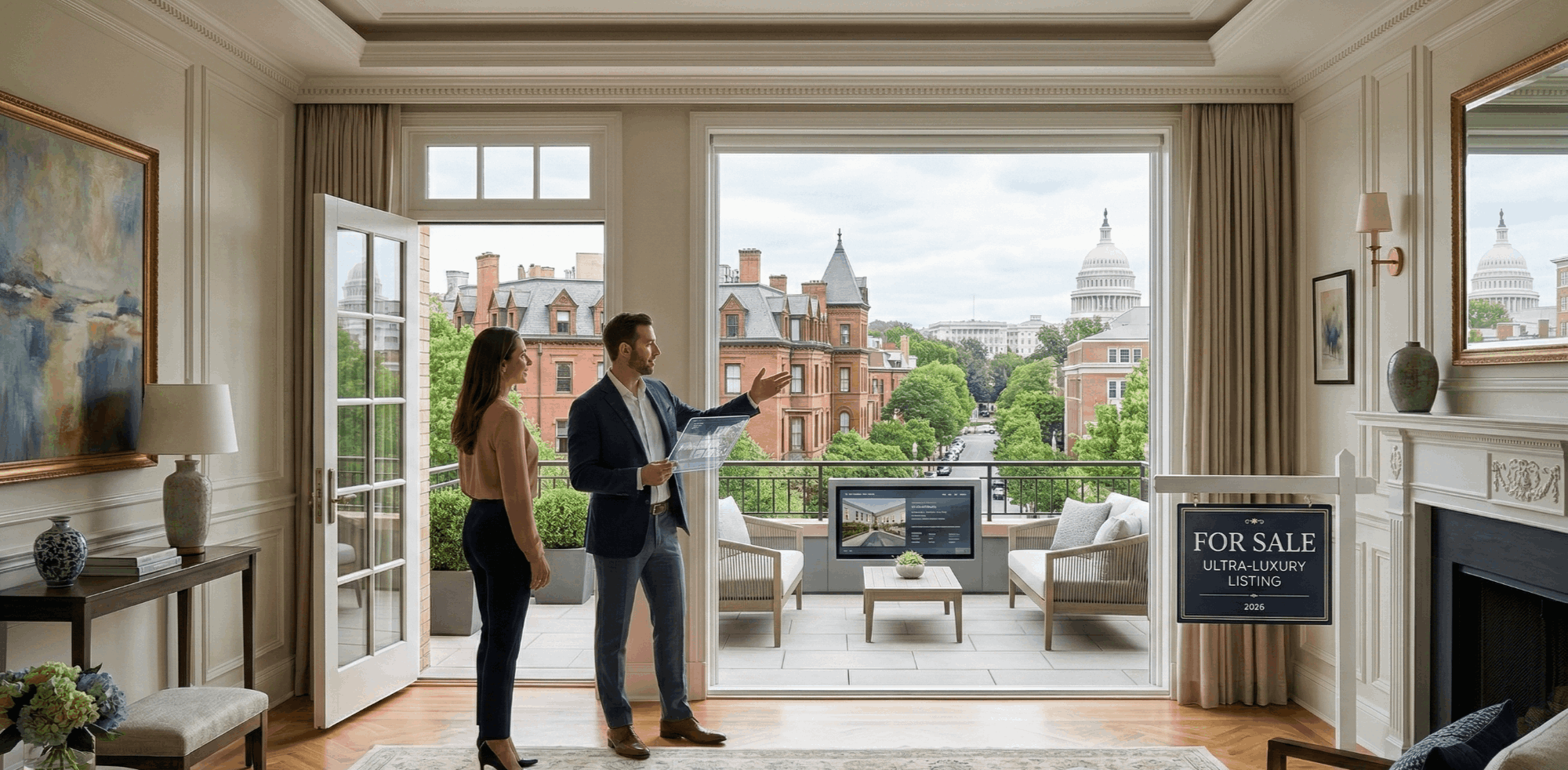
Selling a luxury home here in 2026 demands a strategy purpose-built for this market: one that understands the diplomatic buyer pool, the role of off-market networks, the pricing dynamics driven by scarcity, and the unique closing cost structure that applies to DC transactions at the ultra-premium tier. This guide walks you through every dimension of that strategy.
Quick Answer
Kalorama homes routinely trade at median list prices of $1.75 million and above — with estate-tier properties easily reaching $5M–$22M. Selling successfully in 2026 requires luxury-grade marketing, discreet off-market outreach to diplomatic and executive buyers, precise pricing anchored to recent comparable sales, and a full-service agent experienced in DC's complex transfer and recordation tax structure.
Key Takeaways
- Kalorama's median list price reached $1.75M in April 2025, with estate-tier homes listed as high as $22M.
- The neighborhood's primary buyer pool includes ambassadors, diplomats, corporate executives, tech titans, and high-ranking government officials.
- Off-market and pocket listings are more common here than almost anywhere else in DC — discreet sale strategy is often the right one.
- DC sellers pay a 1.45% transfer tax on all residential sales above $400,000 — a significant cost to model into your net sheet at Kalorama price points.
- Sheridan-Kalorama (west of Connecticut Ave) and Kalorama Triangle (east) behave as distinct sub-markets with different price ceilings and buyer profiles.
- Days on market in the luxury tier can range from under 30 days for well-priced renovated properties to several months for highly customized estates — both are normal.
- Working with an agent who has deep DC and Northern Virginia luxury market experience and strong regional relationships gives your listing a measurable edge.
Table of Contents
- What Makes Kalorama DC's Most Prestigious Address
- Kalorama's Two Sub-Markets: Sheridan-Kalorama vs. Kalorama Triangle
- 2026 Market Data: Prices, Inventory & Trends
- Understanding the Kalorama Buyer Pool
- How to Market a Luxury Home in Kalorama
- Off-Market vs. Full MLS: Which Strategy Is Right for Your Home?
- Pricing Strategy for Ultra-Luxury Properties
- Staging, Photography & Presentation at the Luxury Level
- DC Seller Closing Costs: What to Expect at Kalorama Price Points
- Step-by-Step Selling Timeline
- Common Mistakes Luxury Sellers Make in Kalorama
- How to Choose the Right Agent for a Kalorama Sale
- Alternatives to a Traditional Sale
- Frequently Asked Questions
- Glossary of Key Terms
What Makes Kalorama DC's Most Prestigious Address
Kalorama's name comes from the Greek for "fine view" — a fitting description given both its elevated geography above Dupont Circle and its bird's-eye perch above Washington's political and cultural life. The neighborhood traces its residential development to the late 1800s, accelerated by the arrival of streetcar lines around 1900. What followed was a decades-long accumulation of architectural grandeur: Beaux-Arts mansions, Georgian Revival estates, Mediterranean villas, English Arts and Crafts rowhouses, and landmark apartment buildings that converted to luxury co-ops and condominiums.
The prestige is not merely historical. Kalorama remains an active hub of power and influence. Six presidents have resided here, from Woodrow Wilson (who moved to S Street NW after leaving the White House and never left) to Barack Obama, whose 8,200-square-foot Colonial on Belmont Road NW became one of the neighborhood's most celebrated addresses. High-ranking cabinet officials, Supreme Court justices, senior diplomats, and technology executives continue to choose Kalorama because it offers something almost impossible to find in a major American city: privacy, walkability, prestige, and proximity to power — all at once.
More than 28 embassies and ambassadorial residences fall within or directly adjacent to the neighborhood's boundaries. The French ambassador's Jacobian-Tudor residence on Kalorama Road, the Woodrow Wilson House museum on S Street, Mitchell Park, the Spanish Steps, and the Taft Bridge are all part of the neighborhood's daily texture. Buyers at this level are not just purchasing square footage — they are purchasing a statement about who they are and where they belong in Washington's social fabric.
| Feature | Kalorama Distinction |
|---|---|
| Historic Presidents | Six U.S. presidents have called Kalorama home, including Wilson, FDR, and Obama |
| Embassy Presence | 28+ embassies and ambassador residences within the neighborhood's footprint |
| Architecture | Beaux-Arts, Georgian Revival, Mediterranean, English Arts & Crafts, Colonial Revival |
| Location | ~1 mile from downtown DC; walkable to Dupont Circle, Adams Morgan, Georgetown |
| Metro Access | Red Line: Dupont Circle and Woodley Park/Zoo stations within walking distance |
| Green Space | Borders Rock Creek Park; Mitchell Park and Kalorama Park within neighborhood |
| Privacy & Security | High security presence; gated residences; strong culture of discretion among neighbors |
Kalorama's Two Sub-Markets: Sheridan-Kalorama vs. Kalorama Triangle
While the broader area is commonly called "Kalorama," it is in fact two distinct historic districts separated by Connecticut Avenue. Understanding which sub-market your property sits in is the first step toward an accurate pricing and positioning strategy.
Sheridan-Kalorama (West of Connecticut Avenue)
This is the estate-tier sub-market: the mansion corridor. Bounded roughly by Rock Creek Park, Massachusetts Avenue, P Street, and 22nd Street, Sheridan-Kalorama is where the grandest single-family homes, diplomatic residences, and historic landmark properties sit. Properties here are larger, on bigger lots, and often subject to historic preservation guidelines that restrict exterior modifications. This is where former presidents and ambassadors have made their homes, where the French ambassadorial residence at 2221 Kalorama Road commands an entire block, and where Bezos assembled his landmark compound.
Pricing in Sheridan-Kalorama skews firmly toward the multi-million to eight-figure range. Off-market transactions are particularly common here. Sellers in this sub-market should expect a longer, more selective sales process.
Kalorama Triangle (East of Connecticut Avenue)
Edging up against Adams Morgan, Kalorama Triangle has a slightly more urban character. The housing mix includes narrower rowhouses carved into flats, 1920s co-ops, Victorian townhouses on Biltmore Street, and luxury condominium conversions. Price points are still premium — median sold prices reached approximately $1.16M in early 2025 — but the ceiling is lower than on the Sheridan-Kalorama side. Buyer profiles tend to include more senior professionals and executives, with fewer diplomatic/embassy purchasers than the Massachusetts Avenue corridor.
| Factor | Sheridan-Kalorama | Kalorama Triangle |
|---|---|---|
| Typical Property Type | Grand estates, historic mansions, diplomatic residences | Rowhouses, Victorian townhomes, co-ops, luxury condos |
| Price Range (Est.) | $2M – $22M+ | $700K – $4M+ |
| Primary Buyers | Ambassadors, diplomats, heads of state, UHNWIs | Senior executives, political officials, affluent professionals |
| Off-Market Activity | Very high — private networks dominate | Moderate — MLS listings more common |
| Historic Restrictions | Significant — HPRB oversight common | Present but generally less restrictive |
| Vibe & Character | Quiet, formal, heavily diplomatic, gated | Residential, urban-edge, walkable to Adams Morgan |
2026 Market Data: Prices, Inventory & Trends
Kalorama operates on its own timeline relative to the broader DC market. City-wide, the DC median sale price was approximately $700,000 in mid-2025, with Bright MLS forecasting a slight softening to around $616,700 for the regional metro area in 2026. Kalorama's luxury tier, by contrast, remains structurally insulated from these broader adjustments. Scarcity of inventory, the durability of diplomatic and high-net-worth buyer demand, and the inherent irreplaceability of these properties — you cannot build a new 8,000-square-foot Beaux-Arts mansion in Kalorama — give sellers a persistent advantage.
Key Numbers At-a-Glance: Kalorama 2025–2026
$1.75M
Median list price, Kalorama (April 2025)
$756
Median price per sq ft (April 2025)
$3.4M+
Estimated median for Sheridan-Kalorama estate tier
$22M
Top of current list price range
~33
Active listings, entire Kalorama area (typical)
Stable–Strong
Luxury segment outlook per Bright MLS 2026 forecast
Active inventory in Kalorama remains persistently low compared with broader DC averages. With only a few dozen homes actively listed at any given time — and a meaningful portion of true sales activity happening off-market — supply is chronically constrained. A single large estate sale can shift the neighborhood's monthly averages substantially. This is why rolling 6–12 month comparables, segmented by property type, provide far more reliable pricing signals than point-in-time snapshots.
Notably, Bright MLS's December 2025 forecast projects the luxury segment across the DMV to remain robust even as the broader condo market faces softness and exurban areas cool. For Kalorama specifically, the combination of fixed supply, irreplaceable architecture, and a buyer pool largely insulated from mortgage rate sensitivity (cash and jumbo transactions dominate) makes it among the most resilient micro-markets in the entire Mid-Atlantic region.
| Pushes Prices Up ↑ | Creates Headwinds ↓ |
|---|---|
| Persistent scarcity — supply cannot increase meaningfully | Federal workforce downsizing may reduce some executive relocation demand |
| Historic preservation — no new construction to dilute prestige | Longer days on market for overpriced or condition-challenged properties |
| Diplomatic and international buyer demand remains steady | Appraisal complexity — limited comps can complicate jumbo financing |
| Cash transactions insulate from rate sensitivity | Broader DC condo market weakness may affect luxury co-ops marginally |
| Tech executive and UHNWI relocation to the DC area | High DC transfer taxes add buyer costs — can affect negotiation dynamics |
| What This Means for Sellers | What This Means for Buyers |
|---|---|
| Well-priced, well-presented properties move efficiently — even in the millions | Move-in-ready homes in Sheridan-Kalorama can attract multiple offers quickly |
| Overpricing creates stigma — price reductions signal weakness in this buyer pool | Properties with condition issues or dated interiors offer negotiation room |
| Privacy-first strategy may be preferred — off-market approach can work very well | Connecting with off-market networks is essential to access the best listings |
What Is Your Kalorama Home Worth in 2026?
Kalorama pricing is hyper-local and driven by property type, sub-location, and recent private sales. Get a data-driven estimate grounded in comparable sales from both on- and off-market transactions.
Get Your Free Home ValuationUnderstanding the Kalorama Buyer Pool
Selling a luxury home in Kalorama is not like selling a premium home anywhere else. The buyer pool here has distinct characteristics that should fundamentally shape your marketing, timing, and negotiation strategy.
1. Ambassadors and Foreign Governments
By 1993, more than 25% of Sheridan-Kalorama's 686 buildings were owned by foreign nations. That proportion speaks to the deep structural demand from diplomatic buyers. Ambassadors and senior embassy staff value Kalorama for its proximity to Embassy Row on Massachusetts Avenue, its walkable access to Foggy Bottom and the State Department, and — perhaps most importantly — its culture of privacy and discretion. Foreign government purchases often move through legal counsel and can involve unique financing or cash structures distinct from domestic transactions.
2. Senior Government Officials and Political Figures
Cabinet secretaries, national security officials, senior White House staff, and members of Congress at the highest levels have long chosen Kalorama. The neighborhood's established Secret Service familiarity, its quiet streets, and its proximity to the West End, Georgetown, and Capitol Hill make it operationally practical for those whose professional lives require security and discretion.
3. C-Suite Executives and Technology Titans
The arrival of Jeff Bezos — who purchased the largest private residence in DC, a sprawling Kalorama compound — signaled a broader trend of technology industry wealth entering the neighborhood. CEOs, founders, and senior financial executives seeking a primary or secondary Washington residence are increasingly part of the buyer mix. This segment often purchases with all cash and moves on compressed timelines when motivated.
4. High-Net-Worth DC Residents Upsizing
Long-tenured DC professionals — partners at major law firms, lobbyists, investment bankers, senior consultants — who have accumulated significant equity and liquid wealth represent a stable domestic buyer segment. This group is highly sensitive to condition, finishes, and move-in readiness.
| Buyer Segment | Key Priorities | Typical Transaction Structure |
|---|---|---|
| Ambassadors / Foreign Governments | Privacy, size, proximity to Embassy Row, security | Often all-cash or government acquisition |
| Senior Government Officials | Security infrastructure, quiet streets, established prestige | Jumbo mortgage or cash; tight timelines |
| Tech & Business Executives | Trophy-asset appeal, architectural significance, move-in quality | All-cash; fast close preferred |
| DC Professional Affluent | Condition, finishes, walkability, school access | Jumbo financing; standard timeline |
Marketing to this buyer pool requires more than a Zillow listing. It requires active outreach through agent networks, international real estate connections, private wealth management referral channels, and — in many cases — direct targeted communication through diplomatic and executive networks that never touch public-facing platforms.
How to Market a Luxury Home in Kalorama
Standard residential marketing — a Zillow listing with smartphone photos and a generic open house — is entirely insufficient for a Kalorama home. The marketing program for a high-end property in this neighborhood must be built around the buyer profiles outlined above and delivered through channels those buyers actually use.
Professional Photography, Videography & Aerial
At a minimum, your listing requires architectural-grade photography from a photographer who understands how to capture historic interiors, period moldings, grand staircases, formal reception rooms, and walled gardens. Drone and aerial footage is essential for estate-tier properties to convey lot size, setback, and neighborhood context (proximity to Rock Creek Park, Embassy Row). Cinematic video walkthroughs — not virtual tours — communicate the emotional weight of these properties to buyers who may be reviewing from overseas before a site visit.
International Luxury Portals
A meaningful share of Kalorama buyers are international. Your listing should be distributed across luxury-focused international portals including JamesEdition, Christie's International Real Estate network, LuxuryRealEstate.com, and similar platforms that reach UHNWI buyers in Europe, the Middle East, Asia, and Latin America. Many buyers from diplomatic families will be searching these platforms before ever engaging a local agent.
Private Broker Network Outreach
In a market where the most desirable properties sell off-market or to buyers sourced through agent referral networks before a listing ever goes live, your agent's professional network is your marketing department. This means direct outreach to agents with known ultra-high-net-worth clientele in the DMV, New York, London, and other global cities where DC buyers originate. It also means leveraging relationships with corporate relocation departments, international law firm residential referral contacts, and embassy-adjacent professional networks.
Custom Property Marketing Materials
A Kalorama property warrants a custom printed brochure or digital booklet — with professional floor plans, neighborhood narrative, architectural history, and key specifications — distributed to qualified buyers and referring agents. This level of presentation signals to the buyer community that the seller and their representation are serious participants in the ultra-luxury market.
Luxury Marketing Checklist: What Your Listing Needs
- Architectural-grade photography (interior, exterior, detail shots)
- Cinematic video walkthrough (2–4 minutes, professionally scored)
- Aerial/drone footage for properties with significant lot size or park frontage
- Custom digital and print brochure with floor plans and property narrative
- MLS listing with full professional media package
- International luxury portal distribution (JamesEdition, LuxuryRealEstate.com, Christie's network, etc.)
- Direct outreach to DC, NYC, and global ultra-luxury buyer specialists
- Targeted digital advertising to UHNWI audiences in key markets
- Private network and embassy referral channel outreach
- Exclusive preview event for qualifying buyers and top agents (optional)
- Property-specific website or dedicated digital landing page (for estate-tier homes)
Off-Market vs. Full MLS: Which Strategy Is Right for Your Home?
One of the most consequential decisions a Kalorama seller faces is whether to pursue a discreet off-market sale, a limited-network preview approach, or full MLS exposure. There is no universal right answer — the best choice depends on your property type, your timeline, your privacy requirements, and current buyer demand.
Off-market and pocket listings are far more common in Kalorama than in virtually any other DC neighborhood. In Sheridan-Kalorama especially, prominent owners — including current or former government officials and diplomats — routinely prefer to avoid public listing to protect their privacy and security. The result is that a meaningful portion of true transaction activity never appears on public portals.
| Strategy | Advantages | Drawbacks |
|---|---|---|
| Off-Market / Pocket | Maximum privacy; no public price history; fewer intrusions | Smaller buyer pool; may leave money on the table without competitive offers |
| Pre-Market Network Preview | Access to top buyers before public launch; can sell quickly at full price | Requires agent with strong network; less transparency on market pricing |
| Full MLS + International Exposure | Maximum buyer competition; price discovery; transparent market validation | Public price history; requires more showings; less private |
For most Kalorama homes in the $2M–$8M range, a strategic approach that begins with a targeted pre-market preview (2–3 weeks of private network outreach) followed by a full MLS launch tends to generate the best price outcome while still allowing a window for a discreet sale. For truly estate-tier properties — particularly those in the $10M+ range — a fully off-market campaign through specialized ultra-luxury networks may be appropriate.
If you are weighing a faster, simpler exit from your Kalorama property, a cash offer option is worth exploring as a benchmark — it gives you a floor to evaluate against what a traditional sale process might yield.
Pricing Strategy for Ultra-Luxury Properties
Pricing a Kalorama home is among the most complex pricing exercises in the entire DC real estate market. Standard automated valuation models — like Zillow's Zestimate — are notoriously unreliable in ultra-luxury, low-inventory micro-markets. These algorithms rely on comparable sales volume that simply does not exist at the estate tier. A single sale of an outlier property can skew reported averages dramatically.
Effective pricing in Kalorama requires a true comparative market analysis that accounts for: the specific sub-market (Sheridan-Kalorama vs. Triangle), property type and architectural classification, lot size and exterior condition, interior renovation status and quality of finishes, historic landmark constraints, proximity to Embassy Row, and off-market sales data that may not appear in the public MLS record.
The Danger of Overpricing
In the Kalorama luxury market, overpricing carries a distinct risk that does not exist in the same way at lower price points. This buyer pool — ambassadors, executives, and ultra-high-net-worth individuals — is highly informed. Many have their own real estate advisors or legal teams conducting due diligence. A home that sits on the market for several months accumulates a visible price history that sophisticated buyers interpret as market rejection. Price reductions signal weakness and often invite aggressive low offers. Getting the initial price right is more important here than almost anywhere else.
Kalorama Price Spectrum by Property Type (Estimated Ranges)
All ranges are estimates based on current and recent market data. Actual values vary based on specific property characteristics, condition, and timing.
See Your Projected Net After All Costs
DC transfer taxes, agent fees, and closing costs can take 7–10% off the top at Kalorama price points. Run a custom seller net sheet before you list so there are no surprises at closing.
Calculate Your Seller Net SheetStaging, Photography & Presentation at the Luxury Level
The standard of presentation required to sell a Kalorama home is significantly higher than what is typical in the broader DC residential market. This buyer pool has seen extraordinary properties around the world. First impressions — both online and in-person — must be impeccable.
Staging Principles for Historic Properties
Historic Kalorama homes often present a specific staging challenge: how to showcase architectural grandeur while making the space feel warm, livable, and current. Period-appropriate furnishings that complement the architecture — rather than contrast it — almost always outperform contemporary minimalist staging in this context. Formal reception rooms should be staged to suggest sophisticated entertaining. Libraries and studies should convey intellectual seriousness. Gardens and exterior entertaining spaces deserve dedicated staging investment.
For estate-tier properties, engage a professional stager with documented experience in luxury historic homes. Do not attempt to stage using owned furniture that does not match the architectural language of the property.
Pre-Listing Preparation Checklist
- Commission architectural/heritage assessment for any historic designation documentation buyers may request
- Complete all deferred maintenance (roof, HVAC, plumbing, electrical) before listing — luxury buyers do not negotiate around maintenance items
- Paint all exterior and interior surfaces to a premium, freshened standard
- Restore or refinish original hardwood floors where present
- Service and certify all mechanicals — provide documentation to buyers
- Landscape and garden: full cleanup, mulch, seasonal plantings, power wash hardscape
- Deep clean entire property including historic fixtures, windows, and skylight glass
- Engage professional luxury stager for primary reception rooms, master suite, and outdoor spaces
- Obtain a pre-listing inspection to identify and address issues before buyer discovery
- Compile all permits, renovation records, and HOA/condo documents for quick buyer review
DC Seller Closing Costs: What to Expect at Kalorama Price Points
Washington DC has some of the highest transfer and recordation tax rates in the country. At Kalorama price points, these costs are significant and must be factored into your net proceeds calculation from the very beginning.
Transfer Tax
DC sellers are customarily responsible for the deed transfer tax. For all residential sales above $400,000 — which captures virtually every Kalorama transaction — the transfer tax rate is 1.45% of the full sale price. On a $3 million sale, that is $43,500 in transfer tax alone.
Recordation Tax (Buyer's Typical Share)
The recordation tax — also at 1.45% for sales above $400,000 — is customarily paid by the buyer, though this can be negotiated. Combined, the DC transfer and recordation taxes total approximately 2.9% of the sale price on luxury transactions. As a seller, you should understand this cost structure when evaluating offers that include seller credits toward the buyer's closing costs.
DC Requires an Attorney at Closing
Unlike many states, Washington DC requires legal representation to complete a real estate sale. Attorney fees vary but typically range from $1,500–$3,500 for a residential luxury transaction, depending on complexity.
| Cost Item | Rate / Amount | Example: $3M Sale | Example: $6M Sale |
|---|---|---|---|
| DC Transfer Tax (seller) | 1.45% of sale price | ~$43,500 | ~$87,000 |
| Listing Agent Commission | Varies (e.g., 1.5%–3%) | $45K–$90K | $90K–$180K |
| Title / Settlement Services | ~$1,400–$3,000 (est.) | ~$1,400–$3,000 | ~$2,000–$4,000 |
| Real Estate Attorney | ~$1,500–$3,500 (est.) | ~$1,500–$3,500 | ~$2,000–$5,000 |
| Recording Fees | ~$50–$100 | ~$50–$100 | ~$50–$100 |
| Prorated Property Taxes | ~0.63% annual rate; prorated to close | Varies | Varies |
| Estimated Total Seller Costs | (excl. mortgage payoff) | ~$90K–$140K | ~$180K–$280K+ |
All figures are estimates only and do not constitute legal or financial advice. Consult your settlement agent and real estate attorney for precise figures applicable to your transaction.
On a $3M Kalorama sale, total seller-side costs (before mortgage payoff) can approach $100,000–$140,000, depending on commission structure and buyer concessions. On a $6M sale, that figure escalates substantially. This is precisely why modeling your net proceeds with a detailed seller net sheet — before committing to a list price — is a non-negotiable first step.
List Your Kalorama Home for a 1.5% Listing Fee
The Jamil Brothers Realty Group offers a full-service listing program at 1.5% — without reducing marketing quality, professional photography, negotiation, or representation. On a $3M home, that difference in commission is real money.
Explore the 1.5% Listing ProgramStep-by-Step Selling Timeline for a Kalorama Luxury Home
Unlike a typical residential sale, selling a Kalorama home warrants a longer, more deliberate preparation phase. The marketing window is shorter and more targeted — but the preparation leading up to it must be thorough.
Agent Selection & Strategic Planning
Interview agents with verified DC luxury experience. Align on pricing strategy, marketing approach, and off-market vs. MLS decision. Discuss buyer pool and timeline.
Pre-Listing Repairs, Staging & Preparation
Complete all maintenance, renovation, and staging work. Obtain pre-listing inspection. Compile all property documentation (permits, HOA records, architectural reports).
Professional Photography, Video & Materials
Schedule and complete full media production (photography, video, drone). Design and print custom brochure and marketing materials. Finalize pricing.
Pre-Market / Private Network Launch
Agent begins targeted outreach to qualified buyers and referring agents. Private previews for top-tier prospects (if applicable). Gauge interest before public launch.
MLS & International Portal Launch
Property goes live on MLS, international luxury portals, and digital advertising platforms. Showings begin by appointment. Open house optional (by invitation for luxury tier).
Offer Review, Negotiation & Contract
Review offers — terms, financing contingencies, due diligence timelines. Negotiate to maximize net proceeds. Ratify contract. Coordinate attorney and title work.
Settlement & Transfer
DC attorney-supervised settlement. Transfer taxes paid. Net proceeds wired. Deed transferred. Keys exchanged.
Common Mistakes Luxury Sellers Make in Kalorama
Even sophisticated homeowners — people who have navigated complex transactions throughout their careers — can make avoidable errors when selling a Kalorama property. Here are the most common ones to avoid.
⚠ Common Mistakes That Cost Kalorama Sellers Money
- Pricing based on AVMs: Zillow, Redfin, and automated estimates are unreliable at this price point. Use a full CMA from an agent with actual Kalorama transaction experience.
- Listing without full luxury marketing: Standard residential marketing leaves potential buyers — particularly international ones — unaware of the property entirely.
- Skipping the pre-market phase: Going straight to MLS without a private network preview can mean missing the buyer who would have paid the highest price.
- Underestimating preparation timelines: Luxury buyers will not negotiate around visible deferred maintenance. Rushing to list before repairs are complete signals desperation.
- Choosing an agent based on firm brand rather than specific experience: The brand on the sign matters far less than the individual agent's track record in Kalorama-tier transactions.
- Not modeling closing costs before listing: DC's transfer tax structure at these price points is significant. Sellers who are surprised by their net proceeds at closing made a planning error.
- Granting public open house access without vetting buyers: In Kalorama, privacy matters. Requiring pre-qualification and appointment-only showings protects both the seller and the property.
How to Choose the Right Agent for a Kalorama Sale
In a market this specialized, agent selection may be the single most important decision you make. The stakes are higher than in any standard residential transaction — and the differences in outcome between a highly capable agent and an average one are measured in tens or hundreds of thousands of dollars.
What to Look For
| Selection Criterion | Why It Matters in Kalorama |
|---|---|
| Verifiable DC luxury sales history | Experience with $2M+ DC transactions is non-negotiable; ask for examples |
| Demonstrated international buyer network | A meaningful portion of Kalorama buyers come from diplomatic and international channels |
| Off-market and private listing experience | Critical for privacy-sensitive sellers and estate-tier properties |
| Specific knowledge of DC closing cost structure | Transfer and recordation taxes can significantly affect net proceeds; agent must model these precisely |
| Strong referral relationships with luxury agents | The best buyers for Kalorama homes are often sourced through agent-to-agent referral channels |
| Track record of protecting seller privacy | Discretion is part of the service — not an afterthought — in this neighborhood |
The Jamil Brothers Realty Group has completed over $500M in total real estate sales across the Washington DC metropolitan area — including Northern Virginia, Maryland, and the District itself. With 800+ buyers and sellers represented and recognition as NVAR Lifetime Top Producers and among Northern Virginia Magazine's Top Real Estate Agents, the team brings deep regional market knowledge, data-driven pricing methodology, and a network extending across the broader DMV luxury and diplomatic communities. Their full-service 1.5% listing program delivers premium-tier marketing and representation without the traditional commission premium — a meaningful distinction at Kalorama price points.
Also Buying After Your Kalorama Sale?
Many Kalorama sellers are simultaneously navigating a purchase — often in a competitive luxury market. Build your buying strategy before you close so you can move decisively when the right home surfaces.
Schedule a Buyer Strategy SessionAlternatives to a Traditional Sale
A traditional listed sale is the right path for most Kalorama sellers, particularly when maximizing net proceeds is the primary objective. However, there are circumstances in which alternative approaches merit serious consideration.
Cash Offer / Direct Sale
If you need certainty of close, speed, or maximum privacy without a marketing campaign, a cash offer option can provide a firm, no-contingency exit on a timeline you control. This approach trades some potential upside for certainty and convenience — which, for some sellers, is precisely the right trade.
1031 Exchange
If your Kalorama property has appreciated significantly since purchase, a properly structured 1031 exchange may allow you to defer capital gains taxes by reinvesting the proceeds into qualifying replacement property. This strategy requires a qualified intermediary and strict adherence to IRS timelines. Consult a tax advisor well in advance of listing.
Sale-Leaseback
For sellers who want to unlock equity from the property but are not ready to vacate immediately — particularly relevant for diplomatic families with defined departure timelines — a sale-leaseback arrangement may allow the sale to close while the seller continues to occupy the property as a tenant for an agreed period.
| Approach | Best For | Tradeoff |
|---|---|---|
| Traditional Listed Sale | Maximizing net proceeds; competitive buyer market | Requires 8–16 week prep & marketing period |
| Off-Market / Private Network | Privacy-sensitive sellers; high-profile owners | Smaller buyer pool; may yield lower price |
| Cash / Direct Sale | Speed, certainty, zero contingencies | Typically below full market value |
| 1031 Exchange | Deferring substantial capital gains tax liability | Requires strict timelines & qualified intermediary |
| Sale-Leaseback | Sellers needing equity but not ready to vacate | Complex to negotiate; smaller buyer pool |
Frequently Asked Questions
What is the typical price range for homes in Kalorama, DC in 2026?
Kalorama spans a wide spectrum. Luxury condominiums and co-ops typically range from $400,000 to $2.5 million. Renovated rowhouses and townhomes generally run from $1.2 million to $4 million. Grand single-family estates fall in the $3.5 million to $12 million range, while true historic landmark mansions — particularly on the Sheridan-Kalorama side — can reach $22 million or beyond. The neighborhood's median list price was reported at $1.75 million in April 2025.
How long does it take to sell a luxury home in Kalorama?
Timeline varies significantly by property type and pricing accuracy. Well-priced renovated townhouses or condos can sell in under 30 days. Estate-tier properties — particularly those priced above $5 million — commonly spend several months on the market, which is entirely normal in this segment. The key variable is accurate initial pricing; overpriced luxury homes in this buyer pool accumulate visible market time that can be difficult to recover from.
Are cash purchases common in Kalorama?
Yes — cash transactions are significantly more prevalent in Kalorama than in the broader DC residential market. Diplomatic buyers, foreign government purchases, and UHNWI individuals frequently transact in cash. This can simplify the deal structure substantially (no appraisal contingency, no mortgage underwriting delays), but it also means sellers should understand cash offers may carry legitimate valuation offsets relative to financed offers.
How do DC transfer and recordation taxes affect sellers in Kalorama?
At any sale price above $400,000, DC charges both a transfer tax and a recordation tax at 1.45% each. Sellers customarily pay the transfer tax (1.45%), while buyers typically pay the recordation tax — though this can be negotiated. On a $3 million sale, the seller's transfer tax alone is approximately $43,500. Modeling these costs accurately in a pre-listing seller net sheet is essential.
Do I need an attorney to sell a home in Washington, DC?
Yes. Washington DC requires legal representation to complete a residential real estate transaction. Your settlement attorney manages the closing process, coordinates with the title company, and ensures the deed transfer is properly executed and recorded with the DC Office of Tax and Revenue. Attorney fees for luxury transactions typically range from $1,500 to $3,500 or more depending on complexity.
What is the difference between Sheridan-Kalorama and Kalorama Triangle?
Sheridan-Kalorama sits west of Connecticut Avenue and is defined by its grand estate homes, mansion corridor, and heavy diplomatic presence along Embassy Row. It is the higher-priced sub-market with stronger privacy and security considerations. Kalorama Triangle lies east of Connecticut Avenue, adjacent to Adams Morgan, and features more rowhouses, Victorian townhomes, and luxury co-ops. Both carry the Kalorama prestige but serve somewhat different buyer profiles.
Should I sell my Kalorama home off-market or list it on the MLS?
It depends on your privacy requirements, timeline, and price point. For most $2M–$8M properties, a hybrid approach — a targeted pre-market preview period followed by full MLS and international portal exposure — tends to generate the best combination of privacy and competitive price discovery. For estate-tier properties above $10M, or for sellers with active security or privacy concerns, a fully off-market campaign through specialized networks may be more appropriate.
Can embassy or diplomatic buyers purchase private homes in Kalorama?
Yes — and they do, frequently. Both foreign governments (purchasing property for official diplomatic use or ambassadorial residences) and individual diplomats purchasing personal residences are active buyers in Kalorama. Foreign government purchases have specific legal structures that differ from domestic transactions, typically involving international legal counsel and cash or structured financial instruments. Your agent should have experience managing the unique documentation and timeline requirements these transactions can involve.
Are there historic preservation restrictions on Kalorama homes?
Yes, particularly in Sheridan-Kalorama, which is listed on the National Register of Historic Places and the DC Inventory of Historic Sites. Properties designated as contributing historic structures are subject to DC's Historic Preservation Review Board oversight for exterior modifications. Sellers should compile documentation of any historic review approvals received for past work, and be prepared to disclose preservation restrictions to buyers.
Is a 1031 exchange possible when selling a Kalorama investment property?
If your Kalorama property qualifies as investment property (not your primary residence), a properly structured 1031 exchange can defer capital gains taxes on the proceeds when you reinvest into qualifying replacement property. Strict IRS timelines apply: 45 days to identify replacement property and 180 days to close. A qualified intermediary must be engaged before closing on the sale. Consult a tax professional with DC-specific real estate expertise well in advance of listing.
How do I choose the best real estate agent to sell my Kalorama home?
Focus on verifiable DC luxury transaction experience (ask for closed sales above $2M in the District), a demonstrated international and diplomatic buyer network, off-market and private listing capability, and specific knowledge of DC's closing cost structure. Firm brand is secondary to individual agent competence and track record. The Jamil Brothers Realty Group brings $500M+ in total regional sales, deep DC-area market expertise, and a full-service 1.5% listing program that delivers premium representation without the traditional commission burden — a meaningful consideration at Kalorama price points.
What is a seller net sheet, and why is it important for Kalorama sellers?
A seller net sheet is a detailed estimate of your expected proceeds after all costs — transfer taxes, agent commission, attorney fees, title costs, prorated taxes, and any agreed buyer concessions. At Kalorama price points, total seller costs can range from $100,000 to $300,000 or more depending on sale price and commission structure. Running a net sheet before you list ensures your price strategy is grounded in what you will actually walk away with, not the gross sale number.
Know Your Net Before You List
At Kalorama price points, the gap between gross sale price and what you take home can be substantial. Use our seller net sheet to model your actual proceeds before you make any decisions.
Run My Net Sheet See the 1.5% Listing ProgramGlossary of Key Terms
Transfer Tax
A DC government tax assessed on the transfer of property ownership. Sellers customarily pay this at a rate of 1.45% for all residential transactions above $400,000.
Recordation Tax
A DC tax on the recording of a deed, customarily paid by the buyer. At 1.45% for luxury transactions, it mirrors the transfer tax. Combined, the two taxes total approximately 2.9% of the sale price.
Seller Net Sheet
A document prepared by your agent that estimates your take-home proceeds after all selling costs are deducted from the gross sale price.
Off-Market / Pocket Listing
A property that is sold without being listed on the public MLS, typically through private agent networks. Common in Kalorama for privacy and security reasons.
Jumbo Mortgage
A mortgage that exceeds conforming loan limits set by the Federal Housing Finance Agency (FHFA). Most financed purchases in Kalorama require jumbo loans. These involve more rigorous underwriting and may require additional appraisal documentation.
HPRB (Historic Preservation Review Board)
The DC body that oversees exterior modifications to historic properties in designated historic districts, including Sheridan-Kalorama. Any significant exterior changes require HPRB review and approval.
1031 Exchange
An IRS provision allowing sellers of qualifying investment property to defer capital gains taxes by reinvesting proceeds into a like-kind replacement property within specified timeframes.
UHNWI (Ultra-High-Net-Worth Individual)
A term used in wealth management for individuals with investable assets exceeding $30 million. This buyer segment is a meaningful part of the Kalorama estate-tier market.
Comparative Market Analysis (CMA)
A professional assessment of a property's market value based on comparable sales. In Kalorama, a proper CMA must account for both public MLS data and off-market transaction activity.
Best Addresses Buildings
A colloquial designation for DC's most historically prestigious pre-war apartment buildings, many of which are concentrated in Kalorama and its immediate surroundings. These buildings — such as The Westmoreland (1905), The Dresden, The Farnsboro, and 2029 Connecticut — feature Beaux-Arts architecture, full-service amenities, and co-op or condo ownership structures.
Final Thoughts: Selling a Kalorama Home Is a Distinct Discipline
Kalorama is not a typical residential market — and selling a home here demands a strategy that matches its exceptional character. The buyer pool is international, influential, and highly informed. The marketing must reach channels that extend well beyond local MLS portals. The pricing must be anchored in real comparable data, not automated estimates. The closing cost structure unique to Washington DC must be modeled accurately from the start.
When you approach a Kalorama sale with the right preparation, the right pricing, the right marketing platform, and the right professional relationships, the outcomes available in this neighborhood are among the strongest in the entire Washington metropolitan area. The neighborhood's structural irreplaceability — its fixed supply, preserved architecture, diplomatic demand base, and enduring prestige — insulates it from the cyclical corrections that affect broader markets.
If you are considering selling your Kalorama home in 2026, start with clarity on your property's current market value, model your projected net proceeds against a realistic cost structure, and evaluate your options — traditional listing, off-market, or otherwise — with the full information picture in front of you.
Ready to Take the First Step?
Whether you want a current home valuation, a detailed seller net sheet, or a full listing consultation, the Jamil Brothers Realty Group is ready to help you navigate one of DC's most complex and rewarding luxury markets.
Categories
- All Blogs (1235)
- Buyer Guide (7)
- Buying a home (2)
- Buying Strategies (30)
- festivals (1)
- General Blog (62)
- Market Intelligence (28)
- Market Updates (7)
- Notable Properties For Sale (32)
- Real Estate Tips, News, and More (396)
- Seller Guides (58)
- Selling Your Home (523)
- Top Realtors in Northern Virginia (58)
Recent Posts








Let's Connect